

Loading, please wait...
Loading, please wait...

Modern medical education rapidly incorporates digital innovations into routine pedagogy. Consequently, the integration of generative AI in clinical reasoning creates unprecedented possibilities and distinct operational hazards for contemporary healthcare trainees. Students across various health disciplines regularly consult large language models to dissect complex patient vignettes. Furthermore, they utilize digital tools to review differential diagnoses and investigate targeted rehabilitation pathways. However, clinical success depends entirely on human analytical oversight rather than automated convenience. Recent investigations demonstrate that uncritical reliance on digital summaries fosters cognitive complacency among emerging practitioners. In addition, trainees frequently struggle to spot subtle physiological inaccuracies hidden beneath fluent computational text. Therefore, academic faculties must emphasize rigorous critical appraisal over blind technological enthusiasm. When aspiring clinicians interact with automated systems, they must maintain active discernment. In contrast to passive information retrieval, active reasoning compels learners to test every algorithmic claim against core biomedical sciences. Moreover, educators observe that structured digital guidance preserves cognitive engagement during complex diagnostic evaluations. Thus, instilling disciplined verification habits forms the indispensable cornerstone of future diagnostic excellence.
A recent cross-sectional comparative study examined verification behavior among 137 physiotherapy students at a major academic institution. Specifically, the researchers evaluated learners across three distinct cohorts based on their participation in a structured healthcare artificial intelligence elective. The study cohort comprised sixty-seven unexposed students, forty-three actively enrolled participants, and twenty-seven students who had completed the course. Each participant undertook a standardized thirty-item open-resource examination. This test rigorously assessed fundamental knowledge, complex case-based reasoning, and deliberate hallucination-trap questions. Crucially, these hallucination traps mirrored erroneous outputs that commercial algorithms routinely generate during differential diagnosis. Researchers simultaneously measured how frequently students validated machine recommendations against peer-reviewed clinical guidelines and established textbooks. Furthermore, statistical evaluations accounted for individual academic grade point averages, prior digital familiarity, and baseline knowledge scores. The empirical findings demonstrated that diligent verification behavior effectively insulated students from deceptive algorithmic traps. In contrast, trainees who skipped verification frequently embraced fabricated clinical guidance as genuine fact. Therefore, systematic verification represents the primary clinical shield against automated misinformation in clinical reasoning.
Metacognitive calibration reflects the precise alignment between a clinician's subjective diagnostic confidence and their actual clinical accuracy. When clinicians display poor calibration, diagnostic vulnerabilities amplify rapidly across clinical practice. For instance, poorly calibrated trainees frequently express unwavering confidence in critically flawed diagnostic conclusions. In this investigation, researchers tracked calibration using item-by-item confidence ratings alongside confirmatory Brier scores. Consequently, the data exposed a troubling calibration gap among students who navigated clinical problems without structured technological guidance. These learners routinely mistook algorithmic fluency for clinical validity. Moreover, digital speed created an unwarranted illusion of cognitive mastery that blinded students to substantial diagnostic omissions. In contrast, students with dedicated coursework exposure achieved superior metacognitive calibration. They acknowledged diagnostic uncertainty honestly and critically scrutinized anomalous algorithmic assertions. Furthermore, properly calibrated learners recognized when computational advice conflicted with core physiological principles. Importantly, accurate self-assessment empowers clinicians to consult secondary clinical resources whenever diagnostic discrepancies emerge. As a result, calibrated healthcare providers maintain higher diagnostic precision and protect patient welfare consistently. Thus, teaching metacognitive calibration protects future practitioners against misplaced clinical overconfidence and reduces premature diagnostic closure.
The statistical modeling yielded an exceptionally clear message for clinical education. Among 108 students who actively utilized machine tools during the examination, cross-checking frequency predicted higher total examination performance. Specifically, multivariable regression revealed that frequent verification strongly associated with superior overall test scores. Students who routinely audited digital answers also scored significantly higher on intricate case-based reasoning questions. In addition, these diligent learners successfully sidestepped the hazardous hallucination traps embedded within the exam. Conversely, the raw quantity of automated queries demonstrated no statistically significant correlation with problem-solving success. Students who executed numerous prompts without cross-checking gained zero academic advantage. In fact, heavy unverified reliance often degraded diagnostic accuracy across challenging clinical vignettes. Furthermore, rigorous adjustments for baseline grade point average and previous computer experience confirmed this discrepancy. The empirical evidence proves that technology usage alone cannot replace diligent human analytical verification. Therefore, training institutions must shift pedagogical focus away from mere technological adoption toward systematic verification behaviors. Clinicians must treat every machine-generated suggestion as an unverified working hypothesis rather than an established medical truth.
The rapid digitization across the Indian healthcare ecosystem makes these findings exceptionally relevant to local medical practice. Across busy outpatient departments, government teaching hospitals, and private tertiary centers in India, clinicians increasingly deploy digital diagnostic platforms. Furthermore, Indian practitioners routinely manage intense patient volumes while working under severe clinical time constraints. Under these demanding conditions, the temptation to accept automated diagnostic formulations without scrutiny rises substantially. However, unchecked technological reliance creates severe risks of misdiagnosis, inappropriate drug prescriptions, and patient morbidity. Therefore, Indian medical institutions and the National Medical Commission must integrate formal technological evaluation into modern training curricula. Faculties should expose trainees to deliberate adversarial testing using flawed algorithmic case simulations. In addition, educators must train medical and allied health students to cross-examine automated outputs against standard Indian Council of Medical Research guidelines. Similarly, hospitals must establish institutional standard operating procedures that enforce mandatory verification steps for digital tools. Consequently, healthcare professionals maintain unwavering accountability while elevating the quality of clinical care. Ultimately, cultivating critical verification behavior ensures that Indian clinicians harness technological efficiency without compromising diagnostic accuracy or patient safety.
Metacognitive calibration represents the clinical alignment between a healthcare provider's subjective confidence and their objective diagnostic accuracy. In artificial intelligence adoption, optimal calibration ensures that clinicians remain constructively skeptical of automated outputs. Consequently, well-calibrated practitioners accurately recognize computational errors and identify potential hallucinations. This balanced awareness prevents misplaced clinical overconfidence, protects against premature diagnostic closure, and guarantees that practitioners seek reliable secondary verification when clinical uncertainty arises.
Hallucination traps refer to plausible yet factually incorrect statements generated by artificial intelligence models. In clinical settings, these convincing errors can mislead unsuspecting clinicians into prescribing incorrect medications or ordering unnecessary diagnostic procedures. Trainees who fail to verify automated outputs often accept fabricated pathophysiology as legitimate medical evidence. Therefore, encountering deliberate hallucination traps during training compels healthcare students to build vital verification instincts, thereby safeguarding clinical decision-making from subtle technological misinformation.
Research shows that merely increasing the volume of automated queries does not enhance clinical reasoning skills. In fact, relying heavily on artificial intelligence without cross-checking often promotes passive cognitive dependency and increases diagnostic error rates. Conversely, systematic cross-checking requires active analytical engagement, corroboration against validated medical databases, and critical appraisal. This disciplined verification behavior strengthens clinical judgment, improves diagnostic accuracy, and ensures that clinicians deploy modern technological solutions safely in real-world healthcare practice.
Disclaimer: This content is for informational and educational purposes only... Refer to the latest local and national guidelines for clinical practice.
References

Read summarized clinical updates, watch expert medical content, and earn CME certifications right from your smartphone.
Open your smartphone camera to scan and install.





A cross-sectional study demonstrates that systematic cross-checking, rather than frequency of use, dictates success when deploying AI in clinical reasoning. Training students in verification behaviors significantly improves metacognitive calibration and protects clinical decision-making from AI hallucinations.
Today

A new study reveals that internalized HIV stigma directly impairs self-rated health by diminishing healthcare empowerment among people living with HIV. Clinicians must actively cultivate patient agency and self-advocacy to interrupt this negative psychosocial pathway and optimize long-term clinical outcomes.
Today

A qualitative study highlights the unaddressed emotional hurdles and role uncertainty faced by men during the transition to fatherhood, calling for father-inclusive perinatal care and tailored digital health support.
Today

A patient-based simulation study reveals that conventional 10% bias in mean normal prothrombin time causes up to 19.2% clinical reclassification in warfarin therapy. Restricting bias to ±2.5% eliminates major INR discrepancies, urging diagnostic laboratories to tighten analytical verification thresholds.
Today
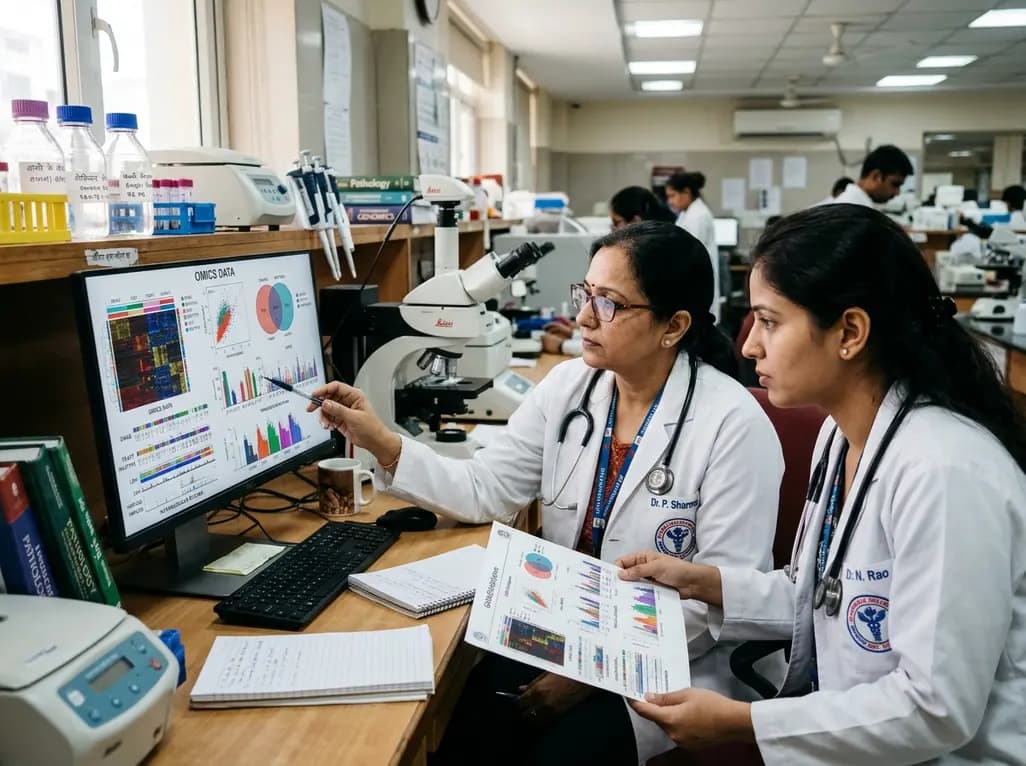
A multi-omic analysis reveals sporadic intramuscular myxoma comprises two molecularly distinct subtypes. GNAS-mutated lesions frequently carry TRAF7 mutations, whereas GNAS-wildtype tumors demonstrate striking genomic instability, loss of heterozygosity, and near-haploid features resembling DNHFN.
Today

Recent physiological findings demonstrate that myoglobin acts beyond oxygen transport, significantly regulating skeletal muscle glucose metabolism and mitochondrial bioenergetics. Understanding these intracellular metabolic shifts offers fresh insights into metabolic health and exercise physiology.
Today
