.webp&w=384&q=75)

Loading, please wait...
Loading, please wait...
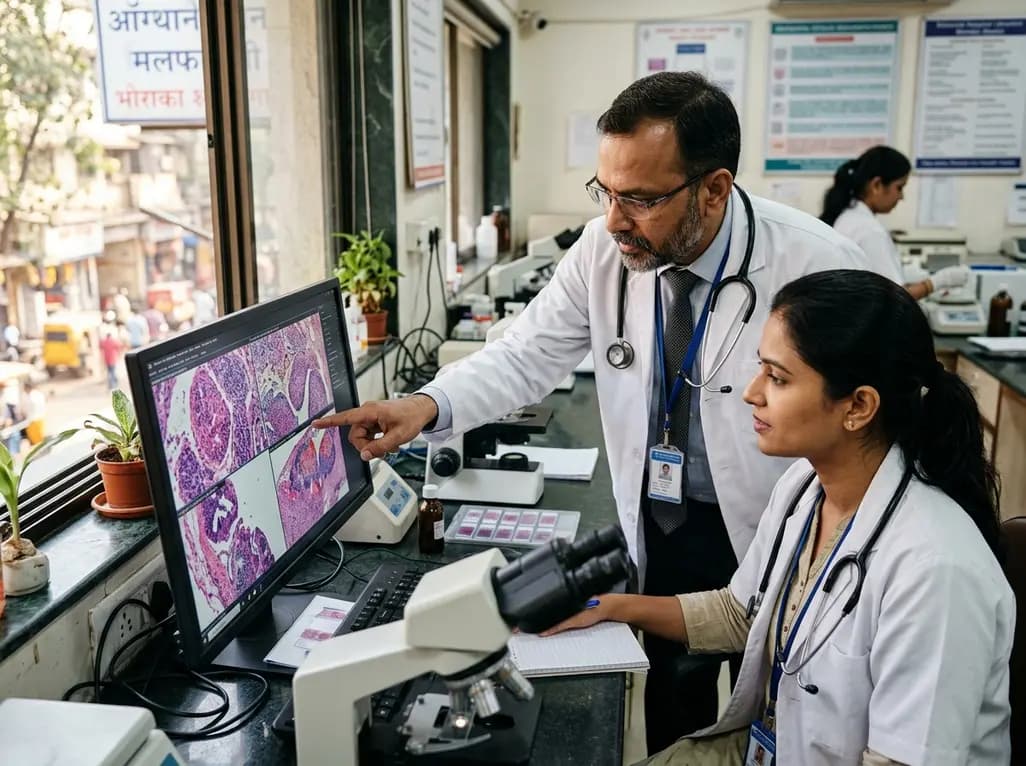
Chronic rhinosinusitis with nasal polyps is a heterogeneous inflammatory disease characterized by variable responses to targeted biologic therapy. While anti-interleukin-5 antibodies offer substantial clinical benefits, predicting individual treatment trajectories remains difficult. Standard histological assessments focus almost exclusively on eosinophil counts; however, this isolated metric provides inconsistent prognostic utility. To overcome these limitations, advanced digital pathology pipelines are transforming tissue analysis. Recent research shows that AI histopathology in CRSwNP extracts deep structural features from baseline biopsies to predict therapeutic efficacy. By evaluating holistic cellular architecture, artificial intelligence enables precise patient stratification for personalized biologic management.
Severe chronic rhinosinusitis with nasal polyps imposes a substantial burden on patient quality of life. Clinicians increasingly prescribe monoclonal antibodies such as mepolizumab for patients with refractory disease. Nevertheless, biologic treatments represent significant healthcare expenditures and require long-term adherence. Clinicians therefore need reliable baseline biomarkers to identify potential responders prior to treatment initiation. Traditional clinical pathways rely primarily on mucosal or peripheral eosinophilia to guide biologic therapy. Unfortunately, isolated eosinophil metrics fail to reflect the intricate pathogenesis of type 2 inflammation. Consequently, many patients undergo prolonged treatment cycles without achieving optimal symptom relief or polyposis reduction. This uncertainty highlights the critical need for objective prognostic tools. Computational pathology addresses this demand by analyzing digital biopsy slides to capture complex morphological profiles. Rather than relying on simple cellular tallies, machine learning evaluates tissue architecture across whole-slide images. Thus, digital pathology platforms can transform subjective histological evaluations into objective, reproducible response stratifications.
To improve predictive accuracy, investigators developed an automated computational pathology workflow for baseline polyp biopsies. The hypothesis-generating substudy evaluated fifty-eight patients with severe nasal polyposis enrolled in a randomized controlled trial. Using an AI-driven spatial histopathology pipeline, researchers extracted eighty-four distinct morphological features per cell. These parameters quantified cellular shape, nuclear characteristics, and spatial distribution patterns across three configurations: eosinophil-only, non-eosinophil, and all-cell models. Investigators used linear discriminant analysis and partial least squares regression to assess response at six and twelve months based on EUFOREA consensus criteria. Furthermore, the pipeline evaluated continuous symptom changes and endoscopic scores. By systematically analyzing spatial arrangements, the algorithm captured complex tissue organization invisible to standard light microscopy. Notably, the multi-cell model highlighted subtle structural interactions among surrounding stromal and immune cells. Therefore, extracting spatial morphological features enables machine learning models to capture nuanced biological signals that correlate with therapeutic success.
The study yielded surprising insights regarding cellular contributions to biologic response prediction. Conventional dogma assumes that eosinophil abundance directly correlates with anti-interleukin-5 efficacy. However, the eosinophil-only model demonstrated poor discriminative ability at twelve months, achieving an area under the curve of only 0.43. In contrast, the non-eosinophil model showed moderate discrimination with an area under the curve of 0.62. Remarkably, the all-cell model achieved the highest predictive performance, with an area under the curve of approximately 0.75. Additionally, for continuous visual analog and polyp score outcomes, non-eosinophil models explained the greatest variance, reaching correlation values of approximately 0.34. These results demonstrate that non-eosinophil constituents, including structural fibroblasts and plasma cells, harbor essential prognostic information. While mepolizumab effectively suppresses eosinophils, the surrounding microenvironment determines whether mucosal remodeling resolves. Consequently, evaluating the broader cellular environment significantly improves predictive power over isolated eosinophil markers.
Another key finding involves the temporal differences observed between intermediate and long-term evaluation timepoints. At six months of treatment, all predictive models exhibited poor discrimination, with areas under the curve averaging 0.49. However, model discrimination improved substantially by twelve months. This temporal lag suggests that early improvements may reflect immediate symptom suppression, whereas sustained long-term control requires structural mucosal remodeling. European guidelines recommend evaluating biologic response at six months to guide treatment continuation. Nevertheless, computational findings indicate that deep cellular changes require extended timeframes to produce definitive clinical divergence. Clinicians should recognize that tissue-level architectural remodeling occurs gradually. Furthermore, patients with dense baseline stromal fibrosis may require longer therapeutic courses before demonstrating measurable polyp reduction. Therefore, integrating multi-cell computational profiling into clinical monitoring could prevent premature treatment termination while optimizing long-term therapeutic decisions.
Integrating artificial intelligence into routine histopathology represents a substantial step forward for precision rhinology. Currently, otolaryngologists rely on clinical symptoms, blood tests, and standard biopsy reports to select biologics. Digital pathology transforms routine hematoxylin and eosin slides into predictive instruments without requiring expensive molecular assays. Consequently, clinical centers could deploy these software algorithms alongside standard diagnostics to predict mepolizumab responsiveness before initiation. This capability helps avoid ineffective biologic trials in predicted non-responders, reducing treatment costs and unnecessary drug exposures. Moreover, identifying likely non-responders allows clinicians to consider alternative biologic mechanisms, such as anti-IL-4 or anti-IgE therapies, much earlier. As computational pathology tools gain regulatory validation, they will enhance clinical decision-making within multidisciplinary airway teams. Ultimately, utilizing artificial intelligence to analyze the complete tissue microenvironment will shift sinonasal polyposis management from empirical prescribing to individualized precision care.
AI histopathology extracts multi-dimensional morphological features from routine baseline biopsy slides, evaluating structural geometry, density, and spatial distribution. Unlike conventional eosinophil counts, computational pathology evaluates all cellular elements across the tissue microenvironment. By analyzing broader structural interactions among non-eosinophil stromal cells, machine learning models achieve superior predictive accuracy for identifying twelve-month therapeutic response compared to single-cell methods.
Although mepolizumab specifically targets interleukin-5 to deplete eosinophils, clinical resolution depends heavily on tissue remodeling and extracellular matrix dynamics. Non-eosinophil components, such as fibroblasts, epithelial cells, and immune aggregates, drive persistent structural polyp alterations. Consequently, baseline non-eosinophilic microenvironmental architecture provides critical prognostic data regarding whether tissue can successfully regress following eosinophil depletion.
Predictive discrimination was limited at six months but improved substantially at twelve months. This temporal difference indicates that early clinical outcomes may reflect acute symptom dampening, whereas sustained one-year remission requires deep tissue remodeling. Clinicians should recognize that structural mucosal reorganization takes time, suggesting that computational baseline stratification helps identify patients who will truly achieve durable long-term disease control.
Disclaimer: This content is for informational and educational purposes only and is intended for registered medical practitioners. It should not be used as a substitute for professional clinical judgment, diagnosis, or treatment. Medical knowledge continuously evolves, and clinical presentations vary. Healthcare providers must evaluate each case individually and verify treatment decisions against prevailing clinical evidence and manufacturer product information. Refer to the latest local and national guidelines for clinical practice.
References

Read summarized clinical updates, watch expert medical content, and earn CME certifications right from your smartphone.
Open your smartphone camera to scan and install.





A study reveals that AI histopathology analyzing the broader tissue microenvironment in CRSwNP outperforms eosinophil-only models in predicting 12-month response to mepolizumab, offering a novel computational pathology approach for biologic stratification.
last month

A landmark study identifies Lynx1 as a critical endogenous brake on nicotinic acetylcholine receptors in the ventral tegmental area. By modulating cholinergic signaling and curbing nicotine reinforcement, Lynx1 reveals novel molecular targets for treating tobacco dependence and substance use disorders.
Today
A nationwide South Korean study shows underreporting of smoking among women dropped from 57.4% to 36.4% between 2008 and 2021. However, over one-third of female smokers still conceal their habit, highlighting the critical role of cotinine verification in clinical risk assessment.
Today

PepsiCo and Monster Beverage have challenged the FSSAI ban on the energy drink label in Indian courts. While companies highlight supply disruptions, regulatory actions spotlight severe cardiovascular and metabolic risks associated with excessive caffeine, sugar, and taurine consumption, especially in adolescents.
Today
A recent investigation analyzes whether cervical disc arthroplasty effectively restores or merely preserves physiological range of motion, providing critical biomechanical insights for treating hypomobile cervical segments.
Today

A Bayesian multilevel meta-analysis reveals that aerobic training combined with moderate carbohydrate restriction modestly lowers HbA1c in type 2 diabetes. However, sparse data and very low certainty leave incremental benefits over exercise or diet alone unproven, highlighting the need for individualized care.
Yesterday
