.webp&w=384&q=75)

Loading, please wait...
Loading, please wait...
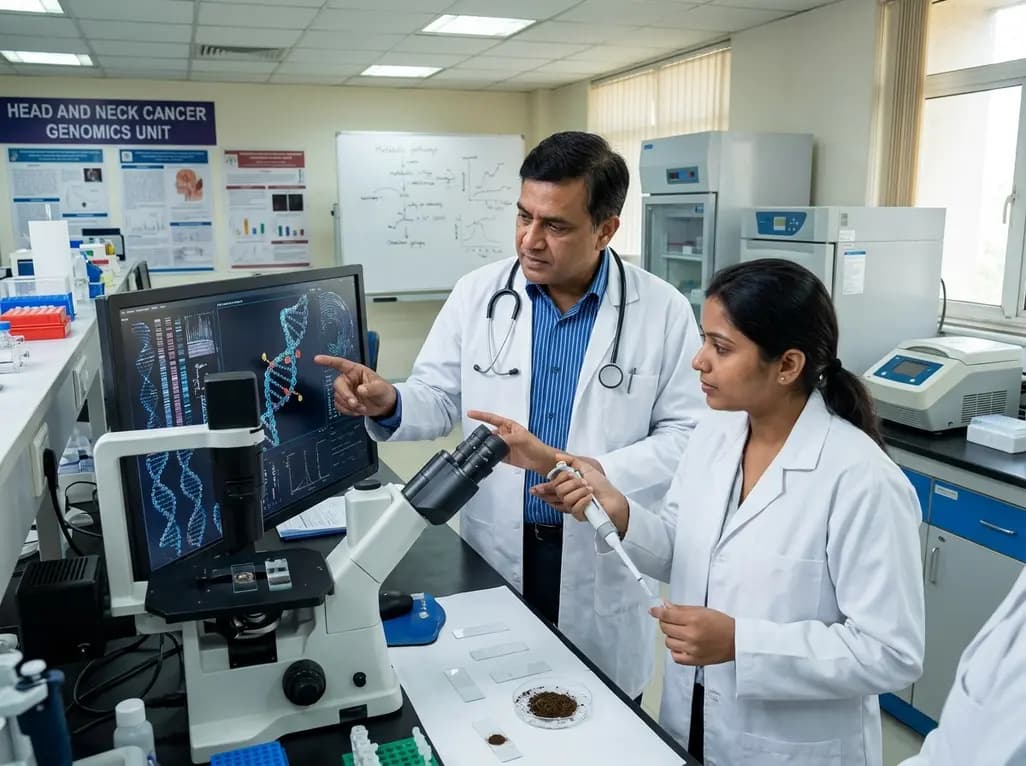
Understanding the exact molecular initiation of malignancy remains a fundamental challenge in modern oncology. Researchers at the Indraprastha Institute of Information Technology Delhi, in collaboration with national research bodies, have introduced MutAIverse. This generative artificial intelligence platform decodes environmental exposures by analyzing DNA adducts in cancer to identify the chemical origins of cellular transformation.
Carcinogenesis frequently begins when exogenous genotoxins enter human tissues and covalently bind to nitrogenous bases. Consequently, these chemical modifications create structural deformities known as DNA adducts. If cellular repair pathways fail to excise these lesions, permanent somatic mutations occur during DNA replication. In India, head and neck squamous cell carcinomas represent a substantial disease burden. These malignancies occur predominantly due to chewing smokeless tobacco products and areca nut mixtures.
Historically, toxicologists faced significant computational hurdles when attempting to catalog these chemical modifications. Conventional reference libraries contained fewer than four hundred characterized adduct profiles. Therefore, identifying rare or complex chemical modifications in clinical biopsies remained difficult. MutAIverse resolves this bottleneck by expanding the global library to over three hundred thousand putative adduct structures. Furthermore, the platform simulates intracellular metabolic pathways to predict how parent genotoxins break down into reactive electrophiles. Thus, the system bridges cellular chemistry with computational genomics.
At the core of the MutAIverse framework lies a specialized machine-learning algorithm called AdductLinker. This algorithmic engine operates like a molecular detective. Specifically, it executes retrograde tracking from observed DNA structural damage back to the initial xenobiotic exposure. When an oncologist uploads tandem mass spectrometry data, AdductLinker cross-references the spectral fragments against its extensive mechanistic database.
Subsequently, the generative AI evaluates nucleotide modifications across adenine, thymine, guanine, and cytosine bases. The platform detects abnormalities even when chemical alterations occur at a minimal frequency of 0.1 percent. Moreover, the algorithmic output delivers a comprehensive metabolic breakdown. It details the primary chemical compound, intermediate bioactivation metabolites, and a statistical confidence score. Consequently, clinicians gain objective insights into the exact chemical agents driving genomic instability in individual tissue specimens.
To establish clinical validity, researchers tested the platform on biopsy samples from twenty-seven patients presenting with head and neck malignancies in Guwahati, Assam. Investigators performed high-throughput DNA adductomics at the National Institute of Pharmaceutical Education and Research in Guwahati. Additionally, they partnered with oncologists at the Dr. Bhubaneswar Borooah Cancer Institute to collect deeply annotated tumor specimens.
Remarkably, the platform successfully identified signature adduct profiles directly linked to smokeless tobacco consumption. The computational pipeline identified both established and previously uncharacterized adducts with high fidelity. Furthermore, the findings confirmed that specific tobacco-derived nitrosamines selectively target vulnerable genomic regions. This experimental validation highlights the capacity of generative AI to deconvolute complex biochemical exposures from heterogeneous patient tissue samples.
Modern analytical chemistry relies extensively on liquid chromatography coupled with high-resolution tandem mass spectrometry. This technology isolates and fragments modified nucleosides to produce distinct spectral signatures. However, biological tissues yield highly complex spectral noise, which often obscures critical diagnostic signals. MutAIverse overcomes this computational barrier by integrating deep learning models trained on millions of simulated fragmentation patterns.
Additionally, the computational model accounts for spatial cellular contexts and variations in xenobiotic metabolism. By incorporating physiological enzyme kinetics, the AI predicts how human cytochrome P450 enzymes bioactivate inert pro-carcinogens into reactive species. As a result, the platform accelerates spectral interpretation, reducing data processing timelines from weeks to mere minutes. Consequently, this computational efficiency empowers researchers to conduct large-scale population adductomics studies across diverse environmental cohorts.
Identifying the precise chemical source of DNA damage provides critical advantages for primary and secondary cancer prevention. When clinicians identify specific environmental carcinogens in a patient, they can immediately implement targeted exposure cessation strategies. Furthermore, public health authorities can utilize this exposure data to protect family members and communities facing similar localized contamination risks.
Moreover, tracing DNA adducts provides valuable prognostic context for managing complex malignancies. Understanding whether a tumor arose from specific industrial genotoxins, contaminated water, or smokeless tobacco informs overall risk stratification. Additionally, clinicians may eventually utilize adduct profiling alongside standard next-generation sequencing to monitor early therapy response. Thus, preventive oncology transitions from broad population warnings toward precise, biomarker-guided risk mitigation strategies.
Despite these remarkable computational capabilities, medical experts urge appropriate clinical caution. Detecting a DNA adduct demonstrates that a chemical interacted with cellular genetic material. However, it does not definitively prove that this specific adduct caused the subsequent malignancy. Cells frequently repair chemical lesions successfully, and genomic instability often requires multiple synergistic mutations over decades.
Consequently, MutAIverse currently serves as an advanced research platform rather than a standalone clinical diagnostic device. Translating this computational framework into hospital workflows requires prospective multicenter clinical trials. Furthermore, researchers must establish standardized laboratory protocols for tissue preparation and mass spectrometry calibration. Nevertheless, integrating generative AI with chemical biology marks a transformative milestone toward mapping the human mutational exposome.
Q1: What are DNA adducts and why are they clinically significant in oncology?
DNA adducts are complex chemical modifications formed when carcinogenic molecules covalently bind to DNA bases. These structural abnormalities disrupt normal replication and transcription mechanisms. If cellular repair pathways fail, adducts cause permanent oncogenic driver mutations, making them valuable biomarkers for chemical exposure.
Q2: How does the MutAIverse generative AI platform trace cancer causation?
MutAIverse analyzes mass spectrometry data from tumor biopsies using an algorithm named AdductLinker. The platform compares detected molecular alterations against a database of over three hundred thousand adduct structures. It then performs reverse computational modeling to pinpoint the primary environmental carcinogen.
Q3: Can MutAIverse be used as a standalone diagnostic tool in routine clinical practice?
No, MutAIverse currently functions as a specialized basic research tool. While it successfully identifies chemical exposures, detecting an adduct does not conclusively establish disease causation. Clinical adoption requires extensive prospective validation, epidemiological correlation, and integration with standardized sequencing protocols.
Disclaimer: This content is for informational and educational purposes only. It does not constitute medical advice or replace professional judgment. Refer to the latest local and national guidelines for clinical practice.
References

Read summarized clinical updates, watch expert medical content, and earn CME certifications right from your smartphone.
Open your smartphone camera to scan and install.





Indian researchers have developed MutAIverse, a cutting-edge generative AI platform that decodes DNA adducts to trace environmental carcinogens in head and neck cancer. This computational breakthrough bridges adductomics and precision oncology.
last month
PZL-26, a selective small-molecule inhibitor of LONP1, reveals essential roles of this mitochondrial protease in complex I biogenesis, translation, and oxidative phosphorylation. These findings provide critical mechanistic insights for developing targeted anticancer therapies against proteostasis-dependent tumors.
Today

A nationwide South Korean study shows underreporting of smoking among women dropped from 57.4% to 36.4% between 2008 and 2021. However, over one-third of female smokers still conceal their habit, highlighting the critical role of cotinine verification in clinical risk assessment.
Today

PepsiCo and Monster Beverage have challenged the FSSAI ban on the energy drink label in Indian courts. While companies highlight supply disruptions, regulatory actions spotlight severe cardiovascular and metabolic risks associated with excessive caffeine, sugar, and taurine consumption, especially in adolescents.
Today

A recent investigation analyzes whether cervical disc arthroplasty effectively restores or merely preserves physiological range of motion, providing critical biomechanical insights for treating hypomobile cervical segments.
Today

A Bayesian multilevel meta-analysis reveals that aerobic training combined with moderate carbohydrate restriction modestly lowers HbA1c in type 2 diabetes. However, sparse data and very low certainty leave incremental benefits over exercise or diet alone unproven, highlighting the need for individualized care.
Yesterday
