.webp&w=384&q=75)

Loading, please wait...
Loading, please wait...
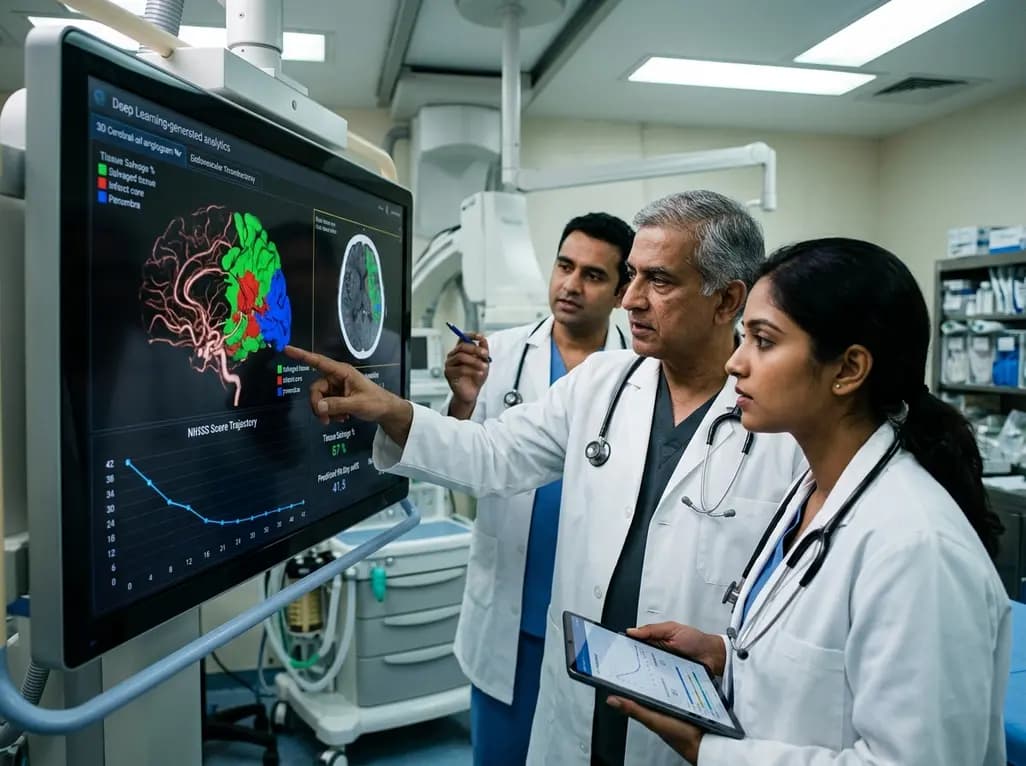
Endovascular thrombectomy has revolutionized acute stroke management for patients presenting with intracranial large vessel occlusions. However, individual clinical benefits vary substantially across patient populations due to dynamic ischaemic pathophysiologies. Consequently, reliable thrombectomy outcome prediction is essential to guide emergent clinical triage and personalize therapeutic expectations. A breakthrough study published in Brain demonstrates that multimodal deep learning models can accurately simulate tissue-level and functional outcomes before neurointervention occurs.
Endovascular therapy reliably recanalizes occluded intracranial arteries. Nevertheless, achieving complete angiographic reperfusion does not universally guarantee functional independence. Many patients experience futile reperfusion because irreversible microvascular failure or tissue infarction has already occurred. Furthermore, geographical disparities and transport logistics often delay access to specialized neurointerventional suites. Clinicians therefore need precise decision-support tools to identify which patients will achieve meaningful recovery from urgent mechanical intervention. Traditional prognostic scores rely heavily on baseline demographic variables and static radiological metrics. However, these conventional frameworks fail to capture individual collateral capacity and evolving ischaemic penumbra. By contrast, advanced artificial intelligence integrates complex radiological biomarkers with patient-specific clinical parameters. Consequently, machine learning provides nuanced simulations of functional recovery, enabling tailored multidisciplinary decision-making during high-stakes emergency evaluations.
Standard stroke imaging protocols frequently utilize automated perfusion CT software to estimate core and penumbral volumes. These conventional clinical platforms apply fixed hemodynamic thresholds, such as cerebral blood flow reductions below thirty percent. However, static perfusion thresholds frequently misestimate true tissue viability across heterogeneous patient cohorts. For example, microvascular collapse and variable collateral pathways produce dynamic changes that fixed thresholding cannot accommodate. In addition, existing linear regression tools cannot model non-linear physiological interactions between time-to-treatment, blood pressure variability, and tissue vulnerability. Therefore, simplistic volumetric cutoffs may mistakenly exclude salvageable patients or overestimate benefit in established non-viable tissue. Machine learning algorithms overcome these constraints by analyzing spatial voxel patterns and raw perfusion dynamics simultaneously. Consequently, deep neural architectures predict tissue fate with significantly higher precision than traditional threshold-based systems.
To address these diagnostic challenges, researchers developed a specialized deep learning architecture trained on routine clinical data from 405 ischaemic stroke patients. The investigators utilized acute multimodal computed tomography, including non-contrast CT, CT angiography, and CT perfusion maps. Furthermore, the model integrated baseline clinical characteristics such as age, admission stroke severity, and time from symptom onset. The training cohort comprised 304 patients, while distinct internal and external cohorts provided robust validation. Specifically, the neural network learned to forecast two distinct trajectories for each patient: successful reperfusion and unsuccessful reperfusion. By generating dual counterfactual scenarios, the algorithm calculated projected penumbral salvage and predicted discharge functional status. This dual-prediction methodology provides clinicians with an individualized estimate of absolute therapeutic gain before starting the intervention.
The deep learning algorithm demonstrated superior prognostic accuracy when benchmarked against standard clinical methods and generalized linear models. In tissue outcome prediction, the model achieved a mean Dice similarity coefficient of 0.48 on internal test data and 0.52 on external validation data. In comparison, standard thresholding methods achieved Dice scores of only 0.26 internally and 0.36 externally. Similarly, generalized linear models achieved Dice scores of 0.34 and 0.35, respectively. In addition to anatomical segmentation, the deep learning tool precisely predicted neurological function at hospital discharge. The system achieved a median absolute error of only 1.5 points on the National Institutes of Health Stroke Scale for internal subjects. Furthermore, it maintained a median absolute error of 3.0 points on external validation subjects. Consequently, the deep learning model outperformed existing statistical and machine learning baselines across both anatomical and neurological endpoints.
Implementing reliable artificial intelligence biomarkers could significantly optimize resource allocation across regional stroke networks. For instance, emergency physicians evaluating patients at secondary community hospitals must rapidly decide between local medical management and urgent interventional transfer. Highly accurate predictive models quantify the exact neurological gain expected from mechanical recanalization. Therefore, clinical teams can prioritize urgent transfers for patients with high predicted penumbral salvage while avoiding unnecessary inter-hospital transports for non-viable cases. Moreover, personalized predictions assist neurointerventionalists in setting realistic expectations with families regarding post-stroke recovery trajectories. As acute stroke networks expand globally, integrating automated decision-support algorithms into picture archiving and communication systems will streamline triage workflows and reduce treatment delays.
Although these validation results are highly promising, prospective clinical trials must evaluate real-time algorithmic integration into acute stroke pathways. Future iterations of deep learning models should incorporate continuous physiological variables, including continuous blood pressure monitoring, automated collateral scoring, and microvascular resistance indices. Furthermore, expanding model validation across ethnically diverse populations will confirm generalizability across varying healthcare infrastructures. Interventional neuroradiologists and emergency neurologists will increasingly utilize predictive AI to refine patient selection criteria, particularly in extended time windows or borderline imaging scenarios. Ultimately, combining computational deep learning with clinical acumen promises to transform stroke care from population-level heuristics into truly personalized neurovascular medicine.
Deep learning models process complex multimodal imaging and clinical variables simultaneously to estimate tissue fate accurately. Unlike static perfusion thresholds, neural networks simulate both successful and unsuccessful reperfusion scenarios, providing clinicians with individualized estimates of functional benefit and tissue salvage to guide urgent recanalization decisions.
The deep learning model predicts discharge neurological status with high precision, achieving a median absolute error of 1.5 points on the National Institutes of Health Stroke Scale in internal validation and 3.0 points in external testing, significantly outperforming conventional linear regression and machine learning baselines.
Yes, the algorithm demonstrated robust generalizability during external validation on independent datasets acquired with varying computed tomography protocols. However, widespread clinical deployment requires seamless integration into local picture archiving systems and prospective validation across heterogeneous regional stroke networks.
Disclaimer: This content is for informational and educational purposes only and should not be taken as professional medical advice. Always consult a qualified healthcare provider for diagnosis and treatment decisions. Refer to the latest local and national guidelines for clinical practice.
References

Read summarized clinical updates, watch expert medical content, and earn CME certifications right from your smartphone.
Open your smartphone camera to scan and install.





A novel deep learning model accurately predicts patient-specific tissue salvage and NIHSS score trajectories after endovascular thrombectomy in acute ischaemic stroke, transforming clinical triage and neurointerventional decision-making.
last month

Chronic eosinophilic pneumonia can present with atypical bronchoalveolar lavage findings and an organizing pneumonia pattern, necessitating surgical lung biopsy.
Today

Discover the crucial distinctions between mesonephric and mesonephric-like proliferations of the female genital tract. Learn the key histomorphologic, immunohistochemical, and molecular differences essential for accurate diagnosis and clinical management.
Today
Kikuchi-Fujimoto disease rarely presents with refractory shock and sinus bradycardia in children. This case report highlights life-threatening hemodynamic instability requiring intensive care, preserved cardiac contractility, and the critical diagnostic role of early excisional lymph node biopsy.
Today

A narrative review investigates whether the articularis genus muscle functions as an independent anatomical entity or blends with the vastus intermedius. We evaluate its morphology, role in retracting the suprapatellar bursa, and direct clinical significance in anterior knee pain and arthroplasty.
Today

A Bayesian multilevel meta-analysis reveals that aerobic training combined with moderate carbohydrate restriction modestly lowers HbA1c in type 2 diabetes. However, sparse data and very low certainty leave incremental benefits over exercise or diet alone unproven, highlighting the need for individualized care.
Today
