.webp&w=384&q=75)

Loading, please wait...
Loading, please wait...

Recent legal developments have renewed global attention on the role of preterm infant formula and specialty nutritional products in neonatal care. Abbott recently announced a $670 million settlement to resolve approximately 2,000 legal claims alleging that its specialty premature formulas contributed to necrotizing enterocolitis. Although the settlement addresses substantial liabilities, the company maintained that its products remain safe and medically vital. This complex intersection of clinical nutrition and legal scrutiny highlights the ongoing challenges that healthcare teams face in neonatal intensive care units. Consequently, pediatricians, neonatologists, and pediatric nutritionists must examine both the scientific evidence and practical implications for fragile infants.
The newly announced agreement partially resolves high-profile litigation across state and federal courts in the United States. Specifically, the $670 million settlement encompasses agreements with three major law firms representing roughly 2,000 claimants. Crucially, the agreement resolves a prominent 2024 verdict in Missouri that originally awarded $495 million to a plaintiff. Abbott agreed to drop further appeals after an appellate court upheld that decision earlier in 2026. Because accrued interest would have pushed that single payout toward $600 million, the manufacturer negotiated a broader resolution.
However, Abbott explicitly denied liability in the settlement. The manufacturer emphasized that specialty products designed for hospital settings provide indispensable nutrition for vulnerable infants. Meanwhile, thousands of other claims remain pending against both Abbott and Mead Johnson. The manufacturers argue that many pending lawsuits include duplicate filings or involve infants who developed complications prior to receiving formula. Therefore, legal proceedings continue to unfold across multidistrict litigation while hospitals evaluate product availability.
Necrotizing enterocolitis represents one of the most severe and devastating gastrointestinal emergencies in premature infants. Pathophysiologically, the condition involves sudden intestinal inflammation that progresses rapidly to bowel necrosis, systemic sepsis, and potential perforation. Clinicians recognize that extremely low birth weight infants face the highest risk because of intestinal immaturity and underdeveloped immune defenses. Furthermore, mortality rates for surgical cases often exceed 20 percent, leaving survivors with severe long-term morbidities such as short bowel syndrome.
The precise etiology of this condition remains multifactorial rather than attributable to a single direct trigger. Several clinical factors interact simultaneously, including mucosal barrier dysfunction, abnormal microcirculatory regulation, and gut microbial dysbiosis. In addition, early enteral feeding practices play an influential role in modulating gut mucosal health. Because premature intestines lack mature digestive enzymes and protective tight junctions, improper feeding advancement can provoke excessive mucosal inflammation. Thus, early clinical surveillance and prompt diagnosis remain paramount in intensive care units.
Medical and regulatory bodies have consistently evaluated the comparative safety of preterm infant formula and human milk. In late 2024, a consensus report from federal health agencies clarified key nutritional evidence. Specifically, the panel concluded that available scientific data do not prove that specialty formulas directly cause bowel tissue necrosis. Instead, extensive research confirms that the absence of human milk is the primary factor increasing neonatal susceptibility.
Furthermore, human breast milk provides unique bio-active factors, including maternal immunoglobulins, lactoferrin, and human milk oligosaccharides. These vital components promote healthy microbiome colonization and reinforce immature epithelial barriers. Consequently, pediatric societies universally recommend mother's own milk as the premier primary diet for preterm infants. However, when maternal milk supply remains insufficient, pasteurized donor human milk serves as the secondary evidence-based option. Specialty formulas remain essential when human milk options are entirely unavailable, ensuring fragile infants receive necessary caloric density.
The ongoing litigation creates significant logistical and clinical challenges for neonatal intensive care units worldwide. Healthcare providers depend heavily on cow's milk-derived fortifiers and specialty liquid formulas to support rapid organ development. Without adequate protein, calcium, and phosphorus fortification, extremely preterm infants risk severe extrauterine growth restriction and metabolic bone disease. Therefore, premature infant feeding protocols require balanced nutritional optimization alongside vigilant risk mitigation strategies.
Moreover, clinicians must adhere strictly to evidence-based feeding bundles to minimize gastrointestinal distress. Standardized feeding guidelines emphasize slow, cautious trophic feeding followed by gradual volume advancement. Additionally, centers should invest in comprehensive lactation support programs to optimize maternal milk expression immediately following delivery. Establishing reliable donor milk banking networks represents another crucial strategy to protect high-risk neonates. When clinicians must introduce specialty formulas, systematic monitoring for feeding intolerance, abdominal distension, and occult blood helps detect early mucosal compromise.
Heightened public coverage surrounding multi-million-dollar court verdicts frequently causes understandable anxiety among parents of hospitalized infants. Consequently, bedside clinicians must engage in transparent, empathetic communication regarding neonatal feeding strategies. Physicians should proactively discuss the essential role of nutritional fortification and the protective benefits of maternal breast milk. By explaining how multidisciplinary teams monitor digestive health, clinicians can reassure families during stressful hospital stays.
Looking forward, ongoing scientific research continues to explore alternative fortifier formulations, including human milk-derived fortifiers and advanced bioactive additives. Furthermore, industry stakeholders and regulatory authorities must collaborate to protect product supply chains from sudden shortages. Maintaining consistent access to specialized neonatal nutrition products remains essential for clinical survival. Ultimately, medical teams must preserve rigorous, evidence-driven feeding decisions within intensive care units rather than altering established care based solely on courtroom litigation.
Q1: Why did Abbott agree to a $670 million settlement regarding its preterm infant formula?
Abbott agreed to the $670 million settlement to resolve roughly 2,000 pending lawsuits and avoid escalating financial liabilities. A 2024 jury verdict previously awarded $495 million to an Illinois mother whose infant developed necrotizing enterocolitis. With accrued interest exceeding $600 million during appeals, the manufacturer chose a comprehensive settlement while maintaining that its specialty nutritional products remain clinically safe.
Q2: Does scientific evidence show that preterm infant formula directly causes necrotizing enterocolitis?
Current scientific consensus from major health agencies indicates that specialty formulas do not directly cause necrotizing enterocolitis. Rather, robust research demonstrates that the absence of protective human milk significantly increases disease vulnerability. Premature infants who lack maternal or donor breast milk miss critical immune factors, making standardized clinical feeding protocols and close monitoring essential for their intestinal health.
Q3: What are the primary feeding recommendations for premature infants in neonatal intensive care units?
Leading pediatric organizations universally recommend mother's own milk as the optimal nutritional source for premature infants, supplemented with appropriate multi-nutrient fortifiers to meet developmental demands. If maternal milk is unavailable, pasteurized donor human milk is the preferred alternative. When human milk supplies are exhausted, clinicians utilize specialized formulas to prevent severe extrauterine growth failure and support organ maturation.
Disclaimer: This content is for informational and educational purposes only. It does not constitute medical advice or replace professional judgment. Refer to the latest local and national guidelines for clinical practice.
References

Read summarized clinical updates, watch expert medical content, and earn CME certifications right from your smartphone.
Open your smartphone camera to scan and install.





Abbott reached a $670 million settlement to resolve approximately 2,000 lawsuits concerning specialty preterm infant formula and necrotizing enterocolitis. Explore the clinical perspectives, scientific consensus on human milk, and key implications for neonatal nutritional management.
last month

Abdominal aortic aneurysm rupture remains a catastrophic vascular emergency. Groundbreaking research reveals that USP53 accelerates aneurysm progression by reprogramming smooth muscle cell metabolism toward aerobic glycolysis, highlighting a promising target beyond conventional diameter-based surveillance.
Today

A pharmacometric and machine learning study reveals that specific vaginal bacteria alter cervical antiretroviral exposure, highlighting the need for precision HIV PrEP strategies.
Today

A nationwide Swedish cohort study shows oral glucocorticoid exposure over 1-2 years strongly predicts overall organ damage in SLE, while cardiovascular risk reflects cumulative doses across 3 years. These findings reinforce early steroid minimization and cautious long-term maintenance.
Today

A scoping review highlights neural mobilization as a promising adjunct in managing cervicogenic headache. Integrating neurodynamics into multimodal physical therapy improves pain, range of motion, and posture, though standardized protocols and larger clinical trials are still needed.
Today
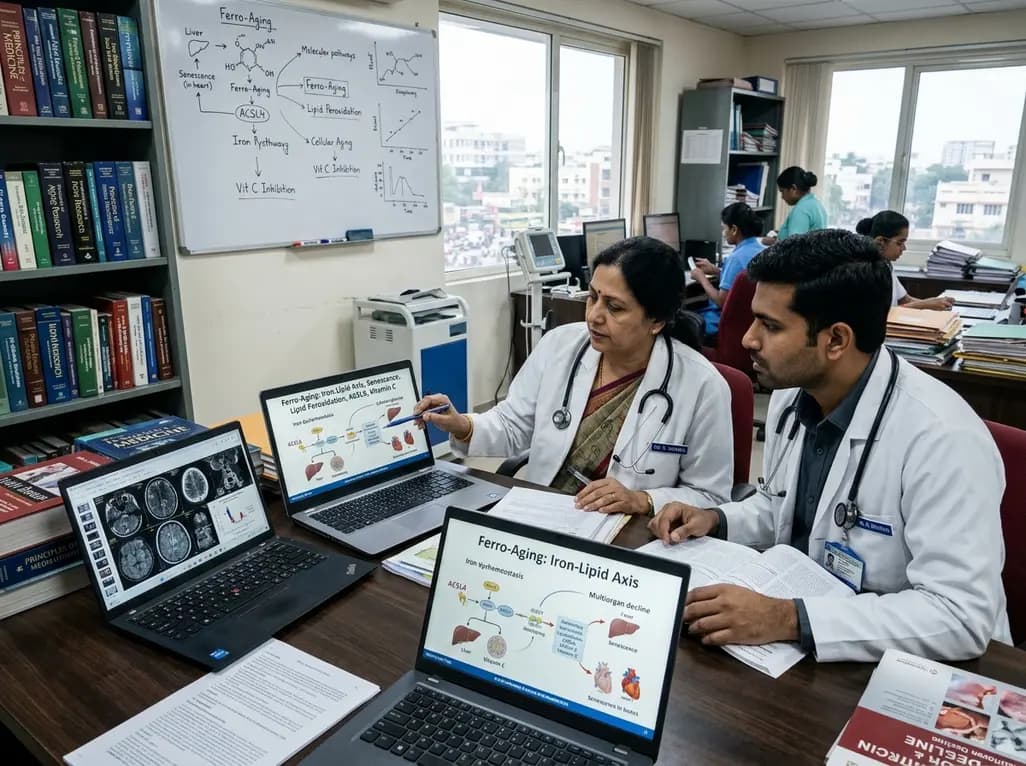
Recent research defines ferro-aging as a conserved iron-lipid axis driving organ decline across primates. Age-related iron dyshomeostasis stimulates ACSL4-mediated lipid peroxidation, promoting cellular senescence. Notably, vitamin C directly inhibits ACSL4, suppressing phospholipid oxidation and multi-organ decay.
Today
