

Loading, please wait...
Loading, please wait...
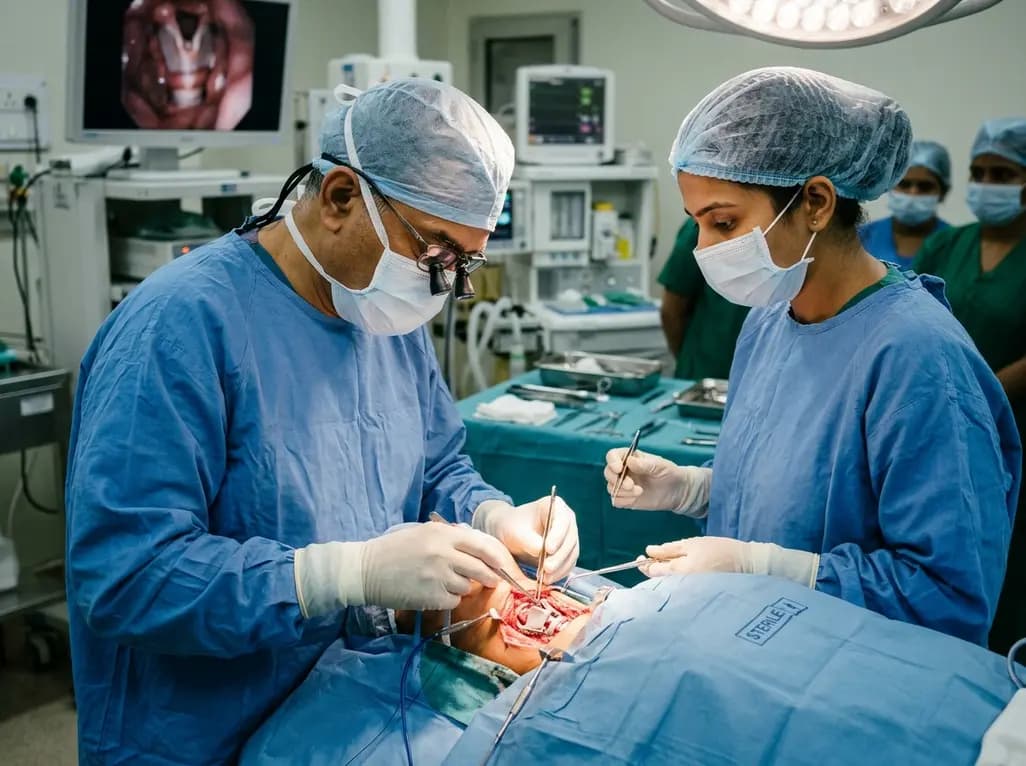
Transoral laser cordectomy remains a primary curative modality for early-stage glottic carcinoma. However, extensive resection of the vocalis muscle and underlying lamina propria frequently precipitates significant glottic incompetence. Consequently, patients often experience severe post-cordectomy dysphonia, characterized by profound breathiness, phonatory strain, and diminished vocal stamina. While medialization thyroplasty successfully manages unilateral vocal cord paralysis, applying it to oncological defects presents formidable hurdles. Recent surgical advancements show that combining structural retrusion with customized medialization offers an effective framework adaptation for recalcitrant vocal deficits.
Endoscopic cordectomy removes malignant tissue effectively, yet it permanently disrupts the delicate microarchitecture of the vocal fold. Surgical resection of the vibratory mucosa and deep vocalis musculature triggers intense secondary intention healing. As a result, dense fibrous tissue replaces compliant lamina propria, which creates severe glottic incompetence. Furthermore, the anterior-posterior tension dynamics shift unfavorably as cicatricial contracture anchors the residual neocord tightly to the thyroid perichondrium.
Traditional phonosurgical interventions often fail to restore adequate phonatory function in these complex presentations. Standard injection laryngoplasty encounters severe mechanical resistance because rigid fibrous tissue prevents homogeneous distribution of injected biomaterials. Similarly, conventional medialization thyroplasty addresses lateral displacement but fails to resolve excessive longitudinal tension across the scarred framework. Consequently, air leaks persist during phonation, leading to marked vocal fatigue and communicative handicap. In developing healthcare contexts, where functional voice preservation directly dictates occupational productivity, managing this multifactorial defect remains a vital surgical objective.
Medialization laryngoplasty, known as type I thyroplasty, successfully displaces the lateralized vocal margin toward the phonatory midline. Nevertheless, simple lateral compression often falls short when managing rigid post-oncological defects characterized by fibrous retraction. In contrast, Isshiki type III thyroplasty involves targeted anteroposterior shortening of the thyroid cartilage framework, which relieves excessive longitudinal vocal fold tension. Therefore, combining these complementary techniques establishes an ideal biomechanical environment for glottic reconstruction.
Specifically, the type III relaxation step reduces tissue stretch, allowing the stiffened cicatricial vocal margin to achieve medial repositioning without tearing delicate structures. Once surgeons release this longitudinal tension, they can safely perform type I medialization to achieve precise glottic closure. Moreover, this dual approach lowers the transglottic driving pressure required for phonation, which significantly diminishes patient effort during speech. Consequently, patients regain sustainable subglottic pressure without experiencing excessive mucosal resistance or dangerous airway compromise during routine daily conversation.
Surgeons perform this sophisticated intervention under monitored local anesthesia supplemented with light conscious sedation, ensuring active patient phonation during crucial adjustments. First, the surgical team creates lateral vertical cartilaginous strips, executing the type III laryngeal retrusion. This framework relaxation shortens the thyroid ala, effectively reducing longitudinal strain along the scarred glottic margin. Subsequently, the operating surgeon carves a customized cartilaginous window within the thyroid lamina on the affected cordectomy side.
Next, the surgeon carefully dissects the inner perichondrium and fibrous neocord away from the cartilage, exercising extreme caution to prevent mucosal tears. Following complete paraglottic mobilization, the team positions a preformed Montgomery thyroplasty implant into the defect. Continuous intraoperative flexible transnasal fiberoptic laryngoscopy guides every micro-adjustment in real time. Meanwhile, the surgeon engages the patient in conversational speech to evaluate acoustic clarity and aerodynamic closure. Once optimal vocal intensity and complete glottic closure occur, surgeons securely fixate the implant within the scarred framework.
Clinical investigations evaluating the combined type I and III Montgomery thyroplasty reveal impressive aerodynamic and functional recoveries. Specifically, patient-reported outcome measures demonstrate substantial subjective improvements following this tailored laryngeal framework intervention. In recent clinical evaluations, scores on the validated Unilateral Vocal Fold Paralysis-10 questionnaire dropped significantly, declining from baseline values of 16 and 26 down to 5 and 21, respectively. These subjective gains directly reflect reduced vocal fatigue and enhanced conversational comfort.
Similarly, objective aerodynamic assessments show marked physiological restoration after surgery. Maximum phonation time serves as a dependable indicator of transglottic airflow efficiency and vocal fold seal. Following the procedure, maximum phonation time increased substantially, extending from 7 to 20 seconds in one patient and from 3 to 6 seconds in another severely compromised individual. Furthermore, perceptual acoustic grading via the standardized Grade, Roughness, Breathiness scale showed clear resolution of breathiness. Crucially, surgical teams observed these functional rehabilitative milestones without recording any intraoperative or postoperative adverse events.
Operating upon an oncologically treated larynx demands rigorous surgical technique and heightened vigilance regarding tissue viability. Many individuals presenting with severe glottic incompetence have previously undergone salvage surgery or adjuvant radiotherapy. Consequently, the cervical soft tissues frequently exhibit microvascular compromise, fibrosis, and impaired wound healing dynamics. Surgeons must handle the inner laryngeal perichondrium with meticulous care, because tearing fragile irradiated mucosa predisposes the patient to implant extrusion or salivary fistula formation.
Additionally, selecting the correct Montgomery implant size requires delicate judgment. Over-medialization risks postoperative dyspnea and laryngeal edema, whereas under-medialization fails to seal the glottic chink. Surgeons should utilize temporary implant sizing devices while evaluating the vocal cord position under flexible videoendoscopy. Furthermore, prophylactic perioperative broad-spectrum antibiotic coverage and short-term corticosteroid administration mitigate infection and swelling. Securing the framework reconstruction with non-absorbable sutures ensures structural stability during post-surgical coughing episodes, promoting uneventful mucosal healing in vulnerable tissue beds.
Isolated type I thyroplasty primarily addresses lateral vocal cord displacement by pushing tissue medially. However, cordectomy defects involve dense scar tissue and severe longitudinal contracture alongside volume loss. Simple medial compression cannot overcome this cicatricial stiffness and may tear fragile inner mucosal linings. Consequently, combining type I medialization with type III relaxation shortens the laryngeal framework, reducing tension and enabling effective glottic coaptation without excessive tissue stress.
Intraoperative flexible fiberoptic laryngoscopy provides real-time visualization of vocal fold position, glottic closure, and airway patency throughout the operation. Because the patient remains awake under conscious sedation, the surgical team can directly inspect neocord medialization during active phonation and quiet breathing. This live assessment ensures precise implant positioning, prevents overcorrection that could compromise the laryngeal airway, and confirms optimal mucosal contact for immediate vocal improvement.
Surgeons typically recommend waiting at least six to twelve months following oncological cordectomy before performing definitive framework thyroplasty. This necessary delay allows spontaneous formation and stabilization of the fibrous neocord, while speech therapy explores non-surgical recovery potential. Most importantly, this observation interval permits thorough oncological surveillance to rule out early local tumor recurrence, ensuring that reconstructive interventions take place safely in a stable, disease-free laryngeal environment.
Disclaimer: This content is for informational and educational purposes only and does not substitute for professional medical advice, diagnosis, or treatment. Healthcare providers must exercise their own independent clinical judgment when managing individual patients. Refer to the latest local and national guidelines for clinical practice.
References
Zapater E et al. Type I + III Montgomery Thyroplasty for Post-Cordectomy Dysphonia. J Voice. 2026 Nov 10. doi: undefined. PMID: 43009417.
Storck C, et al. Surgical Impact of the Montgomery Implant System on Arytenoid Cartilage and the Paralyzed Vocal Fold. J Voice. 2020;34(5):789-795.
Satte M. Effect of thyroplasty in the treatment of dysphonia: a review article. ISJ Theor Appl Sci. 2021;101(9):522-533.

Read summarized clinical updates, watch expert medical content, and earn CME certifications right from your smartphone.
Open your smartphone camera to scan and install.





A combined type I and III Montgomery thyroplasty provides a reliable surgical strategy for patients suffering from severe post-cordectomy dysphonia, restoring glottic closure and significantly improving maximum phonation time and voice-related quality of life.
Last week

A comprehensive systems biology review illuminates how kynurenine pathway dysregulation fuels neurodegeneration in Parkinson's disease. Multi-omics integration identifies critical enzymatic targets, including IDO1, TDO2, and KMO, while underscoring key translational challenges in developing disease-modifying therapies.
Today

A cross-sectional study of 4,862 women highlights how metabolic phenotypes alter female reproductive impairment. Metabolically unhealthy overweight and obesity presented the greatest odds for infertility and impaired fecundity, underscoring the vital need for comprehensive cardiometabolic screening.
Today

A large network analysis of middle-aged and older adults reveals distinct sex-specific dependency pathways between lifestyle factors and cardiometabolic diseases. Physical activity, smoking, and alcohol exhibit divergent bridging roles in men and women, underscoring the need for tailored clinical prevention.
Today

A breakthrough study reveals that teriparatide alleviates sarcopenia by binding MYH9 rather than PTH1R, activating an AKT/CREB1 axis to promote MYOD transcription and muscle regeneration. This discovery offers a promising biological rationale for repurposing bone anabolic therapies to combat age-related muscle loss.
Today

Researchers have engineered a resilient LC-PAM hydrogel that resolves the trade-off between toughness and elasticity. Incorporating lignin and cellulose nanoparticles alongside selenium, this biomaterial offers durable adhesion and antibacterial activity for complex infected and diabetic wound care.
Today
