.webp&w=384&q=75)

Loading, please wait...
Loading, please wait...

In-hospital fires are rare, but they represent high-risk events that require immediate, coordinated action. Nurses are often the first responders during such emergencies. Therefore, establishing effective VR fire safety training is becoming a priority for healthcare institutions worldwide. A recent quasi-experimental study evaluated the feasibility of using virtual reality (VR) compared to traditional lectures to prepare nursing students for these critical situations.
The researchers conducted the study at RAK Medical and Health Sciences University with 130 undergraduate nursing students. They divided the participants into two groups. One group received immersive VR fire-safety training. Meanwhile, the other group attended a time-matched lecture covering the same learning objectives. Both groups took a 12-item knowledge test before and after their respective sessions. Additionally, the VR group provided feedback on the system's usability through standardized scales.
The results clearly favored immersive technology over traditional methods. While both groups showed knowledge improvement, the VR group achieved significantly higher post-test scores. Specifically, knowledge scores in the VR group rose from 5.8 to 9.3 out of 12. In contrast, the lecture group moved from 6.0 to 8.1. These findings suggest that experiential learning through simulation helps students grasp safety protocols more effectively than passive listening.
Furthermore, the students rated the VR system highly for its ease of use. Using the System Usability Scale (SUS), the VR training received an average score of 81.3. This indicates "excellent" usability and high learner satisfaction. Because students find the system engaging and intuitive, they are more likely to participate in regular training drills. Consequently, this leads to better long-term retention of life-saving skills in a clinical environment.
In India, the regulatory landscape for hospital safety is evolving rapidly. The Ministry of Health recently updated the National Guidelines on Fire and Life Safety in Healthcare Facilities (2026). These guidelines emphasize the need for regular staff training and comprehensive mock drills. Similarly, the National Accreditation Board for Hospitals (NABH) mandates strict compliance with fire safety norms to protect patients and staff. Implementing VR fire safety training can help Indian hospitals meet these requirements more efficiently.
Traditional drills often disrupt hospital operations and require significant resources. However, VR allows staff to practice evacuation and fire suppression in a controlled, digital environment. This is particularly useful for high-risk areas like the ICU or neonatal units, where physical drills are difficult to conduct. By integrating VR into their safety protocols, healthcare administrators can ensure that every team member is ready to act during a crisis.
Ultimately, the transition to digital simulation represents a significant step forward in healthcare education. By combining technical knowledge with immersive practice, nursing schools and hospitals can build a culture of safety. This proactive approach not only improves staff confidence but also directly enhances patient safety across the medical ecosystem.
VR training is more effective because it offers experiential learning. Instead of just hearing about protocols, students interact with a realistic virtual environment. This builds muscle memory and improves cognitive retention of emergency procedures.
Indian hospitals must comply with the National Building Code (2026) and MoHFW National Guidelines. These regulations mandate regular safety audits, staff training sessions, and twice-yearly fire drills to maintain accreditation and ensure safety.
Yes, VR simulations can be tailored for various roles, including nurses, doctors, and administrative staff. It is especially beneficial for training teams in specialized areas like the operating theater or intensive care units.
Disclaimer: This content is for informational and educational purposes only. It does not constitute professional medical or regulatory advice. Refer to the latest local and national guidelines for clinical practice.
References

Read summarized clinical updates, watch expert medical content, and earn CME certifications right from your smartphone.
Open your smartphone camera to scan and install.





A UAE study reveals that VR fire safety training significantly enhances nursing students' knowledge and readiness compared to traditional lecture methods....
5 months ago
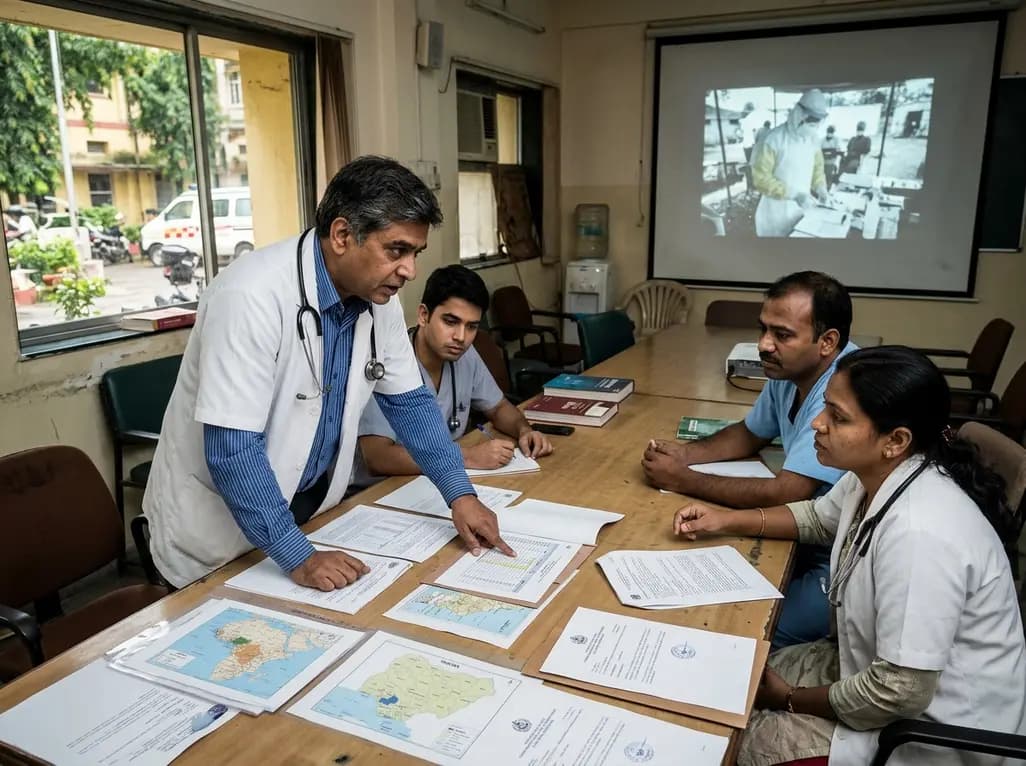
Following Nigeria's first recorded Ebola case linked to regional travel, the Africa CDC has convened an emergency ministerial summit. This alert underscores critical clinical priorities for healthcare professionals, including differentiating early viral infection from malaria, implementing barrier nursing, and triage.
Today

Leucine Rich Bio has introduced South Asia's first comprehensive vaginal microbiome test, BugSpeaks. By profiling microbial dysbiosis, pathogens, and antimicrobial resistance, this next-generation diagnostic platform provides clinicians with deeper insights into recurrent infections, fertility, and reproductive health.
Today

Review how tailored exercise programs benefit frail older patients with heart failure. Explore pathophysiological mechanisms, individualized training prescriptions, and strategies to overcome adherence barriers in clinical practice.
Today

This comparative study evaluates posterior labral tears with and without glenohumeral instability, highlighting distinct demographic patterns, MRI underestimation in stable shoulders, and successful arthroscopic repair outcomes.
Today

A clinical study demonstrates that early intervention with tocilizumab, either as monotherapy or bridged with corticosteroids, achieves significant proptosis reduction and resolves active inflammation in treatment-naive thyroid eye disease.
Today
