.webp&w=384&q=75)

Loading, please wait...
Loading, please wait...

Traditional clinical trial designs usually focus on controlling Type I and Type II errors. However, this narrow focus often ignores the actual economic and clinical value of the data being collected. The value-driven adaptive design offers a pragmatic alternative for modern researchers. By using Bayesian statistics, this method integrates clinical outcomes with health economic data. Consequently, decision-makers can determine if continuing a trial is worth the investment based on the potential to change a health policy or treatment choice.
At each interim analysis, researchers perform a Value of Information (VoI) analysis. Specifically, they calculate the expected net benefit of sampling (ENBS) for the subsequent stages. If the ENBS for the next analysis is low, it suggests that further data collection will not significantly reduce uncertainty. Therefore, the trial can stop early to save valuable resources. This approach is particularly useful in resource-constrained environments where every research investment must yield significant health benefits. The value-driven adaptive design aligns the evidence-generation process with the specific requirements of healthcare payers and clinicians.
Furthermore, the method is highly flexible. It does not require specific distributional assumptions about net benefits, making it applicable to various statistical models. In a recent case study, researchers used this design to compare infant immunoprophylaxis against maternal vaccination for respiratory syncytial virus (RSV). The results demonstrated that this design efficiently identifies the point where additional data collection becomes redundant. By focusing on cost-effectiveness, the model ensures that the trial stays relevant to real-world medical decision-making. Moreover, this framework helps avoid the ethical dilemma of continuing a trial that has already provided enough evidence to inform a decision.
ENBS is a metric that quantifies the monetary value of collecting more data minus the costs of the research itself. It helps determine if the information gained from additional trial participants is worth the expense.
Traditional trials use fixed sample sizes or group sequential rules based on P-values. In contrast, this adaptive design uses Bayesian metrics to stop trials based on the economic value of information to the decision-maker.
Yes, because the framework is flexible to any statistical or decision model, it can be applied across various medical specialties, from oncology to infectious diseases.
Disclaimer: This content is for informational and educational purposes only. It does not constitute medical advice or a substitute for professional consultation. Refer to the latest local and national guidelines for clinical practice.
References
Dymock M et al. A Pragmatic Bayesian Adaptive Trial Design Based on the Value of Information: The Value-Driven Adaptive Design. Med Decis Making. 2026 Mar 13. doi: 10.1177/0272989X261423177. PMID: 41826246.
Flight L, Julious SA. Value-adaptive clinical trial designs for efficient delivery of publicly funded trials. BMC Med. 2021;19(1):128.
"
Read summarized clinical updates, watch expert medical content, and earn CME certifications right from your smartphone.
Open your smartphone camera to scan and install.





This article explores the value-driven adaptive design, a Bayesian method using VoI to optimize clinical trial stopping rules for better cost-effectiveness....
7 months ago
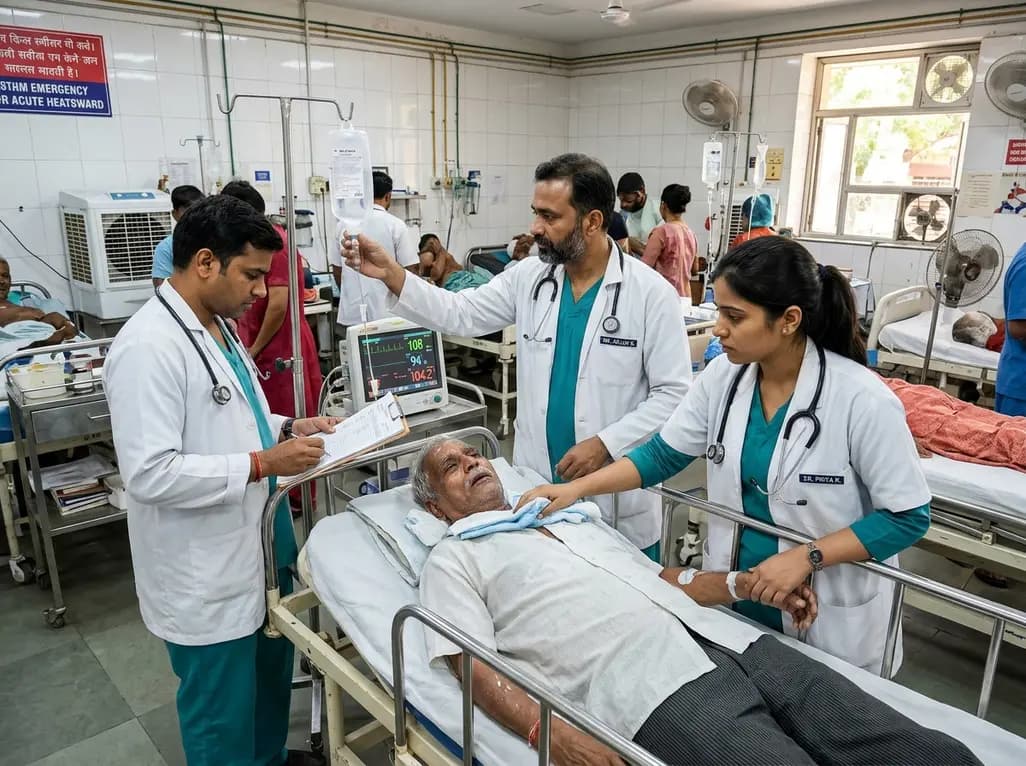
Recent epidemiological data reveals a dramatic surge in summer heat mortality driven by human-induced climate warming. This analysis explores the pathophysiological impacts on cardiac and renal systems, diagnostic dilemmas in death certification, and essential emergency cooling protocols for acute clinical care.
Today

Odisha has established India's first state-level clinical protocol specifically tailored for pregnant women with sickle cell disease. Developed with NHM and UNICEF, the framework provides structured antenatal screening, crisis mitigation, standardized referral pathways, and specialized interdisciplinary care.
Today

India is advancing preventive healthcare by integrating genomics, artificial intelligence, and quantum technologies. With the SANGAM programme sequencing one million Indian genomes, clinicians can unlock personalized therapies, detect cardiometabolic risks early, and curb the burden of diabetes and heart disease.
Today

A randomized controlled trial demonstrates that an eight-week dual-task training intervention significantly improves static and dynamic postural control over standard balance exercises in individuals with chronic ankle instability, addressing critical neurocognitive deficits during athletic and daily activities.
Today

A retrospective cohort study of 7,716 ICU patients from the MIMIC-IV database demonstrates that Gradient Boosting Decision Trees significantly outperform traditional SOFA scores in predicting in-hospital mortality among patients with sepsis and diabetes, with SHAP analysis providing clinical interpretability.
Today
