.webp&w=384&q=75)

Loading, please wait...
Loading, please wait...

Standardizing post-procedural care remains a top priority for interventional cardiologists in India. Specifically, selecting effective TR band deflation protocols helps prevent complications like radial artery occlusion (RAO) and access-site bleeding. A recent randomized controlled trial conducted at King Abdullah Medical City investigated this clinical challenge. The study recruited 207 cardiac patients undergoing trans-radial coronary procedures to identify the most efficient and safest deflation strategy.
The research team compared three distinct approaches to manage hemostasis. Protocol A involved early initiation with long intervals. Protocol B utilized delayed initiation with short intervals. Meanwhile, Protocol C followed a routine, less standardized practice. Although Protocol C achieved the fastest mean removal time of approximately 153 minutes, it also resulted in significantly higher bleeding complications. Specifically, 22.9% of patients in the routine group experienced bleeding, compared to only 11.8% in Protocol A and 15.9% in Protocol B.
Furthermore, the study utilized the patent hemostasis technique across all groups. This method maintains radial artery patency by injecting a small volume of air after detecting a radial pulse via pulse oximetry. Consequently, the incidence of radial artery occlusion remained low across the cohorts. However, the data clearly showed that standardized protocols (A and B) provided a more stable recovery. For instance, only 1.4% of patients in Protocol B reported small hematomas during the second hour of monitoring. This suggests that a more structured approach to air removal minimizes early vascular distress.
Moreover, the researchers emphasized that the timing of the first deflation attempt is critical. Protocol A and Protocol B demonstrated better safety profiles regarding early bleeding within the first hour. In contrast, Protocol C showed a significant increase in bleeding events during this initial window. Therefore, clinicians should consider adopting protocols that balance total compression time with the frequency of air release to optimize patient outcomes and nursing efficiency.
Standardized protocols that utilize either early initiation with longer intervals or delayed initiation with shorter, frequent intervals (Protocols A and B) significantly reduce bleeding rates compared to routine, less structured practices.
The patent hemostasis technique ensures that the radial artery remains open while compression is applied. This approach effectively reduces the risk of radial artery occlusion, which is a common but preventable complication of trans-radial access.
Protocol A starts deflation earlier but uses longer intervals between air removals. Protocol B delays the start of deflation but removes air more frequently in shorter intervals. Both methods appear safer than non-standardized routine protocols.
Disclaimer: This content is for informational and educational purposes only. It does not constitute medical advice or establish a doctor-patient relationship. Always seek the advice of a qualified healthcare provider regarding any medical condition or treatment. Refer to the latest local and national guidelines for clinical practice.
References
Elhihi EA et al. Comparison of Three TR Band Deflation Protocols Following Radial Coronary Procedures: A Prospective Randomized Trial. Catheter Cardiovasc Interv. 2026 Feb 15. doi: 10.1002/ccd.70517. PMID: 41691454.
Maqsood MH et al. Optimal Hemostatic Band Duration After Transradial Angiography or Intervention: Insights From a Mixed Treatment Comparison Meta-Analysis. Circ Cardiovasc Interv. 2023 Feb;16(2):e012781.
Perera R et al. Comparison between two protocols for deflation of the TR band following coronary procedures via the radial route. J Saudi Heart Assoc. 2020 Apr 17;32(2):161-167.

Read summarized clinical updates, watch expert medical content, and earn CME certifications right from your smartphone.
Open your smartphone camera to scan and install.





Research compares early versus delayed TR band deflation protocols to identify the safest approach for radial artery hemostasis post-coronary procedures....
8 months ago

A recent study demonstrates that spinal oxygen sensors do not require mitochondrial electron transport to trigger sympathetic excitation during acute hypoxia, revealing new insights into how mitochondrial oxidative stress modulates autonomic tone in cardiovascular and neurological diseases.
Today

Demanding exhaustive hormonal profiling can inadvertently discourage clinical studies involving females. Methodological standards must align with the specific scientific question to expand, not restrict, equitable evidence for women.
Today

The Directorate General of Health Services directs Indian states to halt the hazardous reuse and reprocessing of single-use medical devices. Discover regulatory implications under the Drugs and Cosmetics Act, critical infection risks, legal liabilities, and operational changes required across clinical specialties.
Today

A novel calcium polyphosphate coacervate enables injectable bone implants with in situ hierarchical porosity via phase separation and gas foaming, significantly enhancing cell proliferation, energy metabolism, and osteogenic differentiation for minimally invasive bone defect repair.
Today
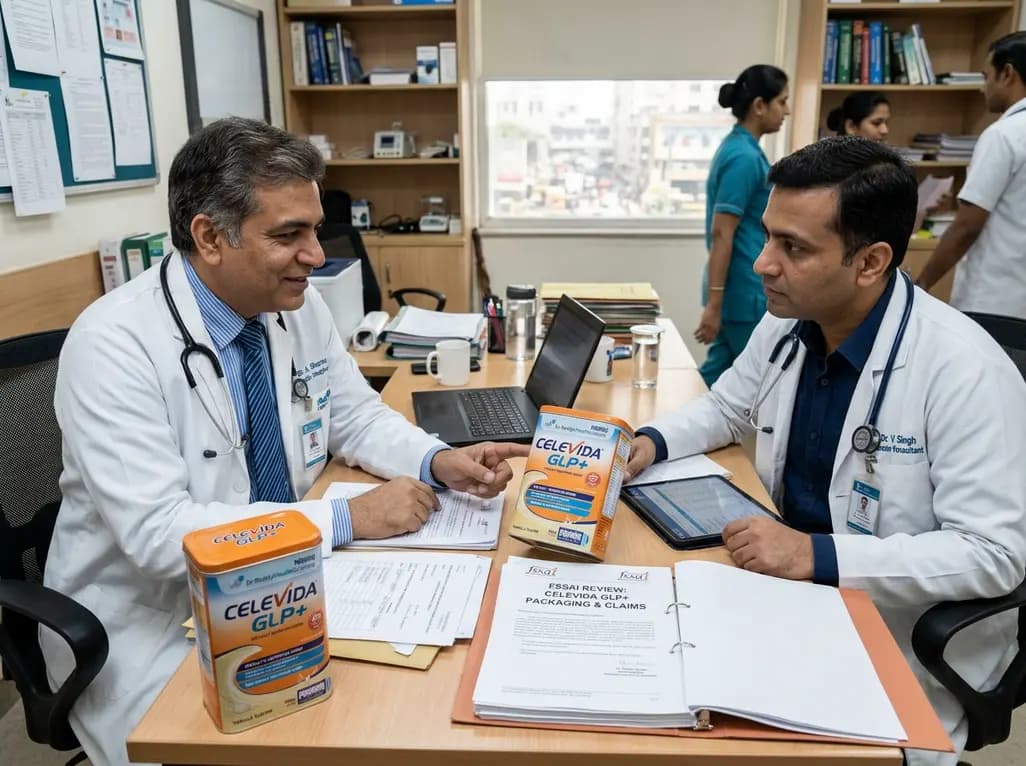
Following regulatory scrutiny from FSSAI regarding promotional representations and lean muscle preservation claims, Dr. Reddy's Laboratories and Nestlé Health Science are currently reviewing the branding and marketing strategy for their joint nutritional supplement Celevida GLP+.
Today
