.webp&w=384&q=75)

Loading, please wait...
Loading, please wait...

The Supreme Court of India recently sought responses from the Union ministries of Health and Consumer Affairs regarding a landmark plea. This petition requests a Consumer Protection Act exemption for medical professionals. Specifically, the Association of Health Care Providers (India) (AHPI) filed a public interest litigation (PIL) to remove doctors from the ambit of the 2019 Act. Currently, the law allows patients to approach consumer courts for allegations of medical negligence. Consequently, the medical fraternity argues that this framework undermines the fiduciary trust essential to healthcare.
The petitioner contends that the current legal structure is philosophically incompatible with medical practice. Unlike commercial transactions with predictable outcomes, medicine involves professional judgment under significant uncertainty. Therefore, the association argues that bringing doctors under consumer law encourages defensive medicine. This practice often leads to unnecessary diagnostic tests and significantly higher healthcare costs for patients. Furthermore, the petition highlights that consumer forums often lack the specialized expertise required to adjudicate complex clinical negligence cases. Most importantly, the AHPI suggests that the National Medical Commission (NMC) provides a more appropriate regulatory framework for monitoring professional conduct.
A central pillar of the argument involves the recent judicial precedent regarding the legal profession. In 2024, the Supreme Court ruled that lawyers provide professional services that fall outside the definition of commercial 'service' under the Act. Notably, the AHPI argues that medical professionals deserve similar treatment due to the noble and fiduciary nature of their work. While the 1995 V.P. Shantha ruling originally brought doctors under consumer law, the petitioners believe this precedent requires urgent reconsideration. Since the legal landscape has evolved, the court has agreed to examine whether healthcare should remain a consumer service. The matter is scheduled for further hearing on April 6.
Q1: Why is the Association seeking a Consumer Protection Act exemption for doctors?
The Association argues that the Act treats medicine as a commercial transaction, which erodes patient trust and forces doctors to practice defensive medicine. They believe professional bodies like the NMC are better suited to handle negligence claims.
Q2: What was the significance of the 1995 V.P. Shantha ruling?
This landmark Supreme Court judgment established that medical services provided for a fee constitute a \"service\" under consumer law. It effectively opened the doors for patients to sue doctors in consumer courts.
Q3: How does the recent exemption for lawyers influence this plea?
The Supreme Court recently exempted advocates from the Act, stating their work is a professional service based on trust. Doctors are now seeking parity, arguing their profession shares the same non-commercial, fiduciary characteristics.
Disclaimer: This content is for informational and educational purposes only. It does not constitute medical advice or replace professional judgment. Refer to the latest local and national guidelines for clinical practice.
References

Read summarized clinical updates, watch expert medical content, and earn CME certifications right from your smartphone.
Open your smartphone camera to scan and install.





The Supreme Court of India has issued notices regarding a PIL to exempt medical professionals from the Consumer Protection Act, citing the 2024 lawyer's rul...
8 months ago
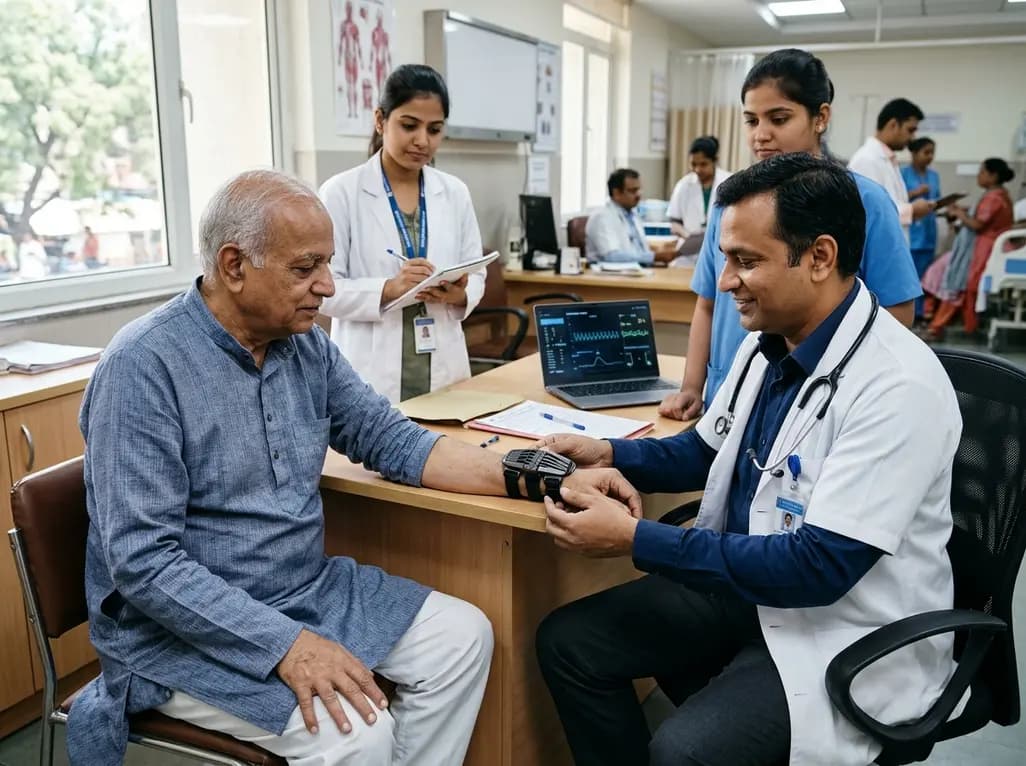
The TREM-AB open-label pilot study evaluated a wearable passive nonlinear vibration absorber for essential tremor. The Nonlinear Energy Sink bracelet reduced clinical Fahn-Tolosa-Marin tremor scores by 32.1% and electrophysiological tremor power by 49.2% with no adverse effects reported.
Today

A population-based study of 20,928 children reveals that small vulnerable newborns face sex-divergent mental capital outcomes at ages 6-7: term SGA girls show higher behavioral difficulties and lower resilience, while preterm non-SGA boys experience increased behavioral problems.
Today
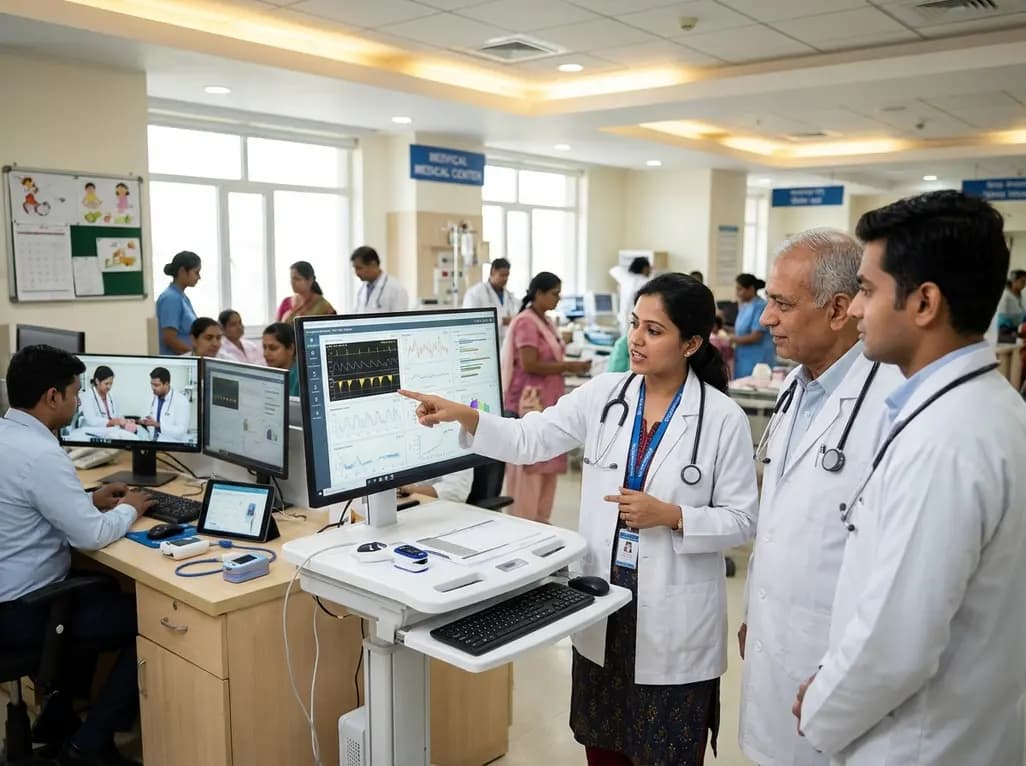
A landmark study details how an enterprise pediatric remote patient management model expanded from a single cardiology pilot to 16 diverse specialty programs by combining centralized digital operations with specialty clinical leadership.
Today

A comparative review of tension band wiring and intramedullary screw fixation in thumb metacarpophalangeal arthrodesis, evaluating union rates, hardware complications, and clinical outcomes.
Today

A breakthrough ultrathin multimodal sensor decouples physical hemodynamic monitoring from disposable electrochemical calibration, achieving long-term wearable glucose prediction with 81.36% accuracy and a 9.12% MARD. This offers a robust, drift-free solution for outpatient metabolic surveillance.
Today
