.webp&w=384&q=75)

Loading, please wait...
Loading, please wait...

The Advanced Centre for Treatment, Research and Education in Cancer (ACTREC) recently reached a significant milestone. By deploying next-generation Spectral CT imaging, this Tata Memorial Centre unit aims to revolutionize early cancer detection in India. This advanced technology addresses the growing cancer burden by providing clinicians with unprecedented diagnostic precision. Consequently, patients may experience fewer diagnostic delays and more targeted treatment plans.
The newly commissioned Spectral CT 7500 captures detailed spectral data during routine scans. This capability allows for deeper disease characterization without increasing the patient's radiation dose. Furthermore, the platform performs comprehensive full-body scans in just two seconds. Therefore, clinicians can make faster decisions in high-volume oncology settings. Clinical studies suggest that this detector-based technology leads to 36 percent fewer follow-up diagnostic procedures. Specifically, it minimizes the need for repeat imaging, which reduces patient anxiety and care timelines.
Beyond its primary role in oncology, the technology offers significant advantages for other medical fields. Notably, it supports cardiology, neurology, and emergency care services. In these areas, rapid clinical assessment often determines patient outcomes. Therefore, the integration of spectral imaging enhances workflow efficiency across multiple hospital departments. This multi-system approach is vital for addressing the rising incidence of complex diseases in India.
Q1: How does Spectral CT imaging improve diagnostic accuracy?
It provides detailed tissue characterization and monochromatic images. This helps clinicians differentiate between similar-looking structures, leading to more precise diagnoses.
Q2: Does Spectral CT imaging increase radiation exposure?
No, the technology captures spectral information during routine scans without adding radiation dose. It actually reduces overall exposure by eliminating the need for many follow-up exams.
Q3: Which departments benefit from this technology?
While primarily used in oncology, it is also highly effective in cardiology, neurology, and emergency medicine for rapid and confident clinical assessments.
Disclaimer: This content is for informational and educational purposes only. It does not constitute medical advice or replace professional judgment. Refer to the latest local and national guidelines for clinical practice.
References

Read summarized clinical updates, watch expert medical content, and earn CME certifications right from your smartphone.
Open your smartphone camera to scan and install.





ACTREC and TMC introduce Spectral CT 7500 to improve diagnostic precision, reduce radiation, and streamline cancer detection pathways in India....
7 months ago
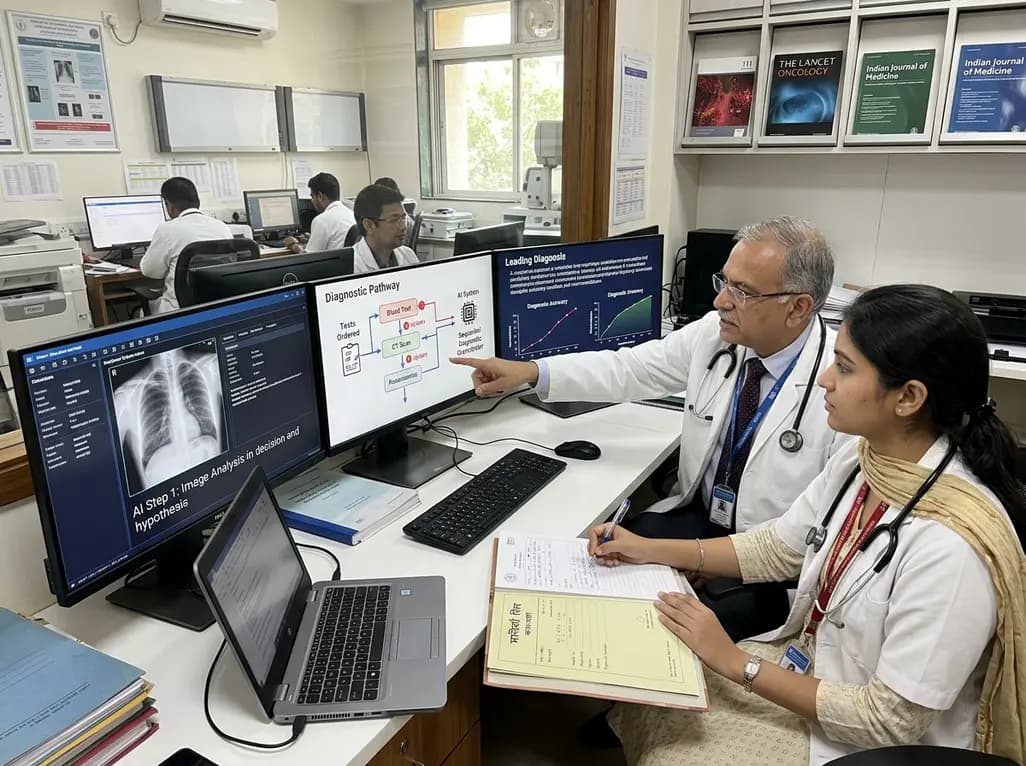
A breakthrough peer-reviewed study demonstrates that a sequential AI diagnosis system can mirror real-world clinical reasoning. By ordering stepwise tests and updating hypotheses dynamically, this multi-agent orchestrator achieved superior diagnostic accuracy while reducing investigative costs.
Today

A prenatal case highlights severe glutaric acidemia type II presenting as bilateral hyperechoic cystic kidneys at 18 weeks. Whole-exome sequencing revealed a novel homozygous ETFDH frameshift variant, demonstrating the power of rapid genetic testing in fetal renal anomalies.
Today

Review how tailored exercise programs benefit frail older patients with heart failure. Explore pathophysiological mechanisms, individualized training prescriptions, and strategies to overcome adherence barriers in clinical practice.
Yesterday

This comparative study evaluates posterior labral tears with and without glenohumeral instability, highlighting distinct demographic patterns, MRI underestimation in stable shoulders, and successful arthroscopic repair outcomes.
Yesterday

A clinical study demonstrates that early intervention with tocilizumab, either as monotherapy or bridged with corticosteroids, achieves significant proptosis reduction and resolves active inflammation in treatment-naive thyroid eye disease.
Yesterday
