.webp&w=384&q=75)

Loading, please wait...
Loading, please wait...

Social drivers of health (SDOH) represent the non-medical factors that influence health outcomes, ranging from economic stability to social support systems. A recent large-scale cross-sectional study compared two significant cohorts of U.S. veterans: the Million Veteran Program (MVP) and the Behavioral Risk Factor Surveillance System (BRFSS). Researchers analyzed data from 2011 to 2023 to determine if these independent research programs produced comparable insights into how social factors affect general health. By evaluating over 1.2 million participants, the study sought to validate the use of SDOH variables in large-scale veteran research.
The study found that differences between the two cohorts were remarkably small across various demographics and health markers. Specifically, the researchers observed standard mean differences (SMD) of less than 0.2 for most variables, including income, education, and partnership status. Furthermore, the risk ratios for favorable versus unfavorable SDOH regarding general health were almost identical between the MVP and BRFSS groups. This consistency suggests that data from these programs are reliable and interchangeable for longitudinal health research.
For clinicians, the primary takeaway is the profound and consistent influence that social context has on a patient\'s perceived health status. In both cohorts, veterans with higher education, stable income, and robust social support reported significantly better health. Consequently, addressing these factors in a clinical setting is not just a matter of social welfare but a vital component of holistic medical care. Specifically, those who lived in larger households or had strong social support systems demonstrated a lower risk of poor health outcomes. Therefore, physicians should consider integrating social screening tools into routine practice to identify non-clinical barriers to recovery.
Ultimately, this research underscores that social drivers of health are not merely secondary variables. Instead, they serve as powerful predictors of clinical outcomes that remain consistent across different populations and research methodologies. Although this study focused on veterans, the underlying principles of economic and social stability apply to patients globally. Recognizing these drivers allows healthcare providers to transition from treating isolated symptoms to managing the comprehensive needs of the individual.
The study focused on demographics, education, income, employment, partnership status, household size, and social support. These factors collectively shaped the reported health status of the veterans involved.
The research demonstrated that SDOH outcomes are highly consistent. Risk ratios for general health in relation to social factors were nearly the same in both the Million Veteran Program and the BRFSS survey data.
Screening allows doctors to identify non-medical barriers, such as financial instability or social isolation, which can hinder treatment adherence and lead to poorer long-term health outcomes.
Disclaimer: This content is for informational and educational purposes only. It does not constitute medical advice, diagnosis, or treatment. Always seek the advice of a qualified healthcare provider with any questions regarding a medical condition. Refer to the latest local and national guidelines for clinical practice.
References
Williams AR et al. Cross-sectional Comparison of Social Drivers of Health in The Million Veteran Program and Behavioral Risk Factor Surveillance System (2011-2023). Mil Med. 2026 Feb 15. doi: undefined. PMID: 41691648.
World Health Organization. Social determinants of health. https://www.who.int/health-topics/social-determinants-of-health.
American Health Information Management Association (AHIMA). Data for Better Health: The Impact of SDOH on Patient Outcomes. 2024-2025 Impact Season.
"
Read summarized clinical updates, watch expert medical content, and earn CME certifications right from your smartphone.
Open your smartphone camera to scan and install.





A cross-sectional study of over 1.2 million veterans reveals how social drivers of health consistently influence health status across research programs....
8 months ago
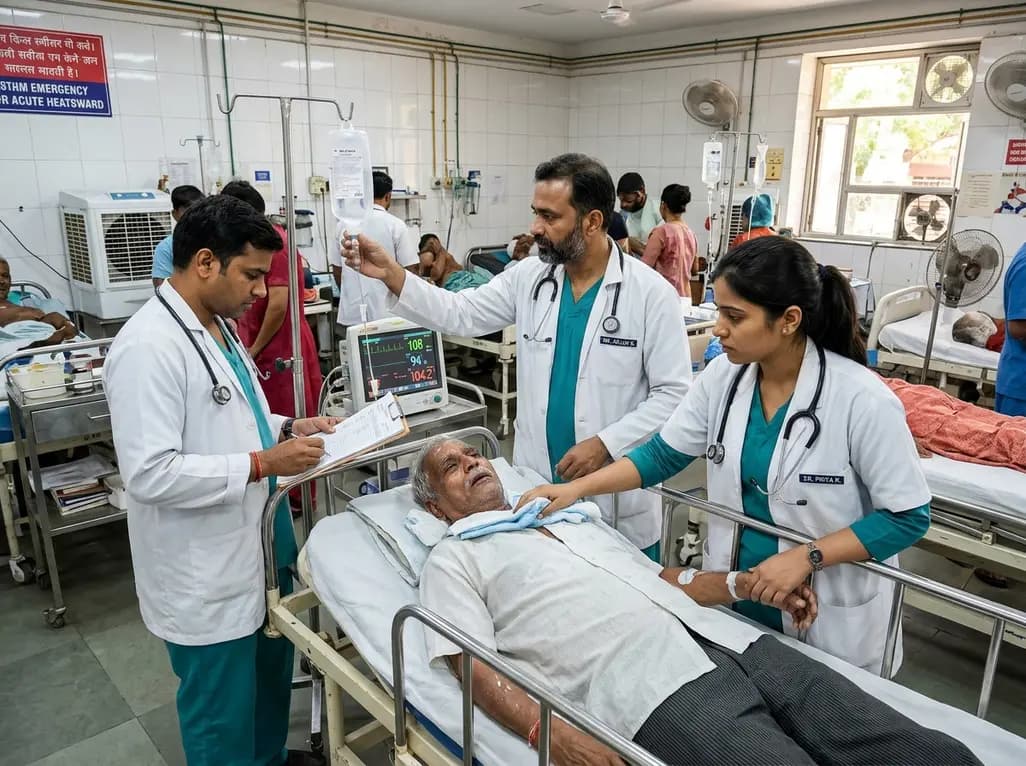
Recent epidemiological data reveals a dramatic surge in summer heat mortality driven by human-induced climate warming. This analysis explores the pathophysiological impacts on cardiac and renal systems, diagnostic dilemmas in death certification, and essential emergency cooling protocols for acute clinical care.
Today

Odisha has established India's first state-level clinical protocol specifically tailored for pregnant women with sickle cell disease. Developed with NHM and UNICEF, the framework provides structured antenatal screening, crisis mitigation, standardized referral pathways, and specialized interdisciplinary care.
Today

India is advancing preventive healthcare by integrating genomics, artificial intelligence, and quantum technologies. With the SANGAM programme sequencing one million Indian genomes, clinicians can unlock personalized therapies, detect cardiometabolic risks early, and curb the burden of diabetes and heart disease.
Today

A randomized controlled trial demonstrates that an eight-week dual-task training intervention significantly improves static and dynamic postural control over standard balance exercises in individuals with chronic ankle instability, addressing critical neurocognitive deficits during athletic and daily activities.
Today

A retrospective cohort study of 7,716 ICU patients from the MIMIC-IV database demonstrates that Gradient Boosting Decision Trees significantly outperform traditional SOFA scores in predicting in-hospital mortality among patients with sepsis and diabetes, with SHAP analysis providing clinical interpretability.
Today
