.webp&w=384&q=75)

Loading, please wait...
Loading, please wait...

Clinicians may soon utilize smartwatch diabetes detection to identify insulin resistance long before traditional tests flag a problem. A recent study by Google Research, published in the journal Nature, presents a scalable framework for analyzing wearable data to predict metabolic risk. Researchers successfully identified insulin resistance in over 1,100 participants by combining smartwatch signals with routine blood biomarkers. This approach offers a continuous view of health, which researchers describe as a \"movie\" rather than a single clinical snapshot.
The study highlights that fasting glucose alone often fails to provide a complete picture of a patient's insulin sensitivity. Consequently, the research team integrated heart rate, sleep patterns, and activity levels from consumer wearables into their predictive models. Specifically, the inclusion of smartwatch data improved detection accuracy from 76% to 88% compared to using lab tests alone. Furthermore, these continuous signals reflect the cumulative demands of metabolic regulation over time. This makes physiological strain visible even when episodic testing appears normal. Therefore, healthcare providers can intervene much earlier in the progression toward type-2 diabetes.
In addition to the predictive model, the researchers developed a large language model agent called the 'IR agent.' This AI tool combines assessment results with lifestyle data to offer holistic metabolic health insights. It provides personalized recommendations to help users manage their diabetes risk effectively. Moreover, the agent utilizes a reason-and-act framework to ensure clinical relevance and factual accuracy. This work establishes a scalable framework for early metabolic risk detection that could reach millions of users. Ultimately, such technology simplifies complex interventions and reduces the long-term burden of metabolic disease.
Q1: How does the framework improve smartwatch diabetes detection?
The framework combines continuous wearable data, such as heart rate and sleep, with routine blood biomarkers and demographics. This multi-dimensional approach captures metabolic fluctuations that single blood tests might miss, significantly increasing the sensitivity of insulin resistance detection.
Q2: What is the 'IR agent' mentioned in the study?
The 'IR agent' is a large language model (LLM) designed to interpret a user's metabolic data. It provides personalized health recommendations and holistic insights into diabetes risk by processing both biomarker results and daily lifestyle signals.
Q3: Can smartwatches replace traditional blood tests for diabetes?
Currently, the framework uses smartwatches to augment routine blood tests rather than replace them. The highest accuracy is achieved when wearable data is combined with biomarkers like fasting glucose and lipid profiles.
Disclaimer: This content is for informational and educational purposes only. It does not constitute medical advice or replace professional judgment. Refer to the latest local and national guidelines for clinical practice.
References

Read summarized clinical updates, watch expert medical content, and earn CME certifications right from your smartphone.
Open your smartphone camera to scan and install.





Google Research introduces a scalable framework using smartwatch data and AI to detect insulin resistance, significantly improving early diabetes risk scree...
7 months ago
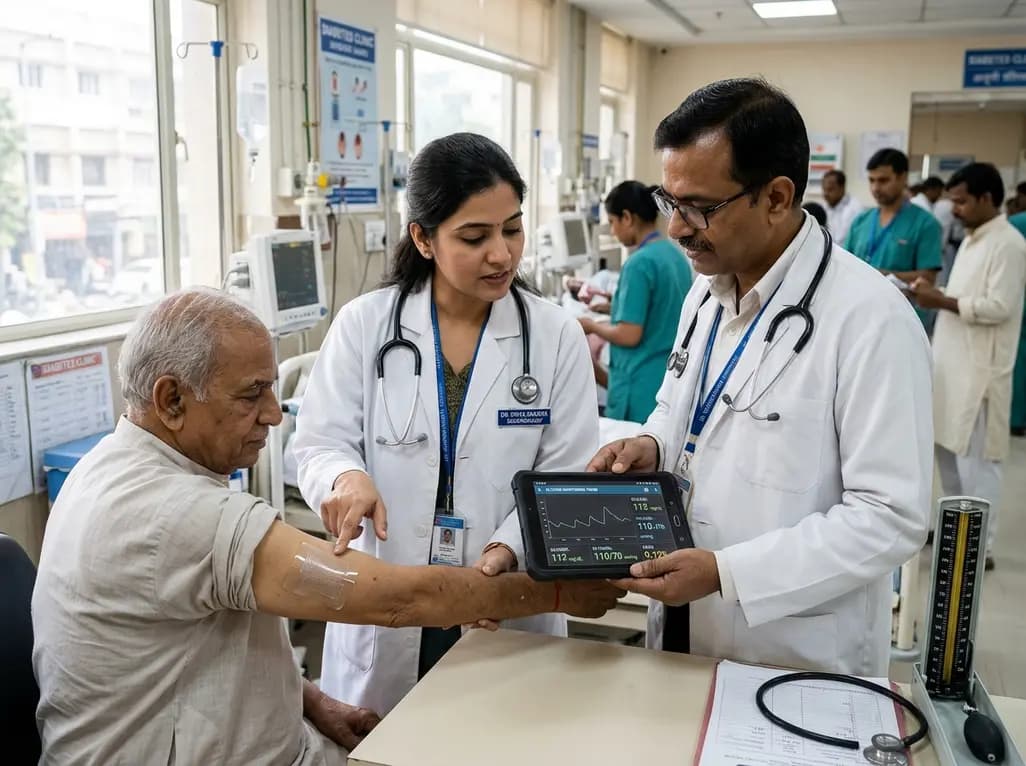
A breakthrough ultrathin multimodal sensor decouples physical hemodynamic monitoring from disposable electrochemical calibration, achieving long-term wearable glucose prediction with 81.36% accuracy and a 9.12% MARD. This offers a robust, drift-free solution for outpatient metabolic surveillance.
Today

A clinical review of menopause and neurology highlights the neurobiological impacts of midlife hormonal shifts on cognition, epilepsy, migraine, multiple sclerosis, and stroke, emphasizing safe hormone therapy prescribing.
Today

Co-administering antiseizure medications and DOACs frequently causes pharmacokinetic interactions, subtherapeutic drug levels, and thromboembolic failures. This review highlights enzyme induction risks, unpredictable outcomes with levetiracetam, and the vital role of therapeutic drug monitoring.
Today

A comparative review of tension band wiring and intramedullary screw fixation in thumb metacarpophalangeal arthrodesis, evaluating union rates, hardware complications, and clinical outcomes.
Today

Following regulatory scrutiny from FSSAI regarding promotional representations and lean muscle preservation claims, Dr. Reddy's Laboratories and Nestlé Health Science are currently reviewing the branding and marketing strategy for their joint nutritional supplement Celevida GLP+.
Today
