.webp&w=384&q=75)

Loading, please wait...
Loading, please wait...

Smartwatch diabetes detection represents a significant leap in preventive medicine. Researchers recently developed a framework to identify early signs of insulin resistance using wearable technology. This approach combines demographic data and blood biomarkers to create a holistic health profile. Consequently, doctors can identify at-risk patients before the onset of clinical symptoms. Smartwatches provide a continuous stream of data, which offers a deeper understanding of metabolic fluctuations over time.
Wearable devices capture continuous physiological signals that episodic testing often misses. For instance, heart rate variability and activity levels reflect metabolic regulation. Scientists analyzed data from over 1,000 participants to predict insulin resistance with high accuracy. They found that traditional fasting glucose tests do not tell the whole story. Therefore, incorporating lifestyle factors into assessments improves clinical outcomes significantly.
The research team also introduced a large language model known as the 'IR agent.' This innovative tool integrates model results with lifestyle data to provide personalized health insights. Furthermore, it helps clinicians and patients understand the cumulative demands of metabolic regulation. Because the system uses consumer-grade wearables, it is highly scalable for population-level screening. Therefore, this method could enable widespread identification of insulin resistance in diverse settings.
By drawing on continuous signals from daily life, the framework highlights physiological strain. This strain remains invisible during standard office visits. Identifying insulin resistance early could possibly enable simpler interventions. Ultimately, this technology reduces the downstream burden of metabolic disease on the healthcare system. The study establishes a path toward proactive rather than reactive medicine.
Q1: Why is fasting glucose alone insufficient for detecting insulin resistance?
Fasting glucose levels provide only a snapshot of metabolic health. In contrast, insulin resistance is influenced by complex lifestyle factors and physiological strains that are invisible to episodic testing.
Q2: How does the 'IR agent' improve patient outcomes?
The 'IR agent' provides holistic insights and personalized recommendations. By combining biomarker data with continuous wearable signals, it allows for timely lifestyle interventions to prevent progression to type-2 diabetes.
Disclaimer: This content is for informational and educational purposes only. It does not constitute medical advice or replace professional judgment. Refer to the latest local and national guidelines for clinical practice.
References

Read summarized clinical updates, watch expert medical content, and earn CME certifications right from your smartphone.
Open your smartphone camera to scan and install.





Google Research presents a scalable framework using smartwatch data and AI to detect early insulin resistance and prevent type-2 diabetes progression....
7 months ago
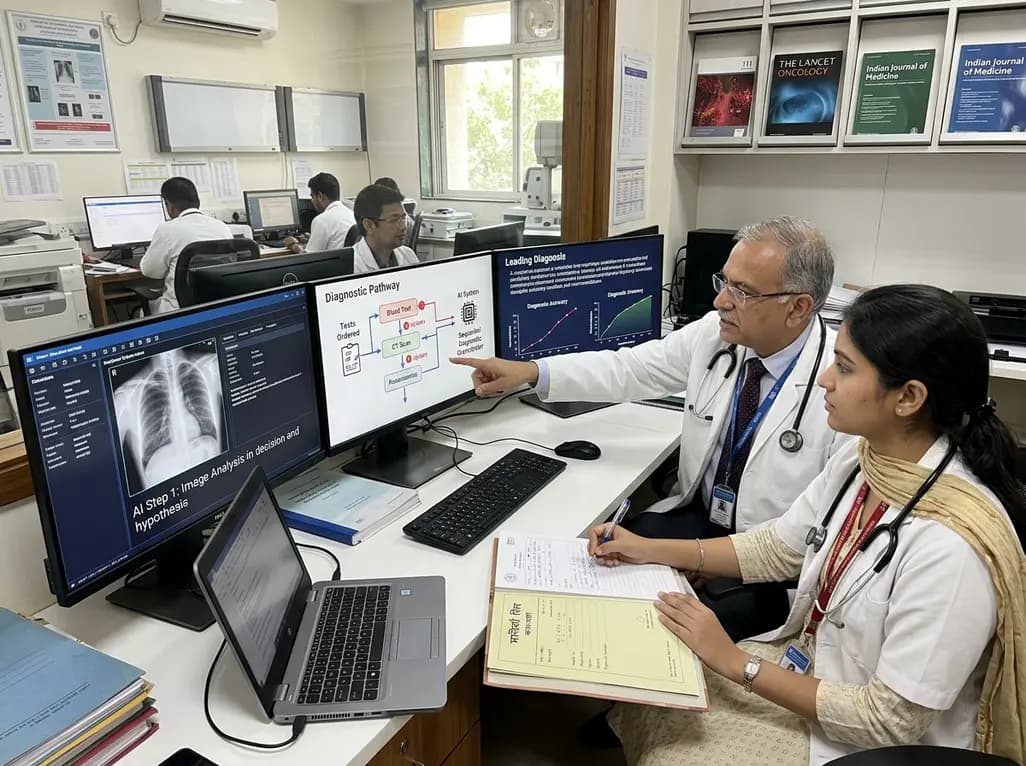
A breakthrough peer-reviewed study demonstrates that a sequential AI diagnosis system can mirror real-world clinical reasoning. By ordering stepwise tests and updating hypotheses dynamically, this multi-agent orchestrator achieved superior diagnostic accuracy while reducing investigative costs.
Today

A prenatal case highlights severe glutaric acidemia type II presenting as bilateral hyperechoic cystic kidneys at 18 weeks. Whole-exome sequencing revealed a novel homozygous ETFDH frameshift variant, demonstrating the power of rapid genetic testing in fetal renal anomalies.
Today

Review how tailored exercise programs benefit frail older patients with heart failure. Explore pathophysiological mechanisms, individualized training prescriptions, and strategies to overcome adherence barriers in clinical practice.
Yesterday

This comparative study evaluates posterior labral tears with and without glenohumeral instability, highlighting distinct demographic patterns, MRI underestimation in stable shoulders, and successful arthroscopic repair outcomes.
Yesterday

A clinical study demonstrates that early intervention with tocilizumab, either as monotherapy or bridged with corticosteroids, achieves significant proptosis reduction and resolves active inflammation in treatment-naive thyroid eye disease.
Yesterday
