.webp&w=384&q=75)

Loading, please wait...
Loading, please wait...

Service robots in nursing are becoming a transformative force in modern healthcare settings. As staffing shortages and increasing patient demands strain clinical environments, automation offers a promising way to support the workforce. A recent study investigated how nursing staff evaluate these robotic systems when they assist with routine inpatient tasks.
Researchers recruited thirty nurses to test a service robot across three distinct scenarios: information services, item delivery, and beverage delivery. Participants alternated roles between caregiver and care recipient during the simulation. Consequently, this allowed for a comprehensive assessment of the robot's performance from multiple perspectives. The results indicated that nurses rated the robot positively across all measured dimensions. Specifically, usability and perceived usefulness received high scores, while skepticism remained notably low.
The study found a strong correlation between a robot's ease of use and the nursing staff's intention to integrate it into their workflow. Furthermore, participants highlighted that the robot could significantly reduce the physical burden of repetitive delivery tasks. Moreover, robots that handle administrative and logistical duties allow nurses to focus more on direct patient interaction. Therefore, these systems do not replace human care but rather enhance the quality of service by optimizing daily operations. However, successful implementation requires a user-centered design approach to ensure the technology meets the specific practical requirements of the ward.
Integrating automation can potentially mitigate professional burnout by removing the 'busy work' that often leads to exhaustion. Additionally, positive attitudes toward robotics increase when staff see tangible benefits in their immediate work environment. Instead of fearing technology, most nurses in the study viewed the robot as a supportive partner. Thus, hospital administrators should consider service robots as a strategic investment to preserve an overextended workforce and improve patient outcomes.
Service robots are designed to handle repetitive and logistical tasks such as delivering beverages, transporting medical supplies, and providing basic information to patients and visitors.
No, robots typically handle mundane tasks that do not require clinical expertise. Consequently, this frees up more time for nurses to provide compassionate, direct care and focus on complex medical decisions.
Recent studies suggest that skepticism is low when robots are usable and clearly beneficial. Most nurses show a strong intention to use service robots if the technology simplifies their daily workflow.
Disclaimer: This content is for informational and educational purposes only and does not constitute medical advice or endorsement of any specific technology. Refer to the latest local and national guidelines for clinical practice.
References
Friese C et al. Nurses' Evaluation of a Service Robot for Inpatient Care: Technology Acceptance Study. JMIR Nurs. 2026 Apr 14. doi: 10.2196/86824. PMID: 41980241.
Khan ZH, et al. Robotics and AI in Healthcare: A Review of Applications and Challenges. Robotics. 2023;12(2):34.
George G. Robotics in Nursing: Purposes, Benefits, Challenges & Future. JournalsPub. 2025 Feb 12.

Read summarized clinical updates, watch expert medical content, and earn CME certifications right from your smartphone.
Open your smartphone camera to scan and install.





A new study reveals that nurses show high acceptance and intention to use service robots for routine inpatient tasks, potentially solving staffing shortages...
6 months ago

A retrospective cohort study of 7,716 ICU patients from the MIMIC-IV database demonstrates that Gradient Boosting Decision Trees significantly outperform traditional SOFA scores in predicting in-hospital mortality among patients with sepsis and diabetes, with SHAP analysis providing clinical interpretability.
Today
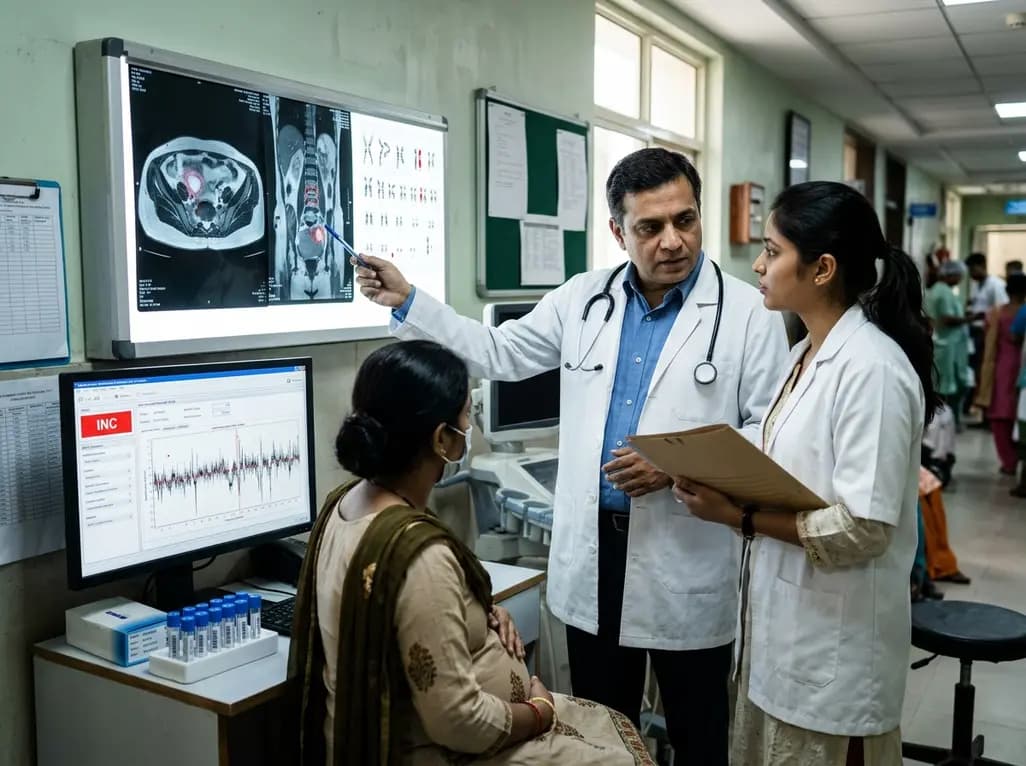
Occult maternal malignancy accounts for 3.82% of persistent unreportable NIPT results with genomic noise. Multiple chromosomal aberrations, notably on chromosome 18, warrant thorough oncological evaluation and whole-body MRI to ensure timely maternal diagnosis while preserving fetal care.
Today

This article reviews the forensic and clinical complexities of acute myocarditis arising on left ventricular hypertrophy in children, highlighting early diagnostic red flags and multidisciplinary postmortem autopsy protocols.
Today

This comparative study evaluates posterior labral tears with and without glenohumeral instability, highlighting distinct demographic patterns, MRI underestimation in stable shoulders, and successful arthroscopic repair outcomes.
Yesterday

A clinical study demonstrates that early intervention with tocilizumab, either as monotherapy or bridged with corticosteroids, achieves significant proptosis reduction and resolves active inflammation in treatment-naive thyroid eye disease.
Yesterday
