.webp&w=384&q=75)

Loading, please wait...
Loading, please wait...

Laparoscopic cholecystectomy remains the gold standard for treating symptomatic gallstones. However, structural misidentification continues to pose a risk for bile duct injuries. Surgeons often rely on specific landmarks to navigate the complex biliary tree safely. One such landmark, Rouviere's sulcus anatomy, has gained significant attention as a reliable extrabiliary reference point that helps define the safe plane of dissection.
A recent longitudinal observational study published in 2026 investigated the visibility and impact of this sulcus on operative metrics. Researchers evaluated 130 cases, including both elective and emergency procedures. They found that surgeons could identify the sulcus in 85.4% of patients. While its presence is common, its absence significantly influenced the initial stages of the procedure, specifically the time required for Calot’s triangle dissection.
Understanding Rouviere's sulcus anatomy is crucial because it indicates the level of the common bile duct. The cystic duct and artery typically lie anterosuperior to the sulcus. Consequently, maintaining dissection above the level of this fissure helps surgeons avoid major biliary structures. The study categorized the morphology into four types: open, slit, scar, and closed. Although these specific shapes did not drastically alter overall operative time, they served as vital visual cues for orientation.
Furthermore, the absence of the sulcus led to a statistically significant increase in the time needed to achieve the Critical View of Safety (CVS). Specifically, the median dissection time rose from 18 minutes when the sulcus was present to 20 minutes when it was absent. Although this difference may seem modest, it underscores the sulcus's role in streamlining surgical flow. Moreover, the study confirmed a strong correlation between dissection time and the total duration of the surgery.
Notably, complications remained low at 4.6% and did not show a direct link to whether the sulcus was visible or not. This suggests that while the sulcus is a helpful guide, it does not replace established safety protocols. Instead, surgeons should use it to complement the Critical View of Safety and other bailout techniques. Ultimately, this anatomical landmark acts as a "safety line" that warns the surgeon when they are straying too close to the common bile duct.
The sulcus is typically classified into four morphological types: open (a deep fissure), slit (a narrow groove), scar (a white fibrous line), and closed. The open type is the most common and provides the clearest orientation for the surgeon.
When the sulcus is absent, surgeons often take longer to dissect Calot’s triangle to reach the Critical View of Safety. However, its absence does not necessarily increase the rate of complications, provided the surgeon uses other landmarks and safety techniques.
Historically, many traditional anatomy textbooks neglected this landmark. Its clinical importance was primarily recognized with the advent of laparoscopic surgery, which provides the magnification and carbon dioxide pressure needed to visualize the sulcus clearly.
Disclaimer: This content is for informational and educational purposes only and does not constitute medical advice or a substitute for professional surgical training. Refer to the latest local and national guidelines for clinical practice.
References
Bandaru SS et al. Rouviere's Sulcus Anatomy and Its Overall Impact on Operative Time and Complications in Laparoscopic Cholecystectomy: A Longitudinal Observational Study. J Laparoendosc Adv Surg Tech A. 2026 Mar 27. doi: 10.1177/10926429261435976. PMID: 41896023.
Cheruiyot I, et al. The prevalence of the Rouviere's sulcus: A meta-analysis with implications for laparoscopic cholecystectomy. Clinical Anatomy. 2021; 34(4):556-564.
Jha AK, et al. Importance of Rouviere's sulcus in laparoscopic cholecystectomy. Annals of African Medicine. 2020; 19(4):274-277.
"
Read summarized clinical updates, watch expert medical content, and earn CME certifications right from your smartphone.
Open your smartphone camera to scan and install.





A 2026 study highlights the importance of Rouviere's sulcus as an extrabiliary landmark to improve safety and dissection time in laparoscopic cholecystectom...
6 months ago

Recent epidemiological data reveals a dramatic surge in summer heat mortality driven by human-induced climate warming. This analysis explores the pathophysiological impacts on cardiac and renal systems, diagnostic dilemmas in death certification, and essential emergency cooling protocols for acute clinical care.
Today

Odisha has established India's first state-level clinical protocol specifically tailored for pregnant women with sickle cell disease. Developed with NHM and UNICEF, the framework provides structured antenatal screening, crisis mitigation, standardized referral pathways, and specialized interdisciplinary care.
Today

India is advancing preventive healthcare by integrating genomics, artificial intelligence, and quantum technologies. With the SANGAM programme sequencing one million Indian genomes, clinicians can unlock personalized therapies, detect cardiometabolic risks early, and curb the burden of diabetes and heart disease.
Today
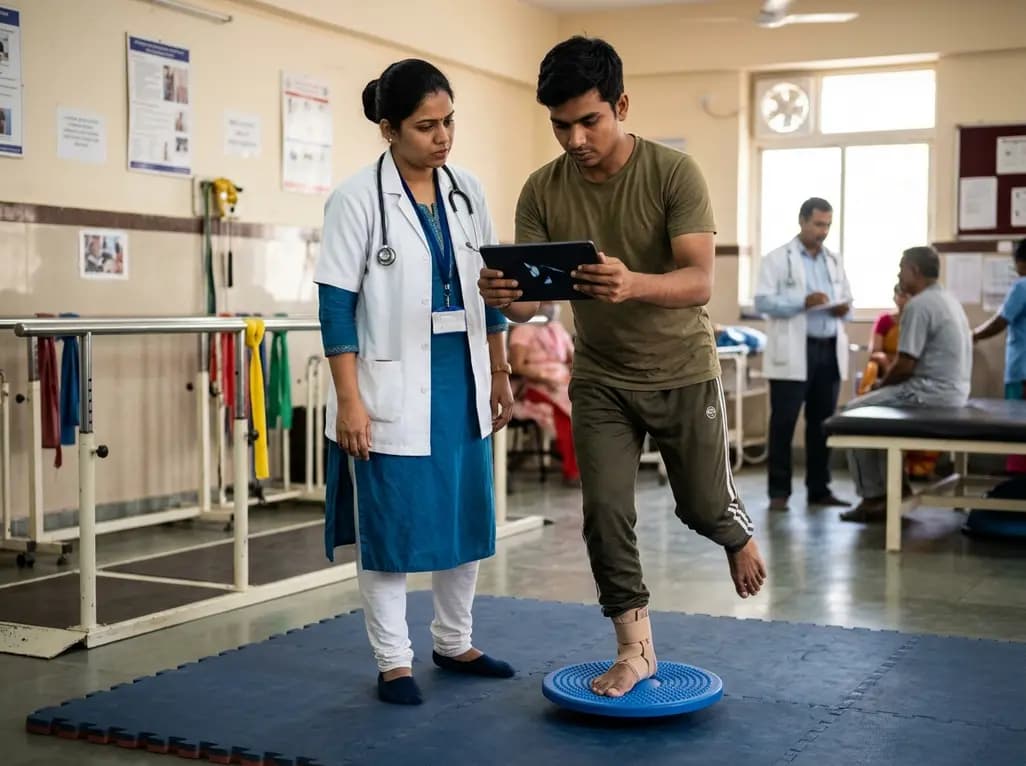
A randomized controlled trial demonstrates that an eight-week dual-task training intervention significantly improves static and dynamic postural control over standard balance exercises in individuals with chronic ankle instability, addressing critical neurocognitive deficits during athletic and daily activities.
Today

A retrospective cohort study of 7,716 ICU patients from the MIMIC-IV database demonstrates that Gradient Boosting Decision Trees significantly outperform traditional SOFA scores in predicting in-hospital mortality among patients with sepsis and diabetes, with SHAP analysis providing clinical interpretability.
Today
