.webp&w=384&q=75)

Loading, please wait...
Loading, please wait...

Plantar pressure gait recognition has emerged as a vital tool for modern biomechanical assessment. Traditional manual feature engineering often struggles with the high-dimensional and nonlinear nature of pressure images. However, modern deep learning offers a robust solution for capturing these complex patterns. Researchers recently evaluated several convolutional neural network (CNN) architectures to determine which model provides the most accurate results for gait identification and classification.
Specifically, the study compared three distinct architectures: a lightweight CNN, an autoencoder (AE)-CNN cascade, and an encoder-augmented CNN. Thirteen healthy volunteers participated in treadmill walking tests while using in-shoe pressure measurement systems to collect frame-wise images. The results demonstrated that the encoder-augmented CNN achieved an impressive F-score of 96.20%. This model significantly outperformed both the lightweight CNN (94.44%) and the cascade model (92.45%), suggesting that integrated representation learning is superior.
Clinical professionals in orthopedics and sports medicine can utilize these AI-driven insights to enhance diagnostic precision. Moreover, plantar pressure gait recognition allows for more objective monitoring of patient recovery and athletic performance over time. The integration of AE-based compression stabilizes training behavior and ensures consistent classification across various walking patterns. While this pilot study focused on healthy individuals, the technology holds immense promise for detecting asymmetries in patients with neurological or musculoskeletal conditions. Future work must validate these models in larger, clinically diverse cohorts to ensure deployment feasibility in real-world healthcare settings.
AI, particularly convolutional neural networks, handles high-dimensional plantar pressure images better than traditional manual methods. These models automatically extract complex, nonlinear features that reflect the unique biomechanical characteristics of an individual's walk.
The encoder-augmented CNN proved most effective, achieving a 96.20% F-score. This specific architecture uses an additional bottleneck layer to refine feature representation, which significantly improves classification stability and performance.
Plantar pressure imaging is a stable modality that directly reflects the forces acting on the foot. It provides detailed spatial and temporal data, making it ideal for identifying gait abnormalities and monitoring orthopedic rehabilitation.
Disclaimer: This content is for informational and educational purposes only. It does not constitute medical advice or a professional relationship. Refer to the latest local and national guidelines for clinical practice.
References
Chang CC et al. Autoencoder-Enhanced Convolutional Neural Networks for Plantar Pressure-Based Gait Pattern Recognition: Model Development and Cross-Validated Evaluation Study. JMIR Form Res. 2026 Apr 21. doi: 10.2196/88488. PMID: 42013453.
Meera R. Foot Pressure Analysis: Advancements, Applications, and Future Directions. Clin Res Foot Ankle. 2025;13:638.
Detels K et al. Clinical Applications of Plantar Pressure Measurement. arXiv preprint. 2024. arXiv:2401.04752.

Read summarized clinical updates, watch expert medical content, and earn CME certifications right from your smartphone.
Open your smartphone camera to scan and install.





A new study demonstrates that encoder-augmented CNNs achieve 96.2% accuracy in recognizing gait patterns through plantar pressure imaging....
6 months ago
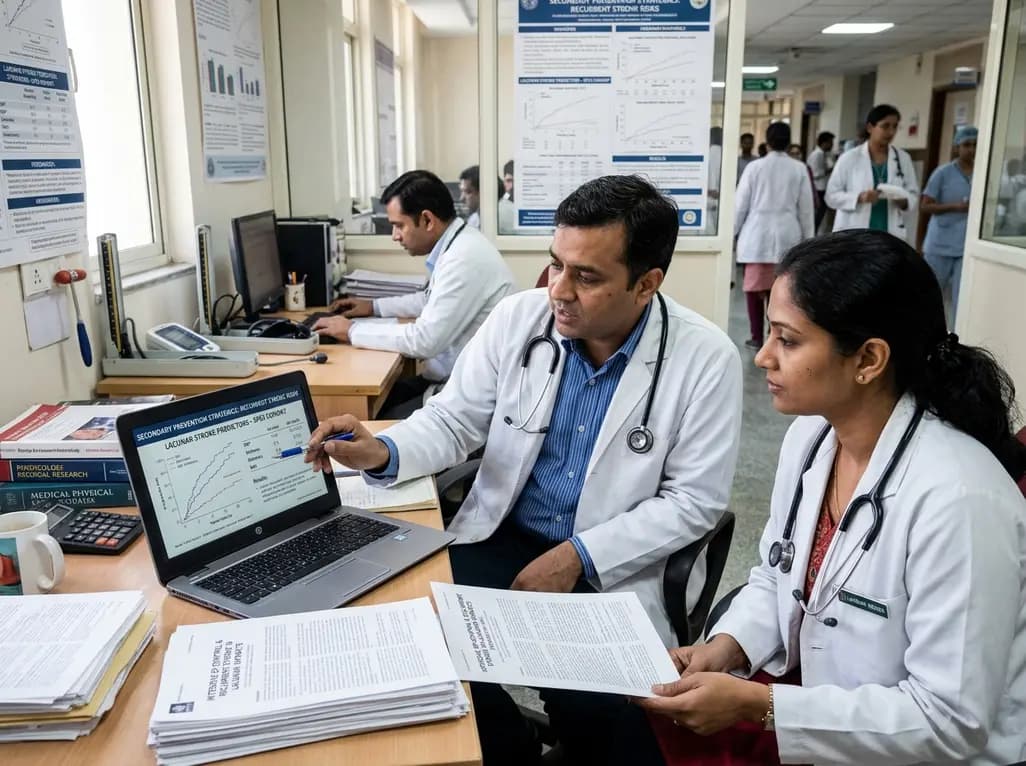
Explore vital recurrent stroke predictors in lacunar stroke patients managed with intensive blood pressure lowering. This analysis examines trial findings from SPS3 to uncover residual vascular risks, metabolic factors, and targeted secondary prevention strategies for high-risk neurological patients.
Today

Odisha has established India's first state-level clinical protocol specifically tailored for pregnant women with sickle cell disease. Developed with NHM and UNICEF, the framework provides structured antenatal screening, crisis mitigation, standardized referral pathways, and specialized interdisciplinary care.
Today

The Directorate General of Health Services directs Indian states to halt the hazardous reuse and reprocessing of single-use medical devices. Discover regulatory implications under the Drugs and Cosmetics Act, critical infection risks, legal liabilities, and operational changes required across clinical specialties.
Today

Mitochondria-targeted nanoparticles self-assembled from EGCG and L-glutamic acid effectively restore mitochondrial homeostasis, suppress synovial inflammation, and attenuate chondrocyte senescence in osteoarthritis, offering a promising disease-modifying nanotherapy.
Today

India is advancing preventive healthcare by integrating genomics, artificial intelligence, and quantum technologies. With the SANGAM programme sequencing one million Indian genomes, clinicians can unlock personalized therapies, detect cardiometabolic risks early, and curb the burden of diabetes and heart disease.
Today
