.webp&w=384&q=75)

Loading, please wait...
Loading, please wait...

Recent advancements in oncology highlight a critical need for early biomarkers to monitor radiation therapy (RT) effectiveness. Specifically, a groundbreaking study suggests that multi-scale photoacoustic imaging (PAI) can accurately predict and detect early responses to treatment. By visualizing tumor oxygenation and vascular architecture in real-time, PAI provides a non-invasive window into biological changes. Consequently, this technology could potentially replace traditional, delayed methods of measuring treatment success, such as monitoring changes in tumor volume. Moreover, the integration of functional imaging allows for a more nuanced understanding of the tumor microenvironment.
The researchers utilized human breast cancer xenograft models to evaluate how tumors respond to different radiation schemes. During the study, they compared hypofractionated delivery with an ablative single-dose approach. Notably, they found that higher pre-treatment oxygenation levels directly correlated with improved clinical outcomes. This observation aligns with the well-known oxygen-enhancement effect, where well-oxygenated tissues respond better to ionizing radiation. Furthermore, PAI can identify which tumors are likely to be radiosensitive or radioresistant before therapy even begins. Because of this, clinicians may soon have a tool to personalize treatment plans based on real-time physiological data.
In addition to oxygenation, the study revealed that different radiation regimens produce unique vascular footprints. For instance, ablative radiation caused an early "pruning" of looping vessels within the first 24 hours post-treatment. In contrast, only hypofractionated radiation led to a significant rise in intratumoral oxygenation at the study's endpoint. This rise indicates a reduction in oxygen consumption by damaged tumor cells, which serves as a functional marker of success. Because PAI captures these shifts so early, it offers a promising tool for monitoring Photoacoustic Imaging RT Response effectively. Additionally, the multi-scale nature of PAI ensures that both superficial and deep vascular structures are assessed accurately.
The ability to monitor the tumor vascular response to RT enables clinicians to adapt treatments more rapidly. If a tumor shows signs of radioresistance through PAI, doctors might consider intensifying the dose or switching to alternative therapies. However, current standards of care often wait weeks for anatomical changes to appear. By providing a multi-scale view of the tumor's physiological state, this imaging modality bridges the gap between anatomy and function. Overall, PAI stands out as a transformative diagnostic tool that could redefine success in radiation oncology.
The primary biomarkers include tumor oxygenation levels, vascular density, and oxygen-diffusion capacity. Specifically, higher pre-RT oxygenation is a strong predictor of a positive response to radiation.
Unlike traditional imaging that relies on delayed changes in tumor size, PAI detects functional and vascular changes within 24 hours of treatment. It uses non-ionizing laser pulses to provide high-resolution data on blood volume and oxygen saturation.
Yes, research shows that PAI can identify regimen-specific effects, such as the early pruning of vessels in ablative therapy versus changes in oxygen consumption during hypofractionated treatment.
Disclaimer: This content is for informational and educational purposes only. It does not constitute medical advice, diagnosis, or treatment. Always seek the advice of a qualified healthcare provider with any questions regarding a medical condition. Refer to the latest local and national guidelines for clinical practice.
References
Lefebvre TL et al. Early Radiation Therapy Response Assessment Using Multi-Scale Photoacoustic Imaging. Adv Sci (Weinh). 2026 Mar 09. doi: 10.1002/advs.202509268. PMID: 41801228.
Mallidi S et al. The Potential of Photoacoustic Imaging in Radiation Oncology. Front Oncol. 2015;5:240. doi: 10.3389/fonc.2015.00240.
Attia AB et al. The emerging role of photoacoustic imaging in clinical oncology. Nat Rev Clin Oncol. 2019;16(12):725-746. doi: 10.1038/s41571-019-0214-z.

Read summarized clinical updates, watch expert medical content, and earn CME certifications right from your smartphone.
Open your smartphone camera to scan and install.





Multi-scale photoacoustic imaging identifies early biomarkers for radiation therapy response, offering a non-invasive way to monitor tumor oxygenation....
7 months ago

A retrospective cohort study reveals that frailty quadruples the odds of pressure injuries in hospitalized older adults. Integrating the Clinical Frailty Scale with comprehensive geriatric care is crucial for identifying vulnerability early and implementing targeted multidisciplinary prevention.
Today
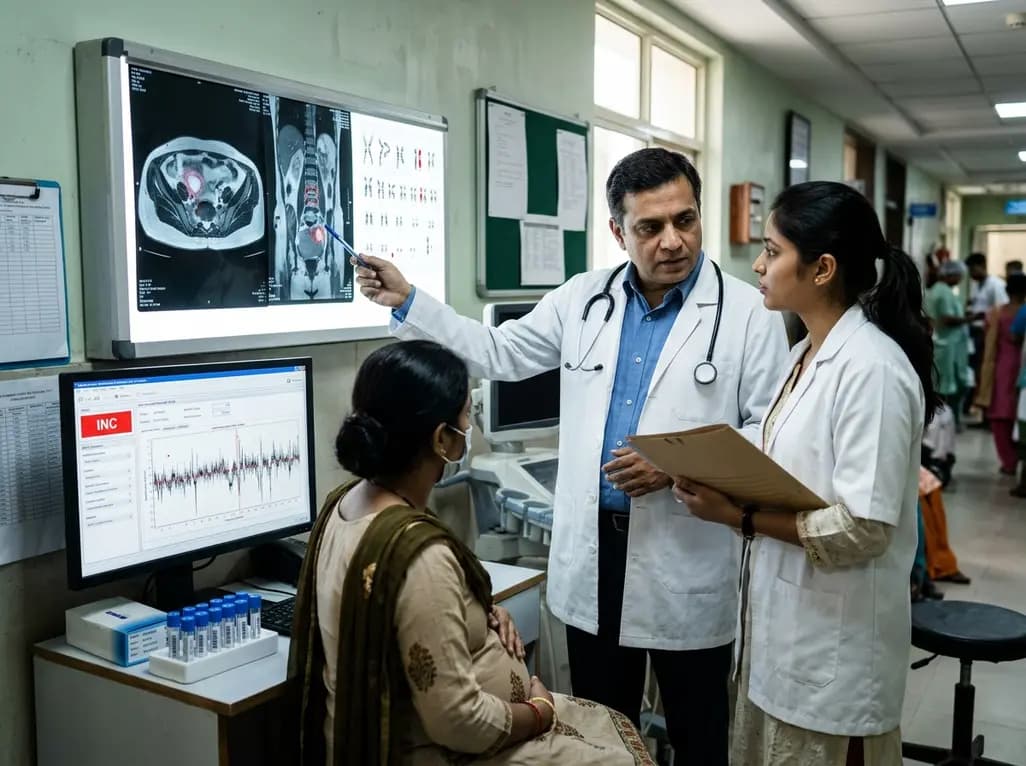
Occult maternal malignancy accounts for 3.82% of persistent unreportable NIPT results with genomic noise. Multiple chromosomal aberrations, notably on chromosome 18, warrant thorough oncological evaluation and whole-body MRI to ensure timely maternal diagnosis while preserving fetal care.
Today

This article reviews the forensic and clinical complexities of acute myocarditis arising on left ventricular hypertrophy in children, highlighting early diagnostic red flags and multidisciplinary postmortem autopsy protocols.
Today

A randomized controlled trial demonstrates that an eight-week dual-task training intervention significantly improves static and dynamic postural control over standard balance exercises in individuals with chronic ankle instability, addressing critical neurocognitive deficits during athletic and daily activities.
Today

A retrospective cohort study of 7,716 ICU patients from the MIMIC-IV database demonstrates that Gradient Boosting Decision Trees significantly outperform traditional SOFA scores in predicting in-hospital mortality among patients with sepsis and diabetes, with SHAP analysis providing clinical interpretability.
Today
