.webp&w=384&q=75)

Loading, please wait...
Loading, please wait...

India faces a major public health crisis due to a projected surge in Parkinson's disease India cases. Experts at the 6th International Annual Symposium-2026 in Kerala delivered a stark warning. They now expect India to become the country with the second-highest number of Parkinson's patients globally within five years. Ultimately, this alarming projection highlights a critical and growing neurological challenge for the nation. Consequently, the King's Parkinson's Research Alliance India (PRAI) symposium brought together global experts to discuss emerging challenges and innovative care.
Parkinson's disease is traditionally an older population ailment. However, symposium experts noted increasing diagnoses among younger individuals in Southeast Asia, including India. Therefore, the issue of young-onset Parkinson's (YOPD) is a known regional concern. This trend creates unique social, economic, and healthcare challenges for working-age patients. Furthermore, India’s current prevalence rate is 15-43 per 100,000. Experts project cases will increase significantly by 2030.
A significant portion of Indian cases are early-onset. Specifically, about 40 to 45% occur between the ages of 22 and 49. The average onset age is roughly 51 years. Doctors link the disease surge to several environmental and lifestyle factors. These include increased industrialisation, worsening air pollution, and changing lifestyles. Additionally, specific factors in North India—such as male gender, genetic history, and head injuries—show an association with a higher prevalence. This progressive neurodegenerative disorder, the second most common in adults over 60, demands enhanced public health policies.
Speakers at the symposium strongly emphasised the need for early diagnosis. Moreover, they called for region-specific research and affordable treatment options tailored to the Indian population. The event also highlighted emerging therapies and technological innovations set to transform Parkinson's treatment. Vinod Mehta, a Movement Disorders specialist, stressed the importance of empowering patients and caregivers. He stated that plenty of treatment options and novel therapies are now available.
King's College Hospital London, in collaboration with PRAI, is currently developing new technologies, like a treatment patch. This innovation must be made affordable through local manufacturing. Currently, patients sometimes pay ₹1 lakh per month for advanced treatments. Conversely, local manufacturing could potentially drop the cost to ₹1,000 per month, benefiting millions. International collaboration and supportive public health policies can dramatically reduce treatment costs. Additionally, researchers noted that Indian populations present a unique genetic landscape, including the p.Leu444Pro mutation, which is linked to earlier onset. Ultimately, long-term strategies require training healthcare professionals, strengthening research infrastructure, and increasing public awareness.
Q1: Why is India expected to see a Parkinson's disease surge?
India is projected to become the country with the second-highest number of Parkinson's cases globally within five years. The surge is linked to factors like increased industrialisation, air pollution, changing lifestyles, and a high rate of young-onset cases.
Q2: What is the primary challenge regarding Parkinson's treatment affordability in India?
The high cost of advanced treatments, sometimes reaching ₹1 lakh per month, poses a major barrier to care. Experts believe local manufacturing of novel therapies, such as a new treatment patch, could reduce this cost to as low as ₹1,000 per month.
Q3: What percentage of Parkinson's cases in India are considered early-onset?
Approximately 40-45% of Indian cases are classified as early-onset, occurring in individuals between the ages of 22 and 49.
Disclaimer: This content is for informational and educational purposes only. It does not constitute medical advice or replace professional judgment. Refer to the latest local and national guidelines for clinical practice.
References

Read summarized clinical updates, watch expert medical content, and earn CME certifications right from your smartphone.
Open your smartphone camera to scan and install.





Experts warn that India will soon have the world's 2nd-highest number of Parkinson's disease cases, with a significant rise in young-onset PD linked to envi...
8 months ago
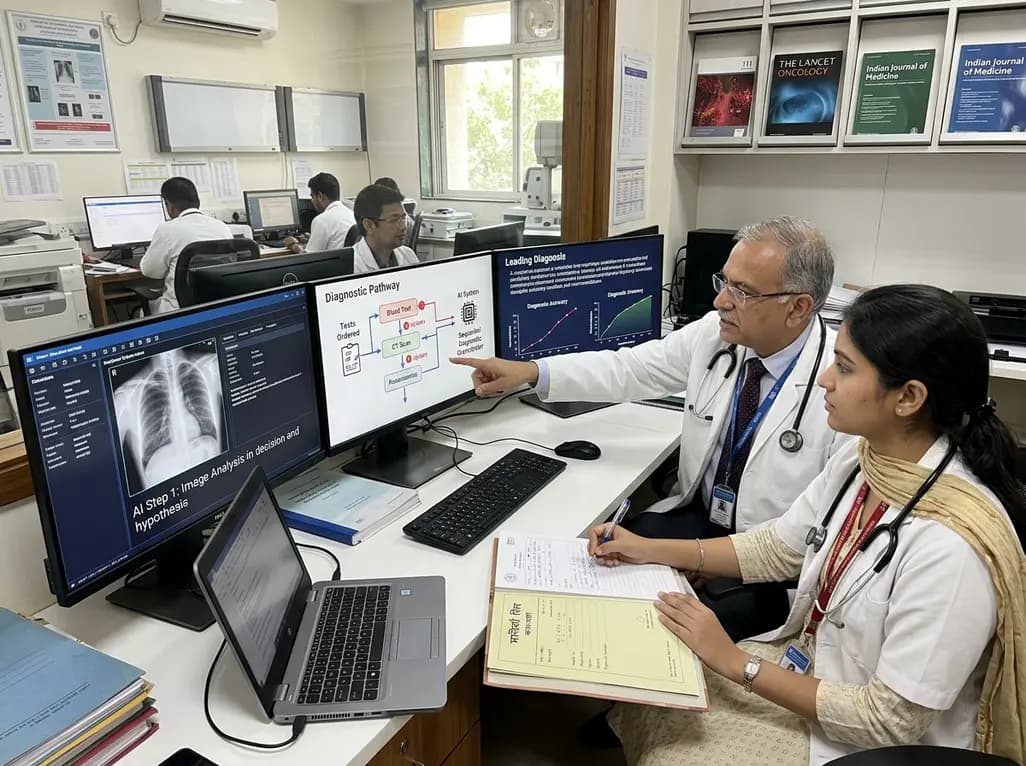
A breakthrough peer-reviewed study demonstrates that a sequential AI diagnosis system can mirror real-world clinical reasoning. By ordering stepwise tests and updating hypotheses dynamically, this multi-agent orchestrator achieved superior diagnostic accuracy while reducing investigative costs.
Today

A prenatal case highlights severe glutaric acidemia type II presenting as bilateral hyperechoic cystic kidneys at 18 weeks. Whole-exome sequencing revealed a novel homozygous ETFDH frameshift variant, demonstrating the power of rapid genetic testing in fetal renal anomalies.
Today

Review how tailored exercise programs benefit frail older patients with heart failure. Explore pathophysiological mechanisms, individualized training prescriptions, and strategies to overcome adherence barriers in clinical practice.
Yesterday

This comparative study evaluates posterior labral tears with and without glenohumeral instability, highlighting distinct demographic patterns, MRI underestimation in stable shoulders, and successful arthroscopic repair outcomes.
Yesterday

A clinical study demonstrates that early intervention with tocilizumab, either as monotherapy or bridged with corticosteroids, achieves significant proptosis reduction and resolves active inflammation in treatment-naive thyroid eye disease.
Yesterday
