.webp&w=384&q=75)

Loading, please wait...
Loading, please wait...

Modern hospitals rely heavily on Electronic Health Record (EHR) systems to safeguard patients and streamline care. However, managing alert fatigue has become a critical challenge for healthcare leaders today. When clinicians receive a constant stream of notifications, they may become desensitized to important warnings. This phenomenon not only impacts clinician well-being but also poses a significant threat to patient safety.
A recent qualitative study involving junior doctors across Australia highlights that alert fatigue is not a simple binary state. Instead, it occurs on a continuum of information processing. Researchers found that doctors often miss alerts entirely or process them using superficial mental shortcuts. Furthermore, the cognitive effort required to interpret complex or irrelevant alerts leads to significant frustration and time loss. Consequently, when doctors are overwhelmed, they are more likely to bypass critical information that could prevent medical errors.
Several system-level factors contribute to the exhaustion clinicians feel. The clinical relevance of an alert is the primary driver of fatigue; many systems trigger warnings for minor issues that do not require immediate action. Additionally, institutional norms and high workloads exacerbate the problem. Information overload from multiple sources, including bedside monitors and administrative tasks, further depletes the mental resources of healthcare providers. Similarly, individual factors such as a doctor's mood, personality, and level of experience influence how they respond to digital interruptions.
To improve patient safety, hospitals must adopt tailored interventions that address technical and organizational causes. Technical improvements, such as tiered alerts, can filter out clinically insignificant data so that only high-priority warnings reach the clinician. Moreover, changing organizational practices, like customizing alert settings for specific hospital units, can significantly reduce background noise. Healthcare organizations should also encourage a culture where clinicians can provide feedback on system usability. Ultimately, reducing the volume of non-actionable alerts allows doctors to focus their cognitive resources on high-priority patient needs.
Alert fatigue is the state where healthcare providers become desensitized to safety alerts due to the high volume of notifications. This often leads to clinicians ignoring or override both critical and non-critical warnings.
When clinicians are overwhelmed by excessive alerts, they may fail to detect life-threatening warnings. This desensitization can result in medication errors, delayed treatments, and missed opportunities for early intervention.
Yes, customizing alert parameters based on specific patient needs or hospital units can reduce irrelevant noise. Tailoring systems ensures that clinicians only receive notifications that are clinically relevant to their current task.
Disclaimer: This content is for informational and educational purposes only. It does not constitute medical advice or establish a doctor-patient relationship. Always seek the advice of a qualified healthcare provider regarding a medical condition or health goals. Refer to the latest local and national guidelines for clinical practice.
References
Newton N et al. Experiences of Alert Fatigue and Its Contributing Factors in Hospitals: Qualitative Study. J Med Internet Res. 2026 Feb 19. doi: 10.2196/78676. PMID: 41712958.
Spok Inc. (2025). 7 ways to reduce alert fatigue in hospitals. Available at: https://www.spok.com/blog/7-ways-to-reduce-alert-fatigue-in-hospitals/
Agency for Healthcare Research and Quality (AHRQ). (2024). Alert Fatigue. Patient Safety Network. Available at: https://psnet.ahrq.gov/primer/alert-fatigue
"
Read summarized clinical updates, watch expert medical content, and earn CME certifications right from your smartphone.
Open your smartphone camera to scan and install.





A qualitative study explores the impact of alert fatigue on junior doctors and offers strategies to reduce sensory overload in hospital settings....
8 months ago
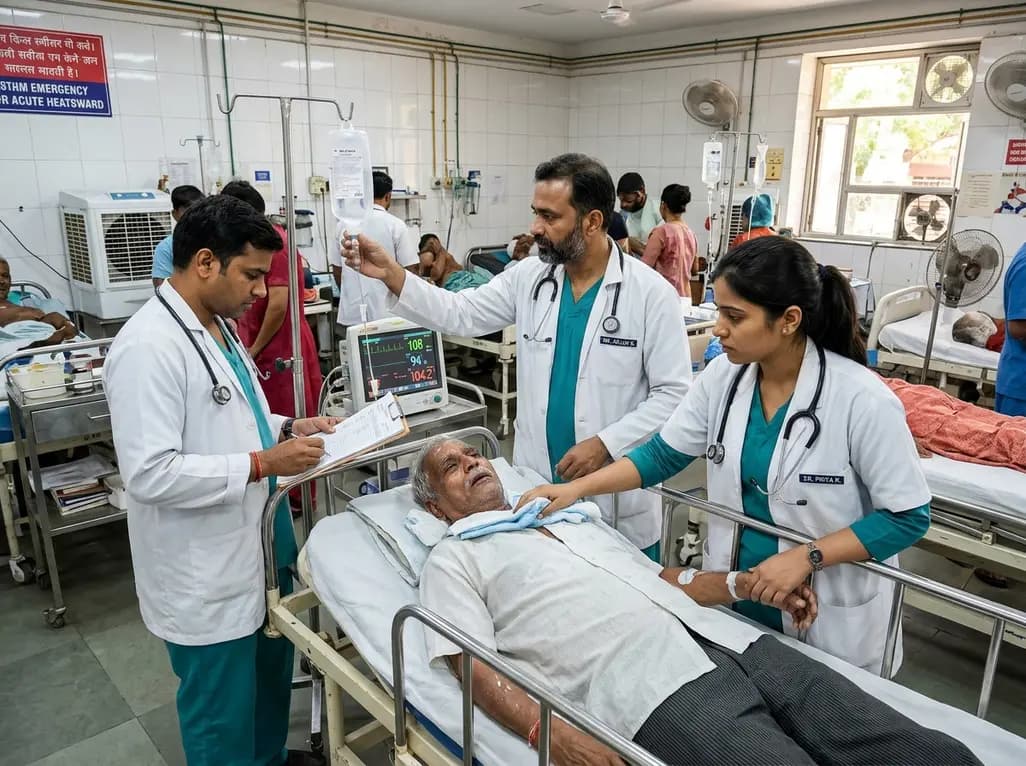
Recent epidemiological data reveals a dramatic surge in summer heat mortality driven by human-induced climate warming. This analysis explores the pathophysiological impacts on cardiac and renal systems, diagnostic dilemmas in death certification, and essential emergency cooling protocols for acute clinical care.
Today

Odisha has established India's first state-level clinical protocol specifically tailored for pregnant women with sickle cell disease. Developed with NHM and UNICEF, the framework provides structured antenatal screening, crisis mitigation, standardized referral pathways, and specialized interdisciplinary care.
Today

India is advancing preventive healthcare by integrating genomics, artificial intelligence, and quantum technologies. With the SANGAM programme sequencing one million Indian genomes, clinicians can unlock personalized therapies, detect cardiometabolic risks early, and curb the burden of diabetes and heart disease.
Today

A randomized controlled trial demonstrates that an eight-week dual-task training intervention significantly improves static and dynamic postural control over standard balance exercises in individuals with chronic ankle instability, addressing critical neurocognitive deficits during athletic and daily activities.
Today

A retrospective cohort study of 7,716 ICU patients from the MIMIC-IV database demonstrates that Gradient Boosting Decision Trees significantly outperform traditional SOFA scores in predicting in-hospital mortality among patients with sepsis and diabetes, with SHAP analysis providing clinical interpretability.
Today
