.webp&w=384&q=75)

Loading, please wait...
Loading, please wait...

Integrating lung cancer screening biomarkers into clinical practice represents a significant shift toward non-invasive early detection. In Aotearoa New Zealand, researchers recently explored Māori views on providing blood samples for these screening programs. Consequently, the findings offer vital insights into how clinicians can design more equitable and trusted healthcare services for indigenous populations. Specifically, the study surveyed potential screenees and their whānau (support people) in the Northland and Auckland regions.
The research demonstrated that most participants were comfortable with blood donation for screening purposes. Over 80% of both potential screenees and whānau supported the use of blood biomarkers. However, participants emphasized the need for transparent communication regarding how their samples would be used. Furthermore, protecting the health of future generations remained a primary motivator for participation. Therefore, any future rollout of biomarker-based screening must prioritize whānau-centered benefits and tissue sovereignty.
Interestingly, the study highlighted regional variations in comfort levels. Those in Te Tai Tokerau expressed slightly more hesitation compared to participants in Tāmaki Makaurau. This underscores that a \"one-size-fits-all\" approach rarely succeeds in community health. Instead, clinicians should foster localized partnerships and culturally safe engagement processes. In countries like India, which also feature diverse cultural landscapes and a high lung cancer burden, these principles of community trust are equally essential for screening success.
The transition from traditional Low-Dose CT (LDCT) to a two-step model involving lung cancer screening biomarkers could reduce the burden on radiology departments. In India, where tuberculosis often causes false positives on CT scans, liquid biopsies and protein panels offer a promising adjunct. Nevertheless, the successful implementation of these tools relies on managing potential harms and ensuring Indigenous data sovereignty. Moving forward, health systems must uphold Māori principles like community partnership and the return of direct benefits to families.
Biomarkers, such as circulating tumor DNA or specific proteins, provide a non-invasive way to identify high-risk individuals. They can act as a pre-screening tool to determine who needs a follow-up LDCT scan, potentially reducing unnecessary radiation exposure and healthcare costs.
Tissue and data sovereignty refers to the right of Indigenous communities to manage, control, and protect their biological samples and health data. This includes having a say in how research findings are shared and ensuring that samples are not used for unauthorized purposes.
Regional differences often stem from varying levels of historical trust in the healthcare system and differences in access to local health resources. The study suggests that engagement strategies must be tailored to the specific needs and cultural context of each community.
Disclaimer: This content is for informational and educational purposes only and does not constitute medical advice or a professional relationship. Always seek the advice of a qualified healthcare provider for any medical condition. Refer to the latest local and national guidelines for clinical practice.
References
Colhoun S et al. The use of blood biomarkers in lung cancer screening in Aotearoa New Zealand: a cross-sectional survey of Māori perspectives and preferences. N Z Med J. 2026 Apr 17. doi: 10.26635/6965.7273. PMID: 41990380.
JAPI. Expert Opinion Statement on Screening for Lung Cancer in India. J Assoc Physicians India. 2024 May 1. Available from: https://www.japi.org.
Cranfield University. New low-cost sensor for lung cancer biomarkers shows promise. ScienceDaily. 2025 Feb 6. Available from: https://www.sciencedaily.com.
"
Read summarized clinical updates, watch expert medical content, and earn CME certifications right from your smartphone.
Open your smartphone camera to scan and install.





A cross-sectional survey explores Māori views on lung cancer screening biomarkers, highlighting the need for cultural safety and community partnership....
6 months ago
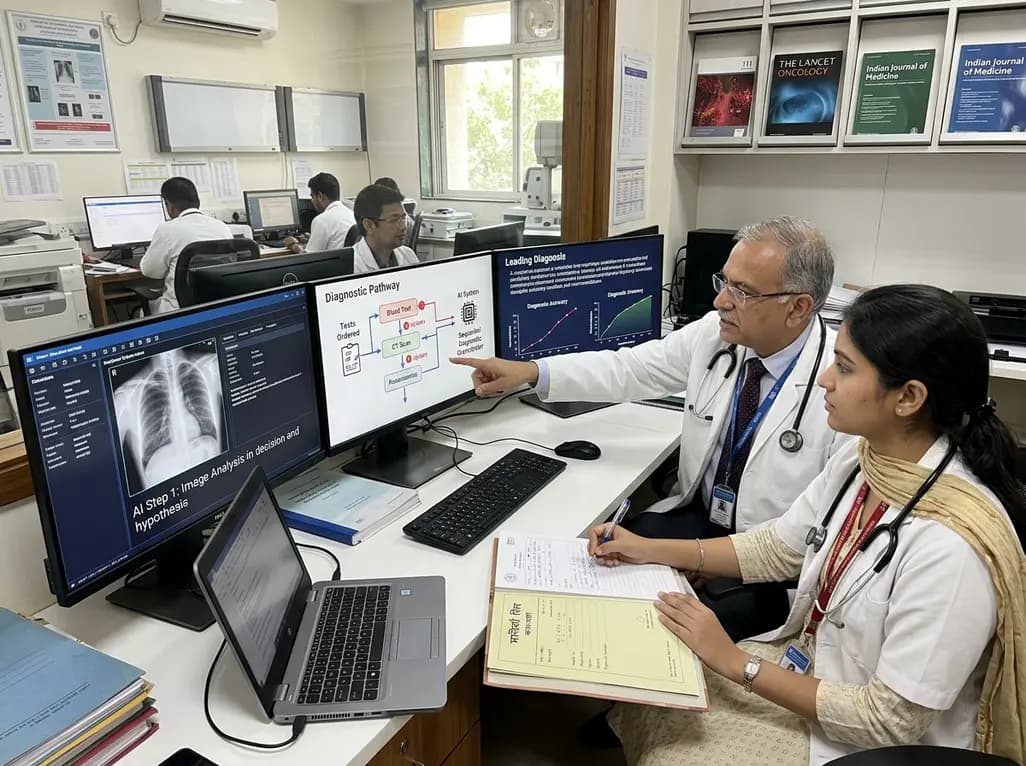
A breakthrough peer-reviewed study demonstrates that a sequential AI diagnosis system can mirror real-world clinical reasoning. By ordering stepwise tests and updating hypotheses dynamically, this multi-agent orchestrator achieved superior diagnostic accuracy while reducing investigative costs.
Today

A prenatal case highlights severe glutaric acidemia type II presenting as bilateral hyperechoic cystic kidneys at 18 weeks. Whole-exome sequencing revealed a novel homozygous ETFDH frameshift variant, demonstrating the power of rapid genetic testing in fetal renal anomalies.
Today

Review how tailored exercise programs benefit frail older patients with heart failure. Explore pathophysiological mechanisms, individualized training prescriptions, and strategies to overcome adherence barriers in clinical practice.
Yesterday

This comparative study evaluates posterior labral tears with and without glenohumeral instability, highlighting distinct demographic patterns, MRI underestimation in stable shoulders, and successful arthroscopic repair outcomes.
Yesterday

A clinical study demonstrates that early intervention with tocilizumab, either as monotherapy or bridged with corticosteroids, achieves significant proptosis reduction and resolves active inflammation in treatment-naive thyroid eye disease.
Yesterday
