.webp&w=384&q=75)

Loading, please wait...
Loading, please wait...

Knee osteoarthritis (OA) remains a leading cause of disability globally, and in India, millions of patients seek alternatives to invasive joint replacement. Consequently, regenerative medicine has introduced intra-articular fat grafting as a promising minimally invasive intervention. This technique utilizes the patient's own adipose tissue to leverage its anti-inflammatory and regenerative properties. A recent systematic review confirms that this therapeutic approach significantly improves both clinical and functional outcomes for patients suffering from chronic joint degeneration.
While various forms of adipose tissue injections exist, the study highlights the specific potential of nanofat. Unlike traditional microfat, which provides structural volume, nanofat acts primarily as a cell-dense regenerative matrix. Researchers found that nanofat grafting serves as a potent strategy for managing OA symptoms. Moreover, the process is generally well-tolerated with minimal adverse effects. Consequently, clinicians are increasingly viewing this as a viable bridge between conservative management and surgical procedures.
The systematic review analyzed 15 high-quality articles focusing on fat grafting in knee OA. All reviewed studies reported consistent improvements in pain relief and physical functioning. Specifically, the data suggests that these injections can provide sustained symptomatic relief for up to two years. Furthermore, the regenerative matrix within the fat tissue may help in preserving cartilage quality, which is a critical unmet need in current OA management. These findings encourage further research to standardize protocols and validate long-term safety across diverse patient populations.
While Platelet-Rich Plasma (PRP) uses growth factors from blood, fat grafting uses adipose-derived stromal cells and a biological matrix. Adipose tissue typically provides a higher concentration of mesenchymal stem cells, which may offer more potent anti-inflammatory effects in advanced OA cases.
The procedure is minimally invasive. It involves a small liposuction step to harvest fat, usually from the abdomen, followed by processing and a simple injection into the knee joint. Most patients can return to daily activities shortly after the procedure.
Patients with Grade II or III knee osteoarthritis who have not found relief with physical therapy or medication are often the best candidates. It is particularly useful for those looking to delay or avoid total knee replacement surgery.
Disclaimer: This content is for informational and educational purposes only. It does not constitute medical advice or a substitute for professional healthcare consultation. Refer to the latest local and national guidelines for clinical practice.
References

Read summarized clinical updates, watch expert medical content, and earn CME certifications right from your smartphone.
Open your smartphone camera to scan and install.





A systematic review highlights intra-articular fat grafting as an effective, promising strategy for managing pain and improving function in knee osteoarthri...
7 months ago
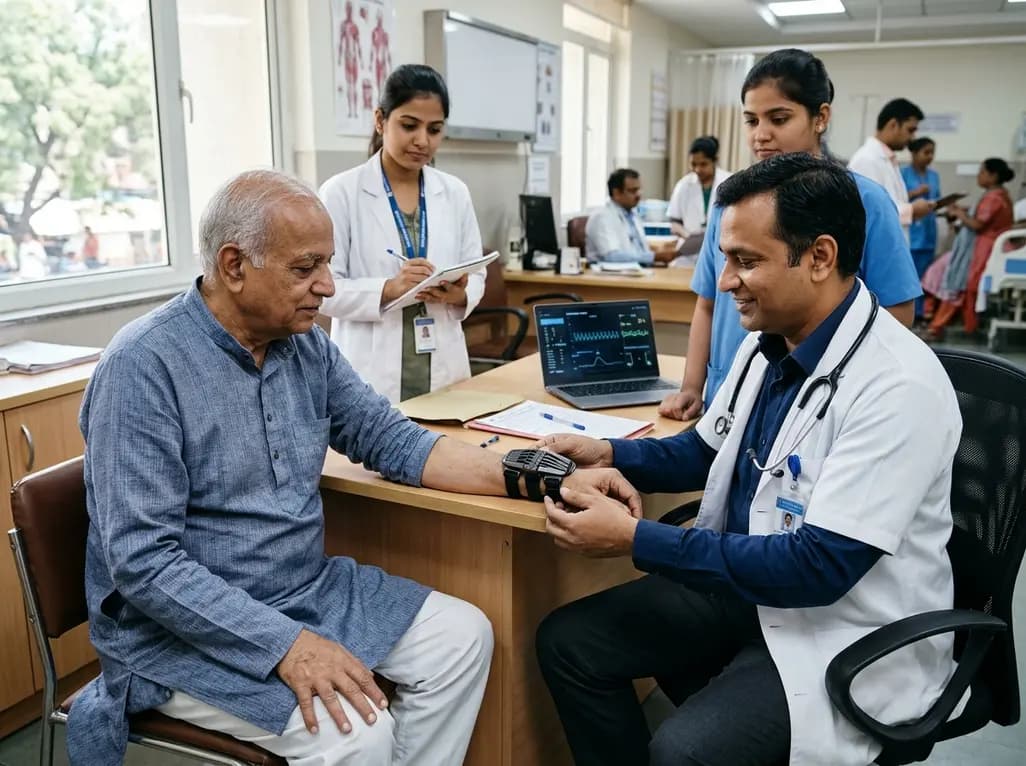
The TREM-AB open-label pilot study evaluated a wearable passive nonlinear vibration absorber for essential tremor. The Nonlinear Energy Sink bracelet reduced clinical Fahn-Tolosa-Marin tremor scores by 32.1% and electrophysiological tremor power by 49.2% with no adverse effects reported.
Today

A population-based study of 20,928 children reveals that small vulnerable newborns face sex-divergent mental capital outcomes at ages 6-7: term SGA girls show higher behavioral difficulties and lower resilience, while preterm non-SGA boys experience increased behavioral problems.
Today

A landmark study details how an enterprise pediatric remote patient management model expanded from a single cardiology pilot to 16 diverse specialty programs by combining centralized digital operations with specialty clinical leadership.
Today

A comparative review of tension band wiring and intramedullary screw fixation in thumb metacarpophalangeal arthrodesis, evaluating union rates, hardware complications, and clinical outcomes.
Today

A breakthrough ultrathin multimodal sensor decouples physical hemodynamic monitoring from disposable electrochemical calibration, achieving long-term wearable glucose prediction with 81.36% accuracy and a 9.12% MARD. This offers a robust, drift-free solution for outpatient metabolic surveillance.
Today
