.webp&w=384&q=75)

Loading, please wait...
Loading, please wait...

Expectant mothers with inflammatory bowel disease often face complex decisions regarding their delivery mode. Specifically, the safety of IBD and vaginal birth remains a significant concern for both patients and clinicians. A recent retrospective cohort study provides vital reassurance for this population. Researchers aimed to determine if IBD, in the absence of active perianal disease, independently increases the risk of perineal trauma during the first vaginal delivery. Consequently, the findings offer a clear path for obstetric management.
The study followed 45,250 primiparous women at a tertiary medical center. Among these participants, 244 were diagnosed with IBD. Notably, overall perineal injury rates were nearly identical between the IBD and control groups. The results showed injury rates of 84.0% and 85.4%, respectively. Furthermore, the risk of obstetric anal sphincter injury (OASI) was comparable, with no significant difference observed. Therefore, patients with stable disease can safely pursue vaginal delivery without fear of increased trauma.
In addition to these core findings, multivariable analysis confirmed that IBD does not independently predict perineal injury. Instead, other clinical factors played a far more significant role in birth outcomes. For instance, vacuum-assisted delivery and higher infant birthweight significantly increased the trauma risk. Moreover, an occiput posterior presentation and a prolonged second stage of labor were identified as key predictors. Consequently, clinical management should focus on these standard obstetric factors rather than IBD status alone.
Subgroup analysis also revealed no differences between ulcerative colitis and Crohn's disease patients. Thus, vaginal birth is an appropriate and safe mode of delivery for this population. However, this recommendation strictly applies to those without active perianal disease at the time of delivery. Healthcare providers should continue to monitor perianal health throughout pregnancy to ensure the best outcomes for the mother and child. Furthermore, multidisciplinary coordination between gastroenterologists and obstetricians remains essential for high-risk pregnancies.
Yes, vaginal delivery is considered appropriate for women with IBD who do not have active perianal disease. Evidence indicates that these patients do not face a higher risk of spontaneous tears or severe perineal injury compared to women without IBD.
The risk factors for perineal injury in women with IBD are the same as those in the general population. These include vacuum-assisted delivery, higher infant birthweight, occiput posterior presentation, and a prolonged second stage of labor.
No, research suggests there are no significant differences in perineal trauma rates between women with ulcerative colitis and those with Crohn's disease, provided no active perianal lesions are present.
Disclaimer: This content is for informational and educational purposes only. It does not constitute medical advice or a professional relationship. Always seek the advice of a qualified healthcare provider regarding a medical condition. Refer to the latest local and national guidelines for clinical practice.
References
Gilboa I et al. Inflammatory bowel disease and risk of perineal injury in primiparous vaginal births: a retrospective cohort study. Inflamm Bowel Dis. 2026 Apr 25. doi: undefined. PMID: 42035293.
Mahadevan U, et al. Global Consensus Statement on the Management of Pregnancy in Inflammatory Bowel Disease. Am J Gastroenterol. 2025.
CCF India. Pregnancy & IBD - Clinical Care Pathway. 2024.

Read summarized clinical updates, watch expert medical content, and earn CME certifications right from your smartphone.
Open your smartphone camera to scan and install.





A study finds that IBD without active perianal disease does not increase the risk of perineal trauma during the first vaginal birth....
5 months ago

An observational study from the NIH All of Us Research Program reveals that adding a multi-ancestry polygenic risk score to machine learning models provides only modest improvements in predicting adult weight gain, underscoring the enduring significance of routine clinical and lifestyle factors.
Today

A study in JAMIA Open shows lightweight open-source reasoning LLMs achieve up to 95% sensitivity and accelerate evidence synthesis screening by nearly twentyfold, presenting a cost-effective, scalable AI solution for biomedical research and systematic reviews.
Today

A landmark study details how an enterprise pediatric remote patient management model expanded from a single cardiology pilot to 16 diverse specialty programs by combining centralized digital operations with specialty clinical leadership.
Today

A comparative review of tension band wiring and intramedullary screw fixation in thumb metacarpophalangeal arthrodesis, evaluating union rates, hardware complications, and clinical outcomes.
Yesterday
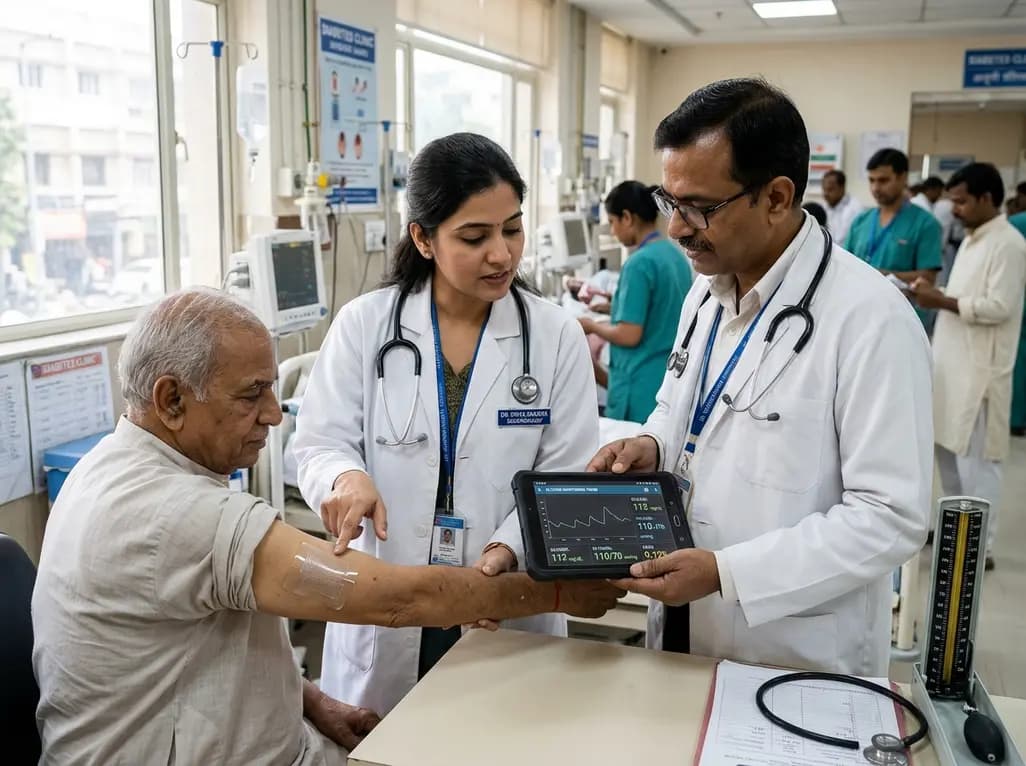
A breakthrough ultrathin multimodal sensor decouples physical hemodynamic monitoring from disposable electrochemical calibration, achieving long-term wearable glucose prediction with 81.36% accuracy and a 9.12% MARD. This offers a robust, drift-free solution for outpatient metabolic surveillance.
Yesterday
