.webp&w=384&q=75)

Loading, please wait...
Loading, please wait...

The Government of India recently introduced a landmark regulatory reform by notifying the National Building Construction Standards (NBCS) 2026. Specifically, this new framework replaces the decade-old National Building Code to address the growing infrastructure needs of the healthcare sector. The most significant change involves the relaxation of height restrictions for hospitals. Previously, a 45-metre cap limited the growth of medical facilities. However, the new standards now permit hospital vertical expansion India for both greenfield projects and existing structures, provided they implement enhanced fire safety protocols.
Furthermore, this move directly addresses long-standing demands from private healthcare providers who face acute space shortages in densely populated urban centers. By allowing buildings to rise beyond the traditional 12 to 15-floor limit, the government aims to optimize land use. Consequently, hospitals can now increase their bed capacity without the need for additional expensive land parcels. This change is particularly vital for high-density cities where horizontal expansion is virtually impossible.
Infrastructure constraints often lead to operational bottlenecks that drive up the cost of care. Additionally, the new NBCS 2026 guidelines allow for the placement of Intensive Care Units (ICUs) above the previous 45-metre limit. This flexibility ensures that hospitals can design more efficient patient-flow systems across multiple floors. Dr. Sangita Reddy, President of NATHEALTH, noted that these rules represent a timely step toward building future-ready healthcare infrastructure. Moreover, she emphasized that unlocking capacity will allow hospitals to operate more efficiently and pass cost benefits to patients.
Notably, the reform also reduces the heavy reliance on capital-intensive greenfield projects. Instead of starting from scratch, healthcare groups can now leverage existing infrastructure to add more departments. Therefore, the gestation period for increasing medical capacity will decrease significantly. As Dr. Ashutosh Raghuvanshi of Fortis Healthcare highlighted, the ability to expand vertically helps bridge capacity gaps while avoiding the long delays associated with new developments.
While the height cap is gone, the government has introduced stringent safety requirements to protect patients. Specifically, hospitals exceeding 45 metres must provide progressive horizontal evacuation features throughout the entire height of the building. Furthermore, designers must include refuge terraces on alternate floors, especially those housing critical care patients. These terraces act as safe zones with temporary medical gas support during emergencies. Consequently, these measures ensure that high-rise hospitals maintain the highest safety standards despite their increased height. Finally, the shift from a prescriptive to a performance-oriented outlook gives architects more room for innovation in safety design.
Q1: What is the main objective of the National Building Construction Standards 2026 regarding hospitals?
The primary goal is to enable the vertical expansion of hospitals by removing the previous 45-metre height restriction, thereby addressing land scarcity and increasing bed capacity in urban areas.
Q2: Are there specific safety requirements for high-rise hospital buildings?
Yes, buildings taller than 45 metres must include enhanced fire safety measures, such as refuge terraces on alternate floors and systems for progressive horizontal evacuation to ensure patient safety during emergencies.
Q3: How does this reform affect the location of Intensive Care Units (ICUs)?
Unlike previous regulations that restricted critical care units to lower floors, the NBCS 2026 allows ICUs to be located beyond 45 metres, provided the facility meets all specified fire and life safety standards.
Disclaimer: This content is for informational and educational purposes only. It does not constitute medical advice or replace professional judgment. Refer to the latest local and national guidelines for clinical practice.
References

Read summarized clinical updates, watch expert medical content, and earn CME certifications right from your smartphone.
Open your smartphone camera to scan and install.





India notifies NBCS 2026, removing the 45-metre height cap for hospitals to allow vertical expansion and address urban healthcare infrastructure gaps....
5 months ago
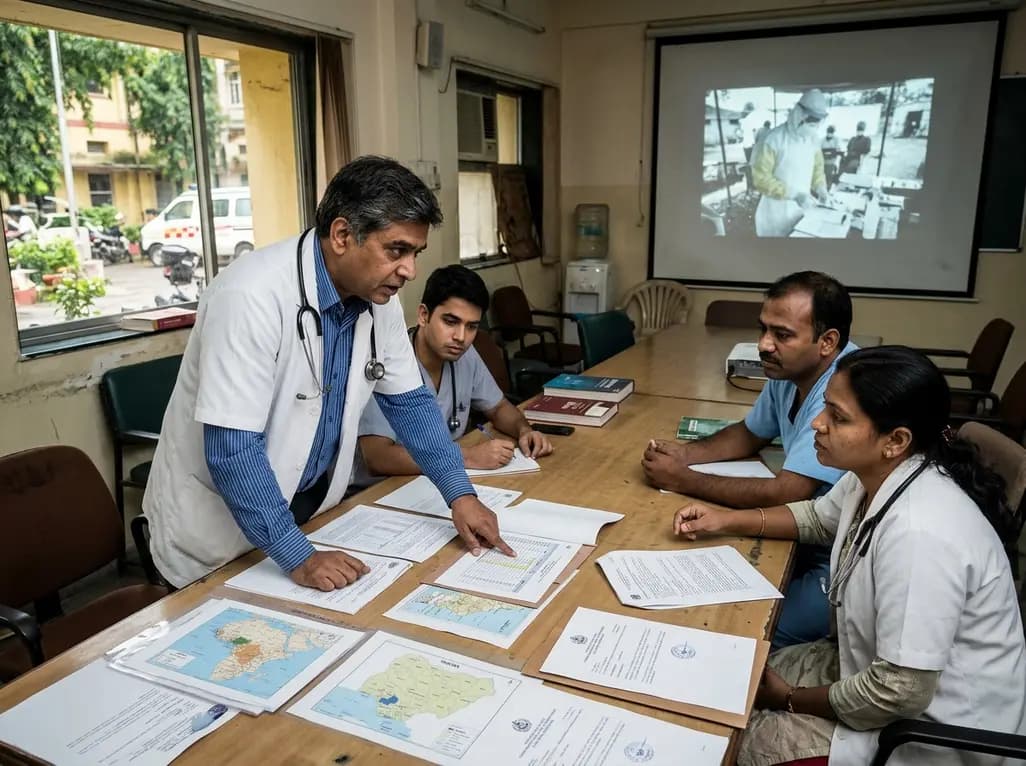
Following Nigeria's first recorded Ebola case linked to regional travel, the Africa CDC has convened an emergency ministerial summit. This alert underscores critical clinical priorities for healthcare professionals, including differentiating early viral infection from malaria, implementing barrier nursing, and triage.
Today

Leucine Rich Bio has introduced South Asia's first comprehensive vaginal microbiome test, BugSpeaks. By profiling microbial dysbiosis, pathogens, and antimicrobial resistance, this next-generation diagnostic platform provides clinicians with deeper insights into recurrent infections, fertility, and reproductive health.
Today

Review how tailored exercise programs benefit frail older patients with heart failure. Explore pathophysiological mechanisms, individualized training prescriptions, and strategies to overcome adherence barriers in clinical practice.
Today

This comparative study evaluates posterior labral tears with and without glenohumeral instability, highlighting distinct demographic patterns, MRI underestimation in stable shoulders, and successful arthroscopic repair outcomes.
Today

A clinical study demonstrates that early intervention with tocilizumab, either as monotherapy or bridged with corticosteroids, achieves significant proptosis reduction and resolves active inflammation in treatment-naive thyroid eye disease.
Today
