.webp&w=384&q=75)

Loading, please wait...
Loading, please wait...

Many patients report significant hearing difficulties in noisy environments despite having perfectly normal audiometric thresholds. Clinicians often refer to this phenomenon as “hidden” because standard tests fail to capture the underlying neural damage. Recent research highlights how hidden hearing loss detection is becoming increasingly achievable through advanced electrophysiological tools like Electrocochleography (ECochG).
Electrocochleography allows specialists to directly assess both cochlear hair cell function and neural responses. Specifically, it measures the summating potential (SP) and the compound action potential (AP). These markers provide a window into the health of the auditory system that traditional pure-tone audiometry simply cannot reach. Furthermore, as the population ages, understanding the natural decline of these potentials becomes essential for differentiating between normal aging and pathological degeneration.
A recent study involving sixty-four participants with normal hearing thresholds (10-69 years) demonstrated that auditory components decline significantly with age. Notably, the researchers found that SP and AP amplitudes, along with the AP-SP amplitude, decreased as participants got older. However, the SP/AP ratio remained relatively stable across different age groups. This stability suggests that while the overall neural and hair cell output diminishes, the relationship between the two components may persist until more advanced stages of degeneration occur.
Interestingly, the study noted that AP latencies showed no significant correlation with age. This finding implies that the speed of neural transmission might stay intact even when the total number of firing neurons decreases. Consequently, clinicians should focus more on amplitude changes rather than timing when evaluating early signs of auditory decline.
In clinical practice, identifying these subtle changes is vital for early intervention. Standard audiograms often miss cochlear synaptopathy, where the connection between hair cells and the auditory nerve is damaged. Moreover, hidden hearing loss detection via ECochG provides objective evidence of neural loss that explains why older adults struggle with speech clarity. Therefore, incorporating ECochG into the diagnostic battery for patients with hearing complaints and normal audiograms can significantly improve diagnostic accuracy.
Additionally, these findings underscore the necessity of establishing age-corrected normative data. Without age-specific baselines, clinicians might misinterpret a natural age-related reduction in AP amplitude as a more severe pathology. By refining these diagnostic parameters, medical professionals can better guide patients toward appropriate management strategies, such as auditory training or environmental modifications, before permanent hearing loss occurs.
Hidden hearing loss refers to auditory damage, such as cochlear synaptopathy, that does not affect the ability to hear faint sounds in a quiet room but impairs the ability to understand speech in noisy settings.
ECochG measures the electrical potentials of the inner ear and auditory nerve. It can detect reduced neural output (action potentials) even when traditional hearing tests show normal results.
As we age, there is a gradual loss of sensory hair cells and the neurons that connect them to the brain. This reduction in biological hardware leads to smaller electrical signals during testing.
Disclaimer: This content is for informational and educational purposes only. It does not constitute professional medical advice, diagnosis, or treatment. Always seek the advice of your physician or other qualified healthcare provider with any questions you may have regarding a medical condition. Refer to the latest local and national guidelines for clinical practice.
References
Chen M et al. Characteristics in SP and AP measured by EcochG in normal-hearing adults: significance for auditory degeneration and hidden hearing loss detection. Acta Otolaryngol. 2026 Mar 02. doi: 10.1080/00016489.2025.2604633. PMID: 41770575.
Liberman MC et al. Hidden Hearing Loss in the Aging Ear. Neuroscience. 2019;407:8-20.
Kujawa SG, Liberman MC. Adding insult to injury: cochlear nerve degeneration after “temporary” noise-induced hearing loss. J Neurosci. 2009;29(45):14077-14085.
"
Read summarized clinical updates, watch expert medical content, and earn CME certifications right from your smartphone.
Open your smartphone camera to scan and install.





A study highlights how ECochG components decrease with age, offering a sensitive method for hidden hearing loss detection in patients with normal audiograms...
7 months ago
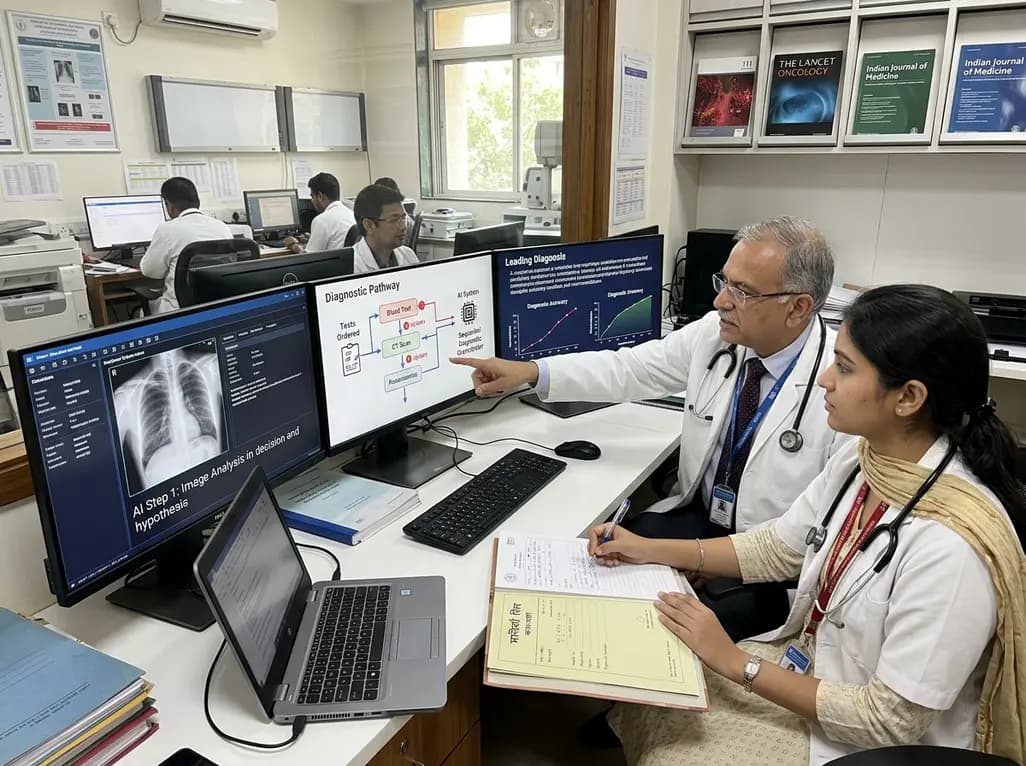
A breakthrough peer-reviewed study demonstrates that a sequential AI diagnosis system can mirror real-world clinical reasoning. By ordering stepwise tests and updating hypotheses dynamically, this multi-agent orchestrator achieved superior diagnostic accuracy while reducing investigative costs.
Today

A prenatal case highlights severe glutaric acidemia type II presenting as bilateral hyperechoic cystic kidneys at 18 weeks. Whole-exome sequencing revealed a novel homozygous ETFDH frameshift variant, demonstrating the power of rapid genetic testing in fetal renal anomalies.
Today

Review how tailored exercise programs benefit frail older patients with heart failure. Explore pathophysiological mechanisms, individualized training prescriptions, and strategies to overcome adherence barriers in clinical practice.
Yesterday

This comparative study evaluates posterior labral tears with and without glenohumeral instability, highlighting distinct demographic patterns, MRI underestimation in stable shoulders, and successful arthroscopic repair outcomes.
Yesterday

A clinical study demonstrates that early intervention with tocilizumab, either as monotherapy or bridged with corticosteroids, achieves significant proptosis reduction and resolves active inflammation in treatment-naive thyroid eye disease.
Yesterday
