.webp&w=384&q=75)

Loading, please wait...
Loading, please wait...

Recent research highlights a critical link between oral health and cognitive longevity. A new matched-cohort study published in the Journal of Alzheimer's Disease suggests that edentulism and dementia risk are significantly correlated. Researchers analyzed data from the Health and Retirement Study (2006-2020) and linked Medicare claims. They found that complete tooth loss independently predicts the onset of cognitive decline in older adults. This association remains robust even after accounting for socioeconomic factors and the competing risk of mortality.
The study included over 15,000 older adults. Findings revealed that edentulous individuals faced a 21% higher risk of all-cause dementia (ACD). Furthermore, the risk of Alzheimer’s disease (AD) increased by 33% in the total cohort. These results suggest that losing all natural teeth serves as a biological marker for systemic disadvantage and severe oral disease. Consequently, clinicians should view edentulism as a potential red flag for future neurodegenerative conditions.
One of the most striking findings involves baseline cognitive status. For individuals already experiencing cognitive impairment (CIND), the study did not observe a significant additional risk for AD. However, for those with normal cognition at baseline, edentulism was associated with a 69% higher risk of Alzheimer's disease. This indicates that the window for effective oral health intervention is likely before cognitive symptoms appear. Therefore, maintaining natural teeth may provide a protective effect against the early stages of neurodegeneration.
Several mechanisms may explain this connection. Tooth loss often stems from chronic periodontal disease, which triggers systemic inflammation. Moreover, reduced masticatory function often leads to nutritional deficiencies as individuals avoid fiber-rich foods. Some researchers also propose that reduced chewing decreases neural feedback to the brain. This lack of stimulation may accelerate the shrinkage of the hippocampus, a brain region vital for memory. Addressing these factors through prosthodontic rehabilitation or preventative dentistry remains essential for aging populations.
Edentulism, or total tooth loss, increases the risk of Alzheimer\'s disease by approximately 33%. The risk is particularly high—up to 69%—among individuals who are cognitively healthy when they lose their teeth. This suggests a direct link between oral health and the early pathology of dementia.
The study suggests that edentulism acts as an early-life or mid-life risk factor. Once an individual has already reached the stage of cognitive impairment, other pathological processes may overshadow the impact of oral health. Early intervention is therefore critical for prevention.
While more research is needed, current evidence suggests that preserving natural teeth or using effective dentures can mitigate systemic inflammation and nutritional deficits. These factors are known contributors to cognitive decline, making oral health a modifiable risk factor for dementia.
Disclaimer: This content is for informational and educational purposes only and does not constitute medical advice. Always seek the advice of a qualified healthcare provider regarding any medical condition. Refer to the latest local and national guidelines for clinical practice.
References

Read summarized clinical updates, watch expert medical content, and earn CME certifications right from your smartphone.
Open your smartphone camera to scan and install.





A matched-cohort study finds edentulism increases the risk of all-cause dementia by 21% and Alzheimer’s disease by 33%, highlighting oral health as a preven...
7 months ago
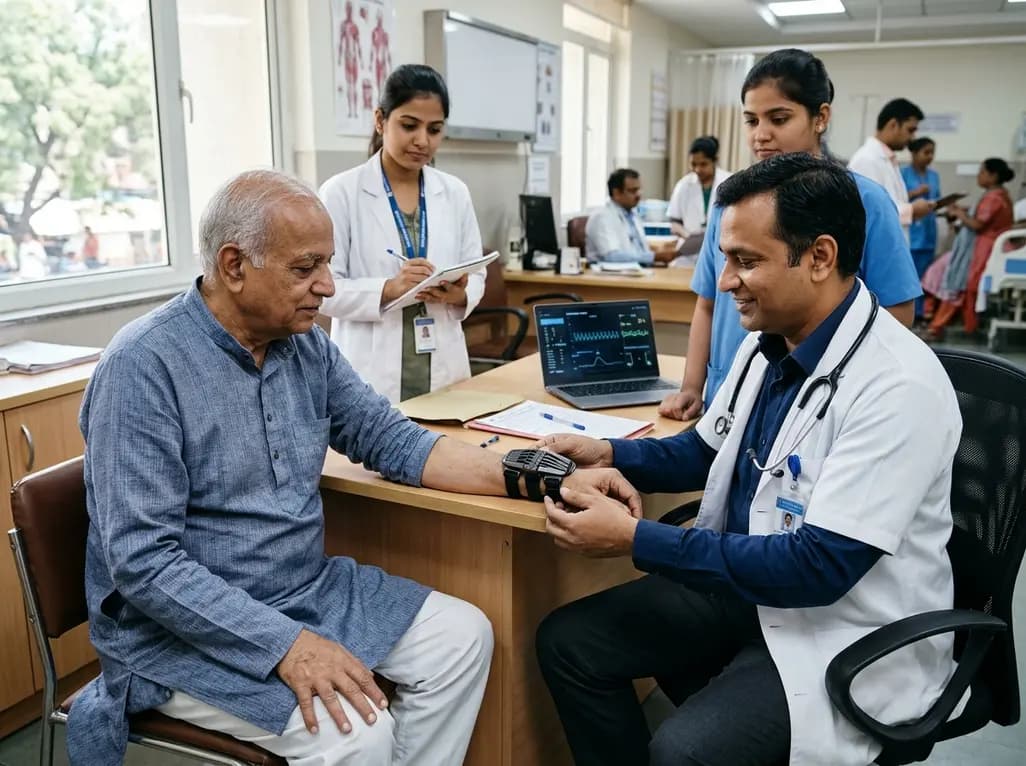
The TREM-AB open-label pilot study evaluated a wearable passive nonlinear vibration absorber for essential tremor. The Nonlinear Energy Sink bracelet reduced clinical Fahn-Tolosa-Marin tremor scores by 32.1% and electrophysiological tremor power by 49.2% with no adverse effects reported.
Today

A population-based study of 20,928 children reveals that small vulnerable newborns face sex-divergent mental capital outcomes at ages 6-7: term SGA girls show higher behavioral difficulties and lower resilience, while preterm non-SGA boys experience increased behavioral problems.
Today

A landmark study details how an enterprise pediatric remote patient management model expanded from a single cardiology pilot to 16 diverse specialty programs by combining centralized digital operations with specialty clinical leadership.
Today

A comparative review of tension band wiring and intramedullary screw fixation in thumb metacarpophalangeal arthrodesis, evaluating union rates, hardware complications, and clinical outcomes.
Today

A breakthrough ultrathin multimodal sensor decouples physical hemodynamic monitoring from disposable electrochemical calibration, achieving long-term wearable glucose prediction with 81.36% accuracy and a 9.12% MARD. This offers a robust, drift-free solution for outpatient metabolic surveillance.
Today
