.webp&w=384&q=75)

Loading, please wait...
Loading, please wait...

Researchers recently explored how Doppler ultrasound cervical auscultation serves as a modern tool for evaluating swallowing proficiency. Traditionally, clinicians used stethoscopes for cervical auscultation (CA), but these tools often provide poor signal quality and lack precision. However, ultrasound technology offers a more robust signal, allowing for detailed analysis of swallowing phases in both young and older adults. This study specifically analyzed thirty healthy individuals to identify how liquid consistency and aging affect swallowing signals.
The study utilized IDDSI levels ranging from thin to extremely thick liquids to test the participants. Consequently, researchers measured several parameters, including the duration of the swallow signal and peak intensity. Findings indicated that older adults experience a longer swallowing duration compared to their younger counterparts. Specifically, both the total duration (T) and the time to the second peak (T) increased significantly with age. Furthermore, these durational changes remained consistent regardless of the bolus thickness. In contrast, frequency and intensity measures showed no significant variation between age groups or liquid types.
Therefore, the results suggest that age primarily affects the timing of the swallow rather than the physical force or frequency of the bolus movement. This distinction is crucial for clinicians who manage dysphagia in geriatric populations. Using Doppler ultrasound cervical auscultation provides a portable and reliable method for bedside assessments. Additionally, the improved signal-to-noise ratio makes it superior to traditional stethoscopic methods. Finally, these findings support the integration of ultrasound CA into standard clinical protocols for evaluating swallow proficiency in India's aging population.
According to the study, bolus consistency does not significantly alter the duration, intensity, or frequency of the ultrasound signal. However, age remains the primary factor affecting swallow timing.
Doppler ultrasound provides a much better signal-to-noise ratio. This allows clinicians to isolate the specific sounds of the swallow more clearly than a traditional stethoscope.
Disclaimer: This content is for informational and educational purposes only. It does not constitute medical advice or a professional relationship. Refer to the latest local and national guidelines for clinical practice.
References
Zhu S et al. Cervical auscultation using Doppler ultrasound for swallows of different consistencies by young and older healthy adults. Logoped Phoniatr Vocol. 2026 Feb 23. doi: 10.1080/14015439.2026.2627396. PMID: 41729567.
Huang CT et al. Emerging Role of Ultrasound in Dysphagia Assessment and Intervention: A Narrative Review. Front Neurol. 2022;13:1015638. doi: 10.3389/fneur.2022.1015638.
Yang L et al. Diagnostic accuracy of ultrasound for dysphagia in neurological disorders including stroke: a systematic review and meta-analysis. Front Neurol. 2025. doi: 10.3389/fneur.2024.1354321.

Read summarized clinical updates, watch expert medical content, and earn CME certifications right from your smartphone.
Open your smartphone camera to scan and install.





Study evaluates Doppler ultrasound cervical auscultation for swallow assessment, finding increased duration in older adults regardless of bolus consistency....
8 months ago
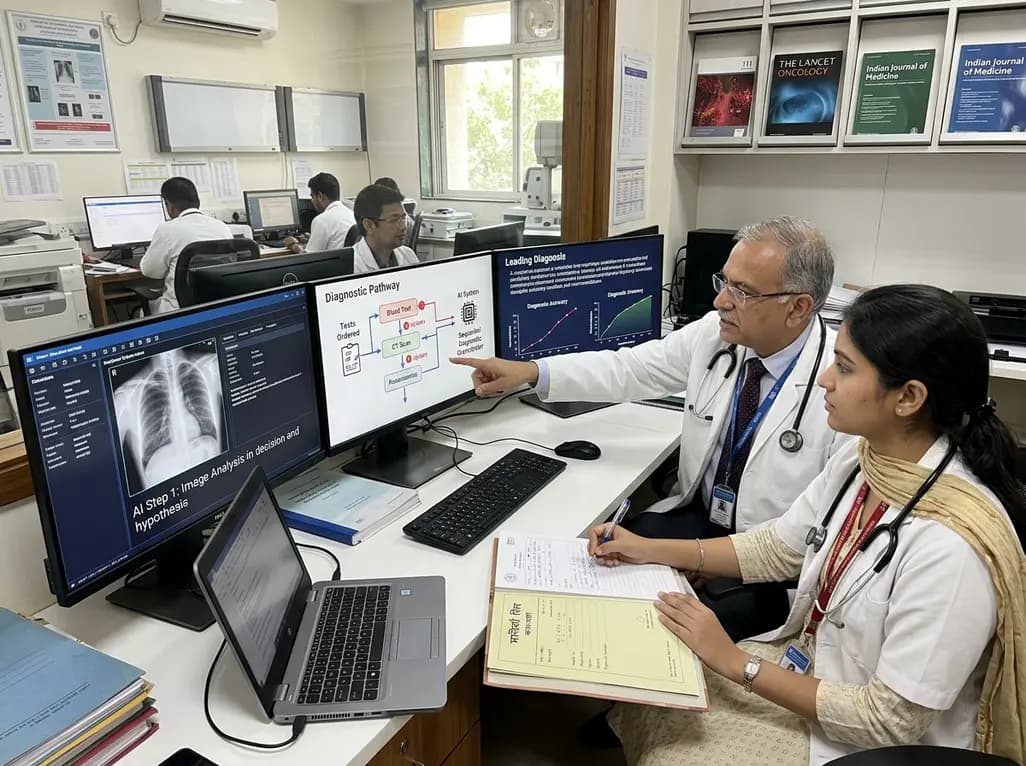
A breakthrough peer-reviewed study demonstrates that a sequential AI diagnosis system can mirror real-world clinical reasoning. By ordering stepwise tests and updating hypotheses dynamically, this multi-agent orchestrator achieved superior diagnostic accuracy while reducing investigative costs.
Today

A prenatal case highlights severe glutaric acidemia type II presenting as bilateral hyperechoic cystic kidneys at 18 weeks. Whole-exome sequencing revealed a novel homozygous ETFDH frameshift variant, demonstrating the power of rapid genetic testing in fetal renal anomalies.
Today

Review how tailored exercise programs benefit frail older patients with heart failure. Explore pathophysiological mechanisms, individualized training prescriptions, and strategies to overcome adherence barriers in clinical practice.
Yesterday

This comparative study evaluates posterior labral tears with and without glenohumeral instability, highlighting distinct demographic patterns, MRI underestimation in stable shoulders, and successful arthroscopic repair outcomes.
Yesterday

A clinical study demonstrates that early intervention with tocilizumab, either as monotherapy or bridged with corticosteroids, achieves significant proptosis reduction and resolves active inflammation in treatment-naive thyroid eye disease.
Yesterday
