.webp&w=384&q=75)

Loading, please wait...
Loading, please wait...

Recent breakthroughs in materials science are reshaping the potential of nanotechnology in medicine. Diamond, typically known as a rigid insulator, undergoes a dramatic transformation at the nanoscale. Researchers have discovered that diamond nanowire conductivity can be significantly increased through mechanical strain, essentially turning an insulator into a metal-like conductor. This finding, published in Nano Letters, offers a glimpse into a future where durable, biocompatible, and conductive materials power next-generation medical devices.
The study utilized atomic force microscopy (AFM) to apply mechanical loads to these tiny structures. Interestingly, the diamond nanowires exhibited remarkable elasticity, achieving a bending angle of 39° before reaching their fracture point. Finite element simulations further supported these findings, suggesting that vertical displacement in the central region of the nanowire is sufficient to achieve metallization. Consequently, this allows for reversible changes in electrical properties without altering the diamond's fundamental chemical stability.
The primary appeal of diamond in a clinical setting is its unparalleled biocompatibility. Unlike many metallic components that may trigger inflammatory responses or degrade over time, diamond is chemically inert. By achieving high electrical conductivity through strain engineering, these nanowires could revolutionize neural interfaces. Specifically, they may lead to more durable deep-brain stimulation electrodes and high-sensitivity biosensors. Furthermore, the ability to control conductivity through mechanical means opens doors for \"smart\" implants that respond to physical pressure within the body.
In addition to neural applications, these findings are pivotal for the development of quantum sensors. These sensors can detect minute changes in magnetic fields or temperature at the cellular level. Because diamond maintains its structural integrity while becoming conductive, it serves as a robust platform for long-term monitoring. Scientists believe this duality of strength and conductivity will eventually lead to safer and more effective biomedical electronics, particularly in the fields of cardiology and orthopedics.
Moreover, the scalability of these nanowires suggests that future manufacturing could integrate them into existing surgical tools. This integration might provide real-time feedback during delicate procedures. While clinical adoption is still several years away, the direct evidence of strain-induced conductance marks a significant milestone in translational research. Therefore, understanding these properties is essential for clinicians involved in the future of medical technology and bioengineering.
Conductive diamond nanowires combine the material's natural biocompatibility and strength with the electrical properties of metals. This makes them ideal for long-term implants like neural probes or cardiac sensors that must function within the body without causing adverse reactions.
Research shows that at the nanoscale, diamond becomes highly elastic rather than brittle. These nanowires can bend up to 39 degrees without fracturing, suggesting they are durable enough to withstand the mechanical stresses found in biological environments.
Applying mechanical load narrows the diamond's wide bandgap. When the strain is sufficient, the bandgap disappears, allowing electrons to flow freely. This process, known as metallization, turns the insulating diamond into a conductor.
Disclaimer: This content is for informational and educational purposes only and does not constitute medical advice. Refer to the latest local and national guidelines for clinical practice.
References

Read summarized clinical updates, watch expert medical content, and earn CME certifications right from your smartphone.
Open your smartphone camera to scan and install.





Researchers demonstrate that diamond nanowires become conductive under mechanical strain, offering new possibilities for biocompatible neural probes and sen...
6 months ago

Novel glucose-responsive mPEG-PSA nanocarriers deliver insulin aspart on demand, achieving dual postprandial and basal glycemic control without hypoglycemia in diabetic models. This biomaterial breakthrough offers promising clinical implications for physiologic diabetes management.
Today

A novel folate-conjugated tecto-dendrimer nanoplatform successfully delivers siRNA to achieve targeted HK2 silencing, disrupting ovarian cancer glycolysis and suppressing lactate output.
Today
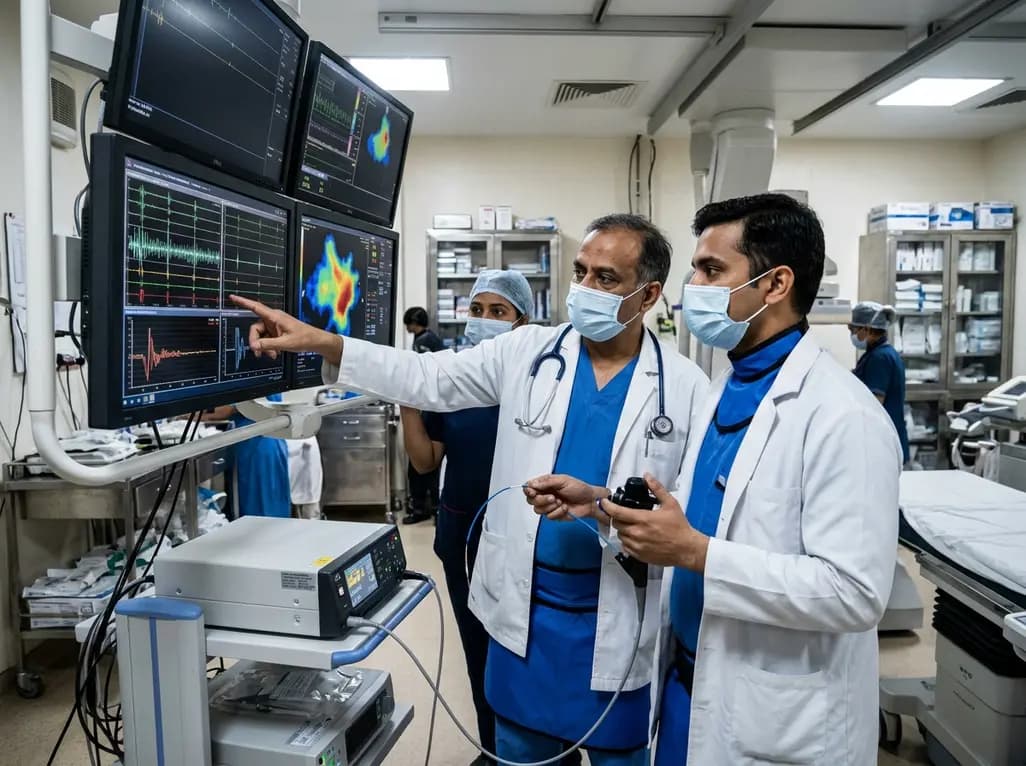
A comparative non-contact study reveals that high-power radiofrequency delivery with the QDOT MICRO catheter induces an artifactual contact force rise. Electrophysiologists must understand this power-dependent thermal and electrical phenomenon to avoid inadvertent catheter withdrawal and ineffective ablation.
Today

A novel proof-of-concept study presents a six-degree-of-freedom articulated manikin neck equipped with linear potentiometers. The system provides real-time kinematic motion feedback during cervical immobilisation, delivering sub-degree tracking accuracy to improve pre-hospital trauma training and patient safety.
Today

A retrospective comparative cohort study evaluated genitourinary safety in HFpEF between dapagliflozin and empagliflozin over six months. Rates of symptomatic UTI and asymptomatic bacteriuria showed no statistically significant differences, supporting comparable safety profiles across both SGLT2 inhibitors.
Today
