.webp&w=384&q=75)

Loading, please wait...
Loading, please wait...

Single-cell genomics has fundamentally changed our perspective on cellular heterogeneity. However, transcriptomic data often fail to represent the functional proteomic state of a cell. Consequently, researchers now utilize CITE-seq technology to bridge this gap. This innovative approach enables the simultaneous quantification of RNA and surface protein expression within individual cells. By leveraging oligonucleotide-conjugated antibodies, the method captures marker-specific tags alongside cellular messenger RNA. This dual-modality provides a more holistic view of cellular biology than traditional sequencing alone.
The methodological principles of this platform ensure compatibility with various sequencing workflows. Furthermore, the technology addresses the common discrepancy between mRNA levels and protein abundance. For instance, transcript levels do not always correlate perfectly with functional protein markers due to post-translational regulations. Therefore, integrating both data types allows for more precise cell classification and the discovery of rare sub-populations. Moreover, modern computational frameworks now support the complex integration required for such multimodal datasets.
In the field of oncology, this technology has proven transformative for dissecting the tumor microenvironment. Researchers use it to map the interactions between malignant cells and infiltrating immune cells with high resolution. Additionally, it helps categorize tumor cells based on their functional response to specific treatments. Beyond cancer, the technology facilitates a deeper understanding of infectious diseases by decoding host-pathogen interactions at the single-cell level. For example, during the COVID-19 pandemic, it provided critical insights into the immune response of various patient cohorts. Consequently, it has become a cornerstone of next-generation biomedical discovery.
Despite these advancements, several technical and computational challenges remain. Background noise from ambient antibodies and the high cost of sequencing are persistent hurdles. However, future directions like spatial integration and predictive modeling promise to enhance the utility of these assays. As computational tools evolve, the seamless integration of CITE-seq data with other omics layers will likely drive significant breakthroughs in personalized medicine.
CITE-seq adds a layer of protein expression data to the transcriptome. This allows scientists to identify cell types more accurately, especially when mRNA levels are low or poorly correlated with protein markers.
Frameworks such as Seurat, Scanpy, and TotalVI are frequently used. These tools provide specialized algorithms to normalize and jointly analyze multimodal datasets from individual cells.
Currently, oncology, immunology, and infectious disease research see the highest impact. The technology is particularly effective at characterizing complex immune landscapes and tumor heterogeneity.
Disclaimer: This content is for informational and educational purposes only. It does not constitute medical advice or a professional recommendation. Refer to the latest local and national guidelines for clinical practice.
References
Fernández ML et al. Beyond the Transcriptome: Leveraging Cellular Indexing of Transcriptomes and Epitopes by Sequencing (CITE-seq) for Deeper Cellular Insights. Annu Rev Biomed Data Sci. 2026 Apr 21. doi: 10.1146/annurev-biodatasci-092724-061209. PMID: 42013463.
Stoeckius M, et al. Simultaneous epitope and transcriptome measurement in single cells. Nat Methods. 2017;14(9):865-868.
Hao Y, et al. Integrated analysis of multimodal single-cell data. Cell. 2021;184(13):3573-3587.e29.
"
Read summarized clinical updates, watch expert medical content, and earn CME certifications right from your smartphone.
Open your smartphone camera to scan and install.





CITE-seq technology enables the simultaneous quantification of RNA and surface proteins, offering unprecedented insights into cellular function and heteroge...
6 months ago
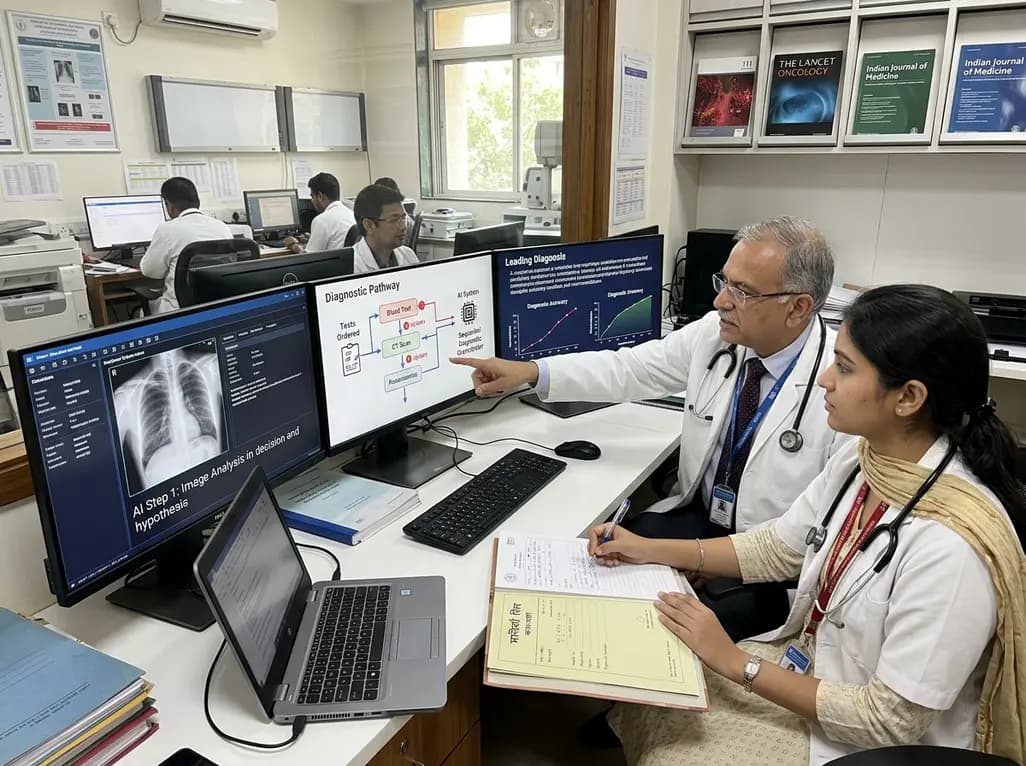
A breakthrough peer-reviewed study demonstrates that a sequential AI diagnosis system can mirror real-world clinical reasoning. By ordering stepwise tests and updating hypotheses dynamically, this multi-agent orchestrator achieved superior diagnostic accuracy while reducing investigative costs.
Today

A prenatal case highlights severe glutaric acidemia type II presenting as bilateral hyperechoic cystic kidneys at 18 weeks. Whole-exome sequencing revealed a novel homozygous ETFDH frameshift variant, demonstrating the power of rapid genetic testing in fetal renal anomalies.
Today

Review how tailored exercise programs benefit frail older patients with heart failure. Explore pathophysiological mechanisms, individualized training prescriptions, and strategies to overcome adherence barriers in clinical practice.
Yesterday

This comparative study evaluates posterior labral tears with and without glenohumeral instability, highlighting distinct demographic patterns, MRI underestimation in stable shoulders, and successful arthroscopic repair outcomes.
Yesterday

A clinical study demonstrates that early intervention with tocilizumab, either as monotherapy or bridged with corticosteroids, achieves significant proptosis reduction and resolves active inflammation in treatment-naive thyroid eye disease.
Yesterday
