.webp&w=384&q=75)

Loading, please wait...
Loading, please wait...

Ensuring food safety remains a critical challenge in public health, particularly regarding chemical contaminants and nutrient degradation. Recent research has introduced a sophisticated material that addresses these issues simultaneously. Scientists have developed nitrogen and sulfur co-doped fluorescent carbon dots (N, S-CDs) that facilitate precise chlortetracycline detection in food while providing superior ultraviolet (UV) shielding. This dual-function platform offers a promising strategy for smart packaging and environmental monitoring.
The researchers synthesized the N, S-CDs through a one-step hydrothermal approach using L-proline and methyl orange. These carbon dots exhibit robust cyan photoluminescence with a high quantum yield of 22.5%. Due to their unique optical properties, the dots serve as a highly sensitive fluorescent probe. The sensing mechanism relies on dynamic quenching, which allows for a wide linear response ranging from 0 to 25 µmol·L and a remarkably low detection limit of 0.94 µmol·L. Furthermore, practical trials in environmental water and milk samples yielded satisfactory recovery rates between 83.67% and 94.46%, highlighting its reliability for real-world applications.
Beyond chemical sensing, the team incorporated these carbon dots into a polyvinyl alcohol (PVA) matrix to create multifunctional composite films. These flexible, transparent films demonstrate exceptional protective capabilities. Specifically, they shield over 99.5% of UV-C and UV-B radiation. Instead of merely blocking the radiation, the films convert absorbed energy into visible light through a down-conversion effect. Consequently, application trials using grapes confirmed that the composite films significantly reduce moisture loss and prevent UV-induced deterioration, thereby extending shelf life.
In India, the prevalence of antibiotic residues in the dairy and poultry sectors is a growing concern. Studies have frequently detected tetracycline-class antibiotics in raw milk and eggs, sometimes exceeding the maximum residue limits (MRL) set by the Food Safety and Standards Authority of India (FSSAI). Chronic exposure to such residues can contribute to the development of antimicrobial resistance (AMR). Therefore, implementing accessible technologies for chlortetracycline detection in food is vital for safeguarding consumer health and ensuring regulatory compliance across the food supply chain.
Carbon dots detect chlortetracycline through a process called dynamic quenching. When the antibiotic interacts with the fluorescent carbon dots, it absorbs or dissipates the emitted light energy, causing a measurable decrease in fluorescence intensity that corresponds to the concentration of the drug.
UV radiation can accelerate the oxidation of fats and the degradation of vitamins in food products, leading to off-flavors, color changes, and nutritional loss. Effective UV-shielding materials, like the PVA@N, S-CDs film, protect sensitive food items from these harmful effects while remaining transparent.
While the study demonstrates significant benefits in food models like grapes, further toxicological assessments and migration studies are typically required to ensure that the nanomaterials meet international safety standards for direct food contact materials.
Disclaimer: This content is for informational and educational purposes only and does not constitute medical or regulatory advice. Refer to the latest local and national guidelines for clinical practice and food safety standards.
References
1. Liu Y et al. Nitrogen and Sulfur Co-Doped Fluorescent Carbon Dots Constructing PVA@N, S-CDs Composite Film: A Next-Generation Food Packaging Material With Dual Functions of Chlortetracycline Detection and Ultraviolet Shielding. Small. 2026 Mar 09. doi: 10.1002/smll.202514630. PMID: 41797688.
2. Moudgil P et al. Analysis of antibiotic residues in raw and commercial milk in Punjab, India vis-à-vis human health risk assessment. ResearchGate. 2019.
3. Eurofins India. Antibiotic Residues in Milk: Causes, Effects & How They're Detected. Published August 12, 2025.
"
Read summarized clinical updates, watch expert medical content, and earn CME certifications right from your smartphone.
Open your smartphone camera to scan and install.





A new study introduces N, S-CDs composite films that detect chlortetracycline and block 99.5% of UV radiation, enhancing food safety and shelf life....
7 months ago
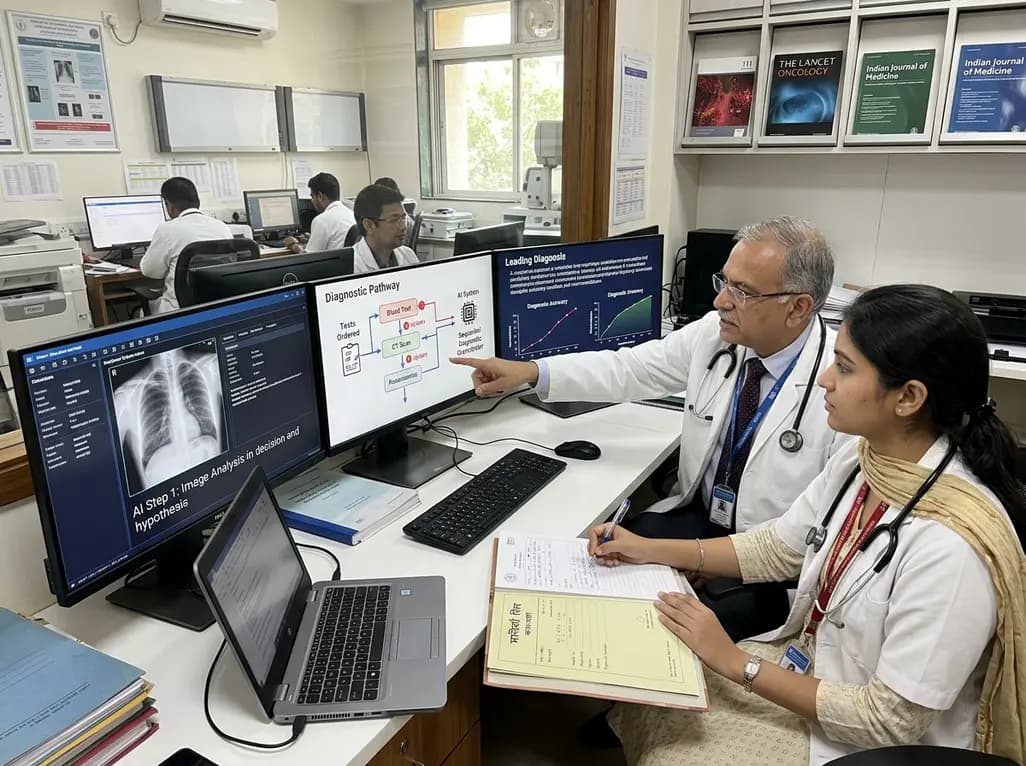
A breakthrough peer-reviewed study demonstrates that a sequential AI diagnosis system can mirror real-world clinical reasoning. By ordering stepwise tests and updating hypotheses dynamically, this multi-agent orchestrator achieved superior diagnostic accuracy while reducing investigative costs.
Today

A prenatal case highlights severe glutaric acidemia type II presenting as bilateral hyperechoic cystic kidneys at 18 weeks. Whole-exome sequencing revealed a novel homozygous ETFDH frameshift variant, demonstrating the power of rapid genetic testing in fetal renal anomalies.
Today

Review how tailored exercise programs benefit frail older patients with heart failure. Explore pathophysiological mechanisms, individualized training prescriptions, and strategies to overcome adherence barriers in clinical practice.
Yesterday

This comparative study evaluates posterior labral tears with and without glenohumeral instability, highlighting distinct demographic patterns, MRI underestimation in stable shoulders, and successful arthroscopic repair outcomes.
Yesterday

A clinical study demonstrates that early intervention with tocilizumab, either as monotherapy or bridged with corticosteroids, achieves significant proptosis reduction and resolves active inflammation in treatment-naive thyroid eye disease.
Yesterday
