.webp&w=384&q=75)

Loading, please wait...
Loading, please wait...

Normative modeling acts like a growth chart for the brain. It helps clinicians determine if an individual's brain development follows a typical path. The latest research introduces Baseline-Conditioned Norms (B-Norms) to track longitudinal changes more effectively than ever before. This advanced model uses a person's initial brain scan as a unique starting point. Consequently, it provides a much clearer picture of individual brain development over time compared to traditional cross-sectional methods.
Researchers analyzed longitudinal data from the Adolescent Brain Cognitive Development (ABCD) study. They followed over 6,000 young participants across three time points over four years. The study compared the new B-Norms against standard cross-sectional norms (C-Norms), which only use age and sex as predictors. The results showed that B-Norms consistently predicted cortical thickness with far greater accuracy across nearly all brain regions. Specifically, these models were significantly more sensitive to identifying developmental changes linked to puberty.
These findings are crucial for the future of personalized medicine and computational psychiatry. Standard models often overlook subtle individual variations because they rely on population averages. However, B-Norms incorporate the specific baseline anatomy of the patient. This baseline integration allows for superior detection of sex-specific development. This is particularly evident in girls during their pubertal years, where brain changes are rapid and distinct. Furthermore, these models capture more developmental variance, making them a vital tool for identifying deviations from healthy brain maturation.
In the Indian context, where early identification of neurodevelopmental disorders is a growing priority, such tools could revolutionize clinical assessments. While standard norms are useful, they often lack the granularity required for individual diagnostic confidence. Consequently, adopting longitudinal B-Norms could provide clinicians with the precision needed to tailor interventions more effectively. Future research will likely focus on how these improved norms can assist in the early detection of psychiatric and neurological conditions.
B-Norms are a type of normative modeling that predicts an individual's future brain measures by using their own baseline scan as a reference point, rather than relying solely on age-based population averages.
Traditional cross-sectional models (C-Norms) only use data from a single point in time to predict typical brain structure. In contrast, B-Norms track the same individuals over time, making them better at capturing how an individual's brain actually changes.
Adolescence is a period of rapid brain change. B-Norms are more sensitive to these changes, particularly those related to puberty and sex-specific development, allowing for more accurate tracking of healthy versus atypical brain growth.
Disclaimer: This content is for informational and educational purposes only and does not constitute medical advice or a professional relationship. Always seek the advice of a qualified healthcare provider regarding any medical condition. Refer to the latest local and national guidelines for clinical practice.
References
Seidel P et al. Predicting developmental norms from baseline cortical thickness in longitudinal studies. Biol Sex Differ. 2026 Feb 10. doi: 10.1186/s13293-026-00846-4. PMID: 41668180.
Bethlehem RAI, Seidlitz J, White SR, et al. Brain charts for the human lifespan. Nature. 2022;604(7906):525-533. doi:10.1038/s41586-022-04554-y
Marquand AF, Rezek I, Buitelaar J, Beckmann CF. Understanding Heterogeneity in Clinical Cohorts Using Normative Models: Beyond Case-Control Studies. Biol Psychiatry. 2016;80(7):552-561. doi:10.1016/j.biopsych.2016.03.2101
"
Read summarized clinical updates, watch expert medical content, and earn CME certifications right from your smartphone.
Open your smartphone camera to scan and install.





New research shows Baseline-Conditioned Norms (B-Norms) predict cortical thickness more accurately than traditional models, improving pubertal brain trackin...
8 months ago
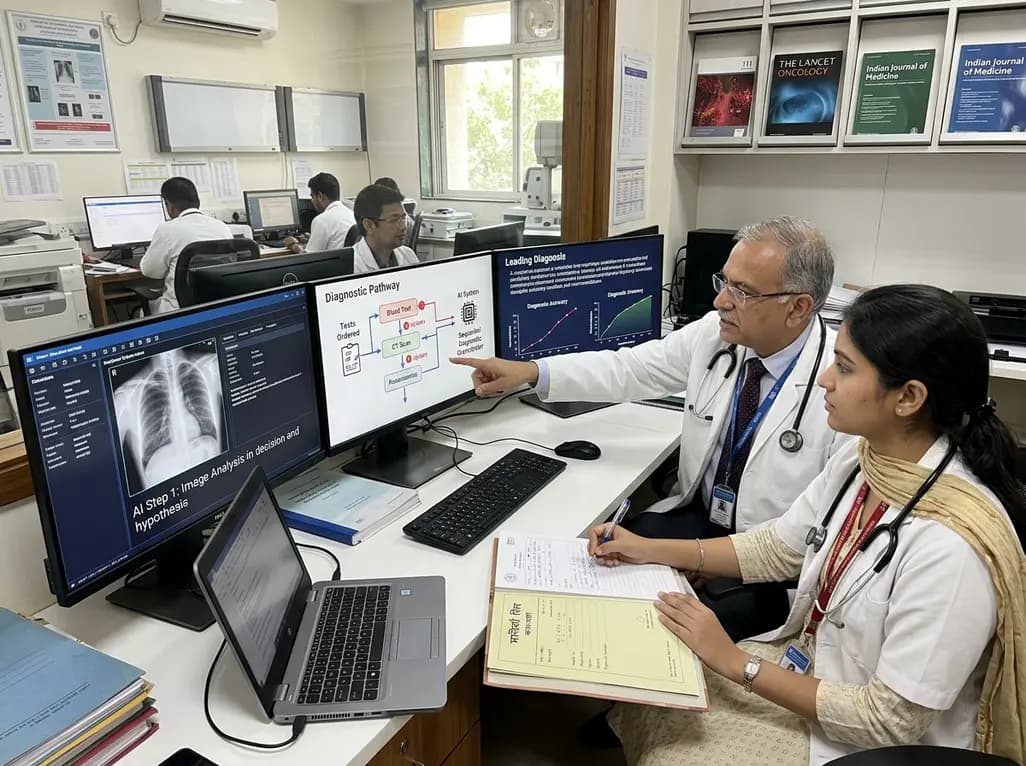
A breakthrough peer-reviewed study demonstrates that a sequential AI diagnosis system can mirror real-world clinical reasoning. By ordering stepwise tests and updating hypotheses dynamically, this multi-agent orchestrator achieved superior diagnostic accuracy while reducing investigative costs.
Today

A prenatal case highlights severe glutaric acidemia type II presenting as bilateral hyperechoic cystic kidneys at 18 weeks. Whole-exome sequencing revealed a novel homozygous ETFDH frameshift variant, demonstrating the power of rapid genetic testing in fetal renal anomalies.
Today

Review how tailored exercise programs benefit frail older patients with heart failure. Explore pathophysiological mechanisms, individualized training prescriptions, and strategies to overcome adherence barriers in clinical practice.
Yesterday

This comparative study evaluates posterior labral tears with and without glenohumeral instability, highlighting distinct demographic patterns, MRI underestimation in stable shoulders, and successful arthroscopic repair outcomes.
Yesterday

A clinical study demonstrates that early intervention with tocilizumab, either as monotherapy or bridged with corticosteroids, achieves significant proptosis reduction and resolves active inflammation in treatment-naive thyroid eye disease.
Yesterday
