.webp&w=384&q=75)

Loading, please wait...
Loading, please wait...

Managing critically ill patients with acute hypoxemic respiratory failure (AHRF) requires precise ventilator control to prevent complications. Reverse triggering, a frequent ventilatory asynchrony, often complicates this process in sedated patients. Effective reverse triggering management is essential because this phenomenon, where mechanical breaths trigger involuntary patient effort, can lead to significant lung and diaphragmatic injury. Consequently, researchers have recently developed automated tools to identify and characterize these asynchronies more accurately than traditional expert waveform reviews.
Reverse triggering occurs when the ventilator's delivered breath entrains the patient's neural respiratory drive. This interaction creates an involuntary diaphragmatic contraction that follows the passive insufflation. Furthermore, when these efforts are high, they often lead to breath-stacking. This increases tidal volumes beyond safe limits, thereby elevating the risk of ventilator-induced lung injury (VILI). Moreover, eccentric contractions of the diaphragm during this phase can cause significant myotrauma, which eventually delays weaning from mechanical ventilation.
Clinicians often struggle to detect asynchronies through manual waveform inspection. However, automated software using airway pressure and flow tracings has demonstrated an accuracy of over 95%. This technology allows medical teams to monitor the median muscular pressure (Pmus), which often reaches levels that threaten lung-protective ventilation. Specifically, the tools can distinguish between low-effort and high-effort phenotypes. By identifying high-effort patterns, intensive care units can implement more targeted reverse triggering management protocols, such as adjusting sedation levels or modifying ventilator parameters to disrupt the entrainment rhythm.
Recent data indicates that reverse triggering is present in approximately 24% to 30% of breaths in certain AHRF cohorts. Although some low-level contractions might prevent diaphragmatic atrophy, the variability in muscular effort is vast. Some patients exhibit muscular pressures as high as 36 cmH2O. Therefore, continuous automated monitoring provides a safer alternative to intermittent expert review, ensuring that clinicians can respond to injurious efforts in real-time. This proactive approach significantly improves the safety profile of mechanical ventilation in the ICU.
Reverse triggering primarily results from the entrainment of the patient's respiratory rhythm by the periodic mechanical breaths provided by the ventilator. This phenomenon is most common in deeply sedated patients where the brainstem's respiratory center responds to the stretch and pressure of the ventilator-delivered breath.
Breath-stacking occurs when a reverse-triggered effort induces the ventilator to deliver a second breath before the first has been exhaled. This results in high tidal volumes and transpulmonary pressures, which can lead to alveolar overdistension and worsen lung injury in AHRF patients.
Automated tools offer continuous, real-time monitoring of every breath, whereas expert manual review is usually limited to brief segments of waveform data. Automation ensures that transient but dangerous asynchronies are not missed, allowing for more consistent and accurate clinical interventions.
Disclaimer: This content is for informational and educational purposes only. It does not constitute medical advice or establish a doctor-patient relationship. Always seek the advice of a qualified healthcare provider regarding any medical condition or treatment. Refer to the latest local and national guidelines for clinical practice.
References
1. Marambio-Coloma C et al. Identification and Characterization of Reverse Triggering in Acute Hypoxemic Respiratory Failure Using an Automated Tool. Respir Care. 2026 Apr 10. doi: 10.1177/19433654261436371. PMID: 41961520.
2. Pham T, et al. Automated detection and quantification of reverse triggering effort under mechanical ventilation. Intensive Care Med. 2021;47(2):187-197.
3. Baedorf Kassis E, et al. Reverse triggering neural network and rules-based automated detection in acute respiratory distress syndrome. J Crit Care. 2021;63:236-242.
"
Read summarized clinical updates, watch expert medical content, and earn CME certifications right from your smartphone.
Open your smartphone camera to scan and install.





Explore how automated tools identify reverse triggering in AHRF patients to improve management and prevent ventilator-induced lung and diaphragm injury....
6 months ago

A retrospective cohort study reveals that frailty quadruples the odds of pressure injuries in hospitalized older adults. Integrating the Clinical Frailty Scale with comprehensive geriatric care is crucial for identifying vulnerability early and implementing targeted multidisciplinary prevention.
Today
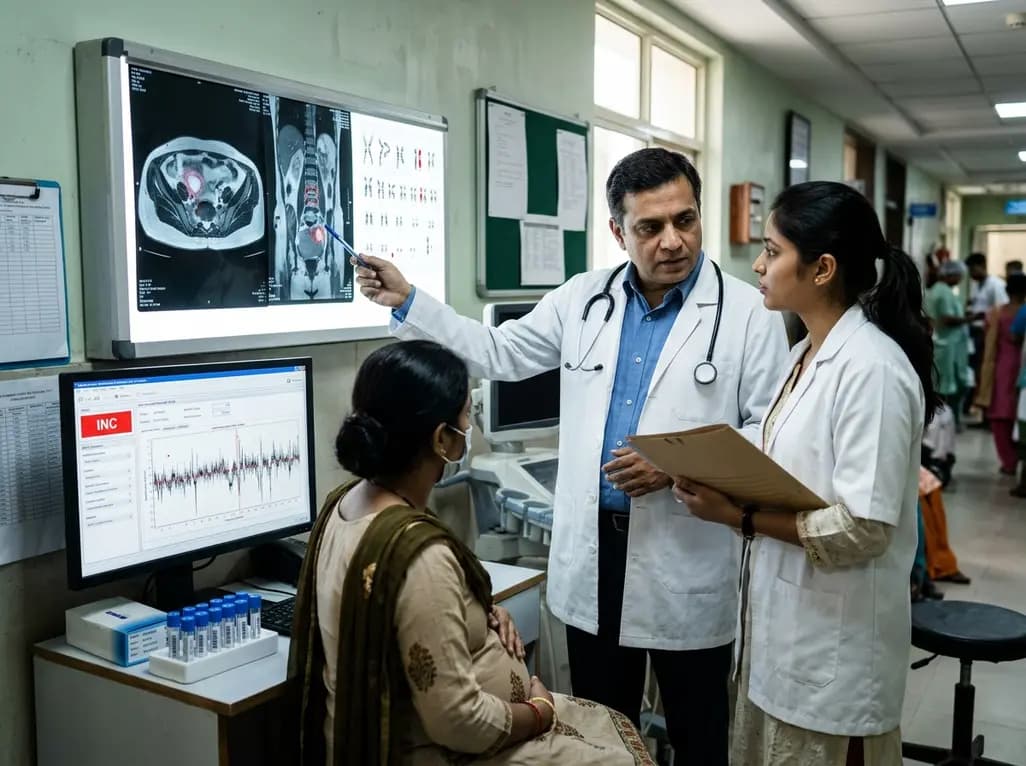
Occult maternal malignancy accounts for 3.82% of persistent unreportable NIPT results with genomic noise. Multiple chromosomal aberrations, notably on chromosome 18, warrant thorough oncological evaluation and whole-body MRI to ensure timely maternal diagnosis while preserving fetal care.
Today

This article reviews the forensic and clinical complexities of acute myocarditis arising on left ventricular hypertrophy in children, highlighting early diagnostic red flags and multidisciplinary postmortem autopsy protocols.
Today

A randomized controlled trial demonstrates that an eight-week dual-task training intervention significantly improves static and dynamic postural control over standard balance exercises in individuals with chronic ankle instability, addressing critical neurocognitive deficits during athletic and daily activities.
Today

A retrospective cohort study of 7,716 ICU patients from the MIMIC-IV database demonstrates that Gradient Boosting Decision Trees significantly outperform traditional SOFA scores in predicting in-hospital mortality among patients with sepsis and diabetes, with SHAP analysis providing clinical interpretability.
Today
